Tottenham's Financial Transformation: From Relegation Threat to Revenue Powerhouse
Tottenham supporters will be desperate to scrub last season from memory.
Another manager gone.
Key players in the treatment room.
Ninety fraught minutes on the final day just to avoid the unthinkable – relegation – for the ninth-richest club in world football.
Seventeenth place. Again.
For a club of Tottenham’s resources, that is not a warning light. It’s a siren.
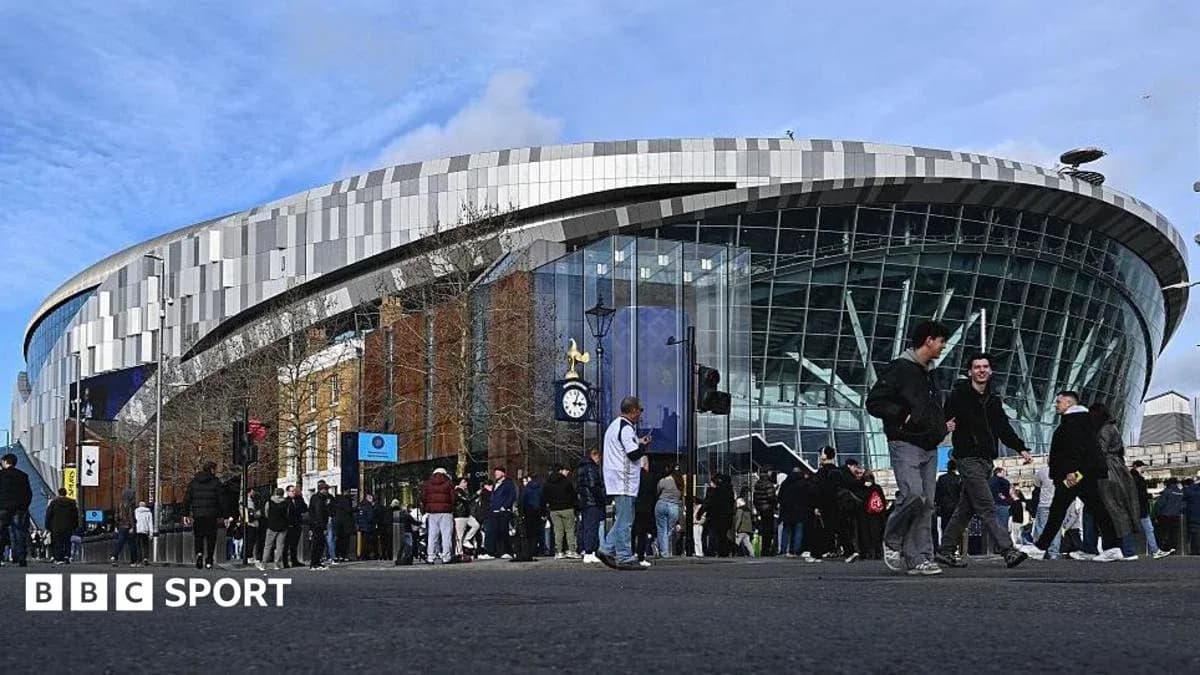
Yet while the football has wobbled, the business has boomed. Behind the anxiety in the stands sits a financial machine humming at full power, driven by the gleaming arena that now dominates the north London skyline.
The contrast could hardly be sharper: a team flirting with the drop, and a club quietly turning itself into a revenue monster.
The Stadium That Changed the Game
Strip it back to basics and one number tells the story.
“Spurs’ matchday income has increased from £45m in 2016-17, the season they left White Hart Lane, to £126m in 2024-25,” says football finance expert Kieran Maguire.
Less than double the capacity. Two and a half times the matchday cash. That is not an incremental gain. It is a transformation.
What Tottenham have built is not just a ground, but a destination. Fans turn up earlier, stay later, and crucially, spend more.
“What Spurs have done is they've created a welcoming environment,” Maguire explains. “So if people are spending an extra 40 to 50 minutes in the stadium itself they're not just spending time - more importantly they're spending money.”
Bars, food courts, club shops, premium lounges – the place is designed to hoover up discretionary income. And that’s just on matchdays.
The club can stage up to 30 non-football events a year at full capacity. That changes the economics entirely.
Major concerts roll through. The NFL has made it a regular stop. Boxing brought Anthony Joshua and Oleksandr Usyk there in 2021 for a world heavyweight title fight. Since 2023, Saracens have turned it into a rugby union showpiece by hosting Harlequins in their London derby.
Every one of those nights drives up commercial revenue. The numbers are stark: from £73m in 2016-17 to £277m in 2024-25.
That kind of uplift filters directly into the squad. This summer’s headline example: Sandro Tonali, signed for a club-record fee that could reach £100m. A statement signing underpinned not by a benefactor’s whim, but by concrete, steel and a lot of corporate hospitality.
New Rules, New Loopholes
This all lands at a critical moment for English football’s finances. The Premier League is ditching its long-debated profitability and sustainability rules and moving to a new framework, built around squad-cost ratio (SCR) and sustainability and systemic resilience (SSR).
Strip away the jargon and SCR is simple enough. It limits what a club can spend on its playing squad as a proportion of its overall revenue. Wages, transfer amortisation – the accounting trick of spreading a fee over the length of a contract – and agent fees all go into the pot.
One huge cost does not. Stadium infrastructure.
“In the case of Spurs, their infrastructure costs are around £70m a year - but those are excluded,” says Maguire. “Any money that you invest in stadiums is completely ring-fenced and excluded from your ability to invest in players.
“There's a separate issue in that stadiums do cost a lot of money. But Spurs borrowed from banks at spectacularly cheap interest rates.”
The upshot? For Tottenham, the upside of building an expensive new home dwarfs the downside. The stadium doesn’t count against their spending cap, but the money it generates inflates the very revenue figure that determines how much they can put into the squad.
“In order to be competitive, you need to have a significant increase in matchday income,” Maguire says. “You could only do that from either increasing prices, which isn't going to go down well, or increasing the size of the stadium with a greater proportion of the tickets going to the non-season ticket fanbase.”
In other words: build bigger, build smarter, and the rules work for you.
The Rest of the League Takes Notice
Tottenham are not alone in chasing that model. Everton and West Ham have already made the jump to new stadiums. The financial logic is clear. The emotional cost has been higher.
Goodison Park and Upton Park were woven into their clubs’ identities. The new homes promise long-term revenue growth, but not every supporter has made the emotional move with them.
Other Premier League clubs now face the same question: stay or go?
Renovation offers a cheaper route on paper, but it comes with a major headache. If you have to move out during the work, where do you play? And if you move permanently, what else do you lose along the way?
The most high-profile case sits in Manchester.
Ratcliffe’s Old Trafford Vision
Sir Jim Ratcliffe has made it abundantly clear: he wants a new stadium to define his involvement at Manchester United. A bold, modern home that signals the club’s intent and drags matchday revenues into a new era.
A 100,000-capacity arena with a heavy corporate footprint would dwarf United’s current matchday takings. Bigger crowds, more premium seating, more hospitality – more money to push back into the senior squad.
The early designs, unveiled in March 2025, featured a vast canopy. Eye-catching, but expensive. That overhang and everything beneath it would sit on United’s footprint, and the club would be responsible for maintaining it. The question lingers: is the visual statement worth the long-term bill?
One potential saving grace lies in construction methods. Club officials suggest large sections could be built off-site and then shipped in. That kind of modular approach should be cheaper than a full, painstaking rebuild on the Old Trafford pitch.
Crucially, the proposed site is just down the road from the existing ground. That neatly sidesteps another thorny issue: where United would play if Old Trafford had to shut for a period.
None of Manchester City, Liverpool or Everton’s grounds are ideal from a security standpoint. All are smaller than Old Trafford. All would be expensive to hire, even if the politics could be managed.
United’s plan allows them to step from one stadium straight into another. No exile. No nomadic season. Just a handover.
Newcastle’s Dilemma: Heart vs Head
Then there is Newcastle United, a club that has felt the teeth of the new financial rules more sharply than most this summer. To stay within the limits, they have effectively been forced to cash in on some of their best players.
The numbers tell you why the debate over a new stadium will not go away.
“For the 2024-25 season Newcastle's matchday income was £52m. Manchester United's was £160m, Arsenal's £154m, Spurs' was £126m,” Maguire points out.
If you are £100m adrift of your rivals every year, you either have to be almost perfect in recruitment and coaching, or you have to charge more. That is the cold arithmetic.
“How can Newcastle increase the yield per fan and still be loyal to the Gallowgate hardcore? You need to be able to offer a different product and St James' Park wasn't built for a corporate audience.”
St James’ Park is iconic, looming over the city centre, stitched into the fabric of Newcastle life. It can host gigs, as supporter Charlotte Robson notes, but not on the industrial scale of Tottenham’s stadium or West Ham’s London Stadium.
“I don't think it would be stupid to move from the ground,” she says, “but I think there is so much identity for Newcastle fans who are attached to St James' Park that it would break a lot of hearts to move the ground in any significant way.”
That is the fault line. On one side, the need to compete financially with clubs pulling in nine-figure matchday sums. On the other, the emotional weight of a place that means more than any balance sheet.
Can Everyone Be Spurs?
For clubs weighing up a move, the lure is obvious. Increased matchday revenue. Extra commercial income from concerts, events, conferences. A modern, flexible arena that can earn money 365 days a year, not just every other Saturday.
But Tottenham’s success comes with caveats.
“Spurs have got the advantage that they're in London - a huge tourist trap,” Maguire says. “They are also a club with a global fanbase, so it works there.
“Is that going to work elsewhere in the country where you've got a more localised fanbase and where there is resistance to putting up prices for tickets? Then it becomes more challenging.
“We have seen a substantial increase in the costs of putting stadiums together, but there still seems to be an appetite for it.”
That appetite will be tested. Construction costs have soared. Fan bases are increasingly vocal about ticket prices and corporate creep. Yet the financial logic, sharpened by the Premier League’s new rules, keeps dragging clubs back to the same conclusion.
Tottenham have shown what a modern stadium can do for a club that gets it right off the pitch, even while the team stumbles on it. The question now is not whether others will follow, but how many are willing to risk tearing up their roots in search of the same financial high ground.