Thomas Tuchel to Lead England into Euro 2028 Despite World Cup Setback
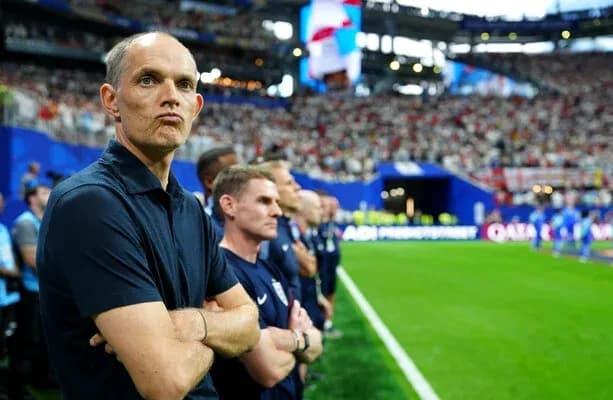
Thomas Tuchel will lead England into Euro 2028 despite the storm swirling around him after their World Cup heartbreak against Argentina.
The 52-year-old, hired in November 2024 to push England beyond Gareth Southgate’s near-miss era, has come under fierce fire for the way a first World Cup final since 1966 slipped through his fingers in Atlanta. Anthony Gordon’s crisp finish had England on the brink, only for a raft of defence-first tweaks to drag the team backwards, invite Argentina on and end in a late 2-1 defeat that felt painfully familiar.
The inquest has been immediate and unforgiving. The Football Association, though, is not blinking.
FA stands firm behind Tuchel
Tuchel’s original contract was tied only to this World Cup cycle, a short, sharp mandate to turn potential into silverware. In February, the FA doubled down, handing him an extension through to 2028. The plan was clear: Tuchel would not just chase glory in the United States but also front a home European Championship.
Nothing in Georgia has changed that. The Press Association understands the German still retains the full backing of the FA hierarchy and fully intends to lead England into those home Euros.
Speaking in the raw aftermath of the semi-final, Tuchel did not shy away from the scale of the setback, but he made his intentions plain.
“I have a contract until the home Euros and I’m looking forward to that even like now it is difficult to look that far ahead,” he said.
The pain of Atlanta hung heavy over every word.
‘Heartbreaking’ near-miss
England flew back to their Kansas City base still nursing the sense of a chance squandered. At the top of the FA, though, there was no appetite for a public rebuke of the manager.
Chief executive Mark Bullingham moved quickly to defend the work of Tuchel and his players.
“It is heartbreaking to be so close,” he said. “The players and Thomas gave it everything today and the squad, coaches and staff could not have worked harder during the tournament.
“I would like to thank them all – and also give my heartfelt thanks to our wonderful fans here in the USA and at home. We felt your support every step of the way and we are all so disappointed not to go further.”
The message was clear: this was not the moment for a reset, but for a regroup.
A semi-final that doesn’t feel like progress
On paper, a World Cup semi-final is a marker of consistency at the elite level. Tuchel knows it, even if he also knows nobody wants to hear it now.
“A lot of big, big, big football nations are eliminated before the semi-final, so, yeah, it is an achievement,” he said. “No one wants to hear that at the moment. Me neither, because we demand the most of ourselves. That’s just the nature of being competitive.”
England had been hired to go that one step further, not to match Southgate’s plateau. The nature of the defeat – the early lead, the retreat, the sense of history repeating – has sharpened the criticism. Tuchel’s “negative decision-making”, as it has already been labelled, will follow him for some time.
Yet he refused to question the effort of his players or the work that carried them to the last four.
“Did we do everything to arrive in this semi-final? Did we give everything? 100 per cent we did, and I think the fans will realise that and do realise that,” he said.
Unwanted date with France
England’s World Cup is not over. It just feels like it.
Instead of preparing for a shot at the trophy, they must drag themselves back to Miami for a third-place play-off against France at the Hard Rock Stadium, the same venue where they had surged past Norway in the quarter-finals a week earlier.
“Nobody of these (England) players, nobody of French players wants to play this match,” Tuchel admitted. “They want to play in the final. We gave everything to be in the final.
“Everyone plays to win the World Cup, but it is what it is. We have for a day less and to recover, but we will do it professionally, of course.”
The honesty was stark. This is the game nobody grows up dreaming about, yet it will offer Tuchel and his squad a first test of their ability to respond to a major blow.
“The second of all is to bounce back, to react,” Tuchel said. “That’s what you have to do on highest level in sports. It’s what is demanded and what we will do.”
Dressing-room silence, long-term noise
Inside the dressing room in Georgia, there were few words and even fewer answers.
“I didn’t say a lot (to the players afterwards),” Tuchel revealed. “Nothing what you say in the dressing room can take away the pain or the disappointment, of course.
“We all know these moments, so I said let’s take it with respect, let’s digest it first. Accept that we gave everything. That is a big part in a defeat.”
Respect, reflection, then reaction: that is the sequence Tuchel is banking on as the noise builds outside.
The FA have nailed their colours to his mast, trusting the coach they chose for his tactical edge to learn from a night when his caution cost him dearly. The World Cup dream is gone; the home Euros are coming. Tuchel stays. The question now is whether England can grow from this scar in time to make 2028 feel like a destination, not another missed turn.