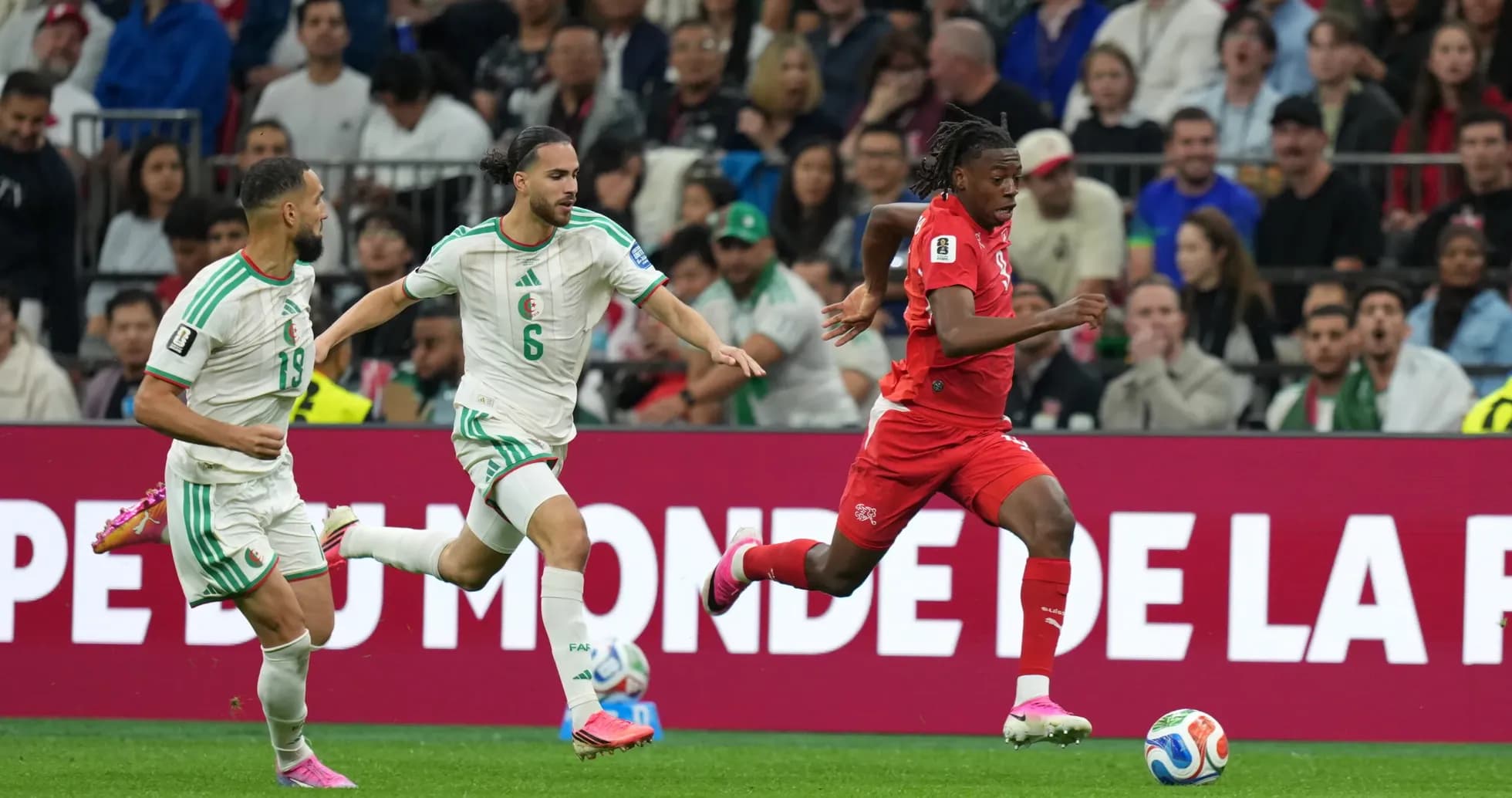
Switzerland's Tactical Masterclass Against Algeria in World Cup
Switzerland’s 2-0 win over Algeria at BC Place was a clinic in controlled efficiency: less of the ball, more of the chances, and a game plan that translated almost perfectly from paper to pitch. In a World Cup Round of 32 tie where Algeria had 55% possession and more passes, Switzerland’s 4-2-3-1 structure, vertical running and compact mid-block repeatedly exposed the spaces behind and between Algeria’s 4-3-3 lines.
Murat Yakin’s side built on a stable back four of Ricardo Rodríguez, Manuel Akanji, Nico Elvedi and Denis Zakaria, shielded by the double pivot of Granit Xhaka and Remo Freuler. This gave Switzerland a clear central spine that Algeria struggled to disorganize. With Switzerland attempting 436 passes to Algeria’s 561, the plan was never to dominate the ball but to control where it was played. The Swiss block stayed narrow, funnelling Algeria’s possession into the wide zones and then compressing aggressively once the ball entered the Swiss half.
The attacking structure was decisive. Johan Manzambi operated as a central attacking midfielder behind Breel Embolo, with Dan Ndoye and Rubén Vargas starting from the flanks but constantly moving into half-spaces. This trio was crucial to Switzerland’s ability to turn 45% possession into 11 total shots, 9 of them inside the box, and an xG of 2.56. They repeatedly received between Algeria’s midfield and defensive lines, then either combined centrally or released Embolo into depth.
Opening Goal
The opening goal on 10 minutes encapsulated the plan. Switzerland broke Algeria’s first line, Manzambi found a pocket and slipped Embolo in, and the forward finished to make it 1-0. It was a direct exploitation of the space behind Ramiz Zerrouki and Nabil Bentaleb, who were often caught between pressing Xhaka/Freuler and protecting the centre-backs. Once ahead, Switzerland could lean even more into their mid-block and transition threat.
Algeria’s 4-3-3, with Riyad Mahrez and Houssem Aouar flanking Ibrahim Maza, was designed for technical dominance and combination play. They succeeded in circulating the ball – 561 passes at 85% accuracy against Switzerland’s 81% – but struggled to convert territory into clear chances. Their 8 total shots, only 5 inside the box and just 0.73 xG, show how rarely they managed to access premium shooting zones. Switzerland’s central defenders, especially Akanji and Elvedi, were rarely pulled out of shape; the Swiss allowed Algeria to play in front of them, then defended crosses and cutbacks with numbers.
Second Half
The second half began with Switzerland striking almost immediately. At 46', Ndoye scored to make it 2-0, a moment that effectively re-framed the match. Tactically, this goal punished Algeria’s need to push higher with their full-backs and midfield line; the Swiss again exploited the transition window just as Algeria were trying to assert control after the interval. From there, Switzerland could manage tempo, compress space, and use substitutions to maintain energy and structure.
Out of possession, Switzerland’s discipline was notable. They committed 10 fouls to Algeria’s 12 but did not receive a single card, reflecting controlled aggression and good timing in duels. The double pivot balanced their roles well: Xhaka as the primary distributor and press trigger, Freuler as the covering midfielder sliding into the back line when full-backs were drawn wide. This balance limited Mahrez’s ability to isolate 1v1 in dangerous zones; he was often met by a full-back plus the near-side pivot.
Algeria’s in-game adjustments – including introducing Jaouen Hadjam, Amine Gouiri, Anis Hadj Moussa, Hicham Boudaoui and Adil Boulbina – were aimed at adding penetration and fresh legs in advanced areas. However, the structural issues persisted. With Switzerland defending deeper at 2-0, Algeria’s attacks became more cross-heavy and less varied, feeding into the strengths of the Swiss centre-backs. Their 3 blocked shots underline how often Swiss defenders got into shooting lanes before attempts could truly test the goalkeeper.
In goal, Gregor Kobel (Switzerland) was protected well by his block and needed only 2 saves, a number that aligns with Algeria’s 2 shots on target and the low xG they generated. On the other side, Luca Zidane (Algeria) also recorded 2 saves, but Switzerland’s shot profile – 5 on target from 11 attempts and a high share inside the box – meant his interventions came against higher-quality chances. Both goalkeepers are credited with identical goals prevented values, indicating that the expected outcomes of the shots they faced were similar, but the tactical context around those chances differed sharply.
Statistically, the match underlines the contrast between possession and threat. Algeria’s 55% ball possession and superior passing volume did not translate into control of danger zones. Switzerland, with fewer passes (436) but strong accuracy (354 accurate, 81%), used the ball purposefully, progressing quickly once they broke Algeria’s first line. Their 4 corner kicks to Algeria’s 2 further reflect the Swiss ability to sustain pressure in the final third despite having less of the ball.
Defensively, Switzerland’s 2 blocked shots and compact structure kept Algeria mostly at arm’s length. Algeria’s 3 blocked shots suggest they did manage to contest Swiss attempts, but not enough to suppress a side that repeatedly reached high-value positions. The foul count (10 vs 12) and the fact that only Algeria picked up yellow cards – Farès Chaïbi for “Tripping” and Hicham Boudaoui for “Roughing” – add to the picture of a Swiss team in control of game rhythm and an Algerian side increasingly forced into reactive, riskier defending.
Overall, this was a tactically mature Swiss performance: a well-drilled 4-2-3-1 that leveraged compactness, verticality and intelligent occupation of half-spaces to outperform an Algerian 4-3-3 that had more of the ball but far less of the penalty-box presence.