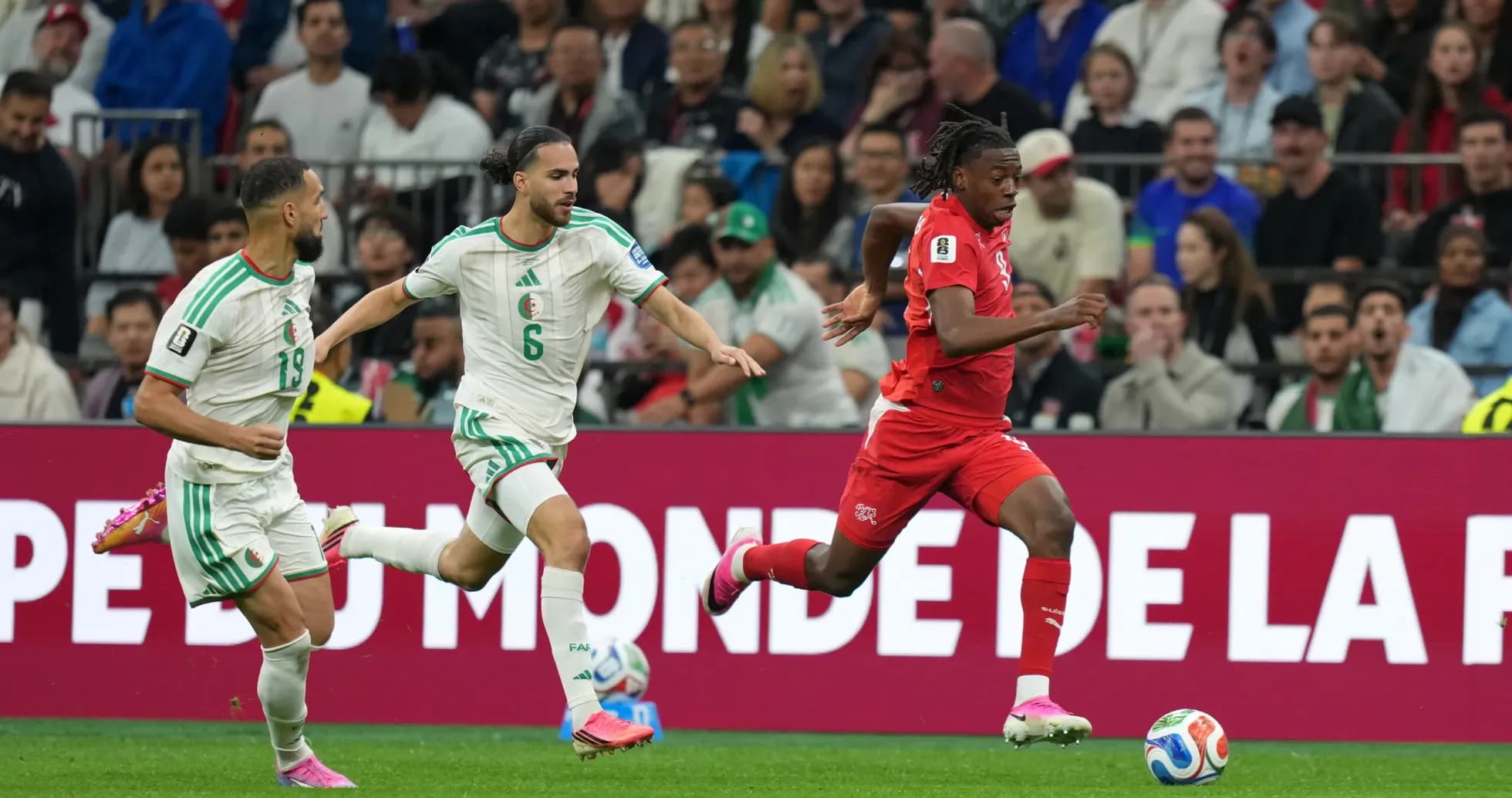
Switzerland Dominates Algeria 2–0 in World Cup Round of 32
Under the closed roof of BC Place in Vancouver, Switzerland’s 2–0 win over Algeria in the World Cup Round of 32 felt less like a one-off knockout tie and more like the natural extension of two very different group-stage stories.
Switzerland arrived as the polished group winners from Group B, top of their section with 7 points and a goal difference of 4 after 3 matches (7 scored, 3 conceded overall). Their tournament to this point had been defined by control: 3 wins in 4 fixtures overall, no defeats, and an attacking output of 9 goals in total, built primarily “at home” in this World Cup environment with 8 goals at home at an average of 2.7 per home game. Algeria, by contrast, had edged through Group J in more turbulent fashion. They finished 3rd in their group with 4 points and a goal difference of -2, scoring 5 and conceding 7 overall in the group stage. Their campaign had already contained extremes: a 1–2 away win as their standout result, but also a bruising 3–0 away loss that exposed defensive frailties.
The Round of 32 stage framed this as a clash between a side that thrives on structure and a team that lives on moments. Murat Yakin doubled down on Switzerland’s established identity with a 4-2-3-1, while Vladimir Petkovic mirrored his own past Swiss blueprint, now in charge of Algeria, with a 4-3-3 designed to unleash Riyad Mahrez and Houssem Aouar in transition.
For Switzerland, the spine was reassuringly familiar. Gregor Kobel in goal, Manuel Akanji and Nico Elvedi as the central pairing, Ricardo Rodriguez at left-back and Denis Zakaria to the right formed a back four that had already conceded only 3 goals in total this tournament, at an overall rate of 0.8 per match. Ahead of them, Granit Xhaka and Remo Freuler sat as the double pivot, the former dictating tempo, the latter knitting phases together and providing the screen.
The three behind Breel Embolo told the real story of Switzerland’s evolution. Dan Ndoye on the right, Ruben Vargas on the left, and Johan Manzambi as the central attacking midfielder offered a far more dynamic, vertical trio than the more conservative Swiss sides of previous tournaments. Manzambi entered this tie as one of the breakout figures of the World Cup: 3 goals and 2 assists overall, from just 4 appearances and 200 minutes, with a rating of 7.7 and 3 key passes from 55 total passes. His blend of direct dribbling (14 attempts, 5 successful) and penalty-box timing has made him both Switzerland’s top scorer and their leading provider.
Embolo, with 2 goals and 2 assists overall and 8 key passes from 49 total passes, has functioned as the reference point and facilitator. His duels numbers — 35 contested, 18 won — underline why he is so important when Switzerland go long or need to secure second balls. In this 4-2-3-1, the “hunter vs shield” dynamic is essentially Embolo and Manzambi together against any back line that dares to hold a high line.
Algeria’s 4-3-3 carried a different energy. Luca Zidane in goal sat behind a back four of Rayan Ait-Nouri, Ramy Bensebaini, Aïssa Mandi and Rayan Belghali. In front of them, Ramiz Zerrouki and Nabil Bentaleb flanked Farès Chaibi in a midfield three that, on paper, offered both bite and progression. Ahead, Mahrez from the right, Aouar from the left and Ilyes Maza centrally formed a front line with clear technical pedigree.
But the numbers coming into this tie painted a more fragile defensive picture. Algeria had conceded 9 goals overall in 4 matches, at an average of 2.3 per game, including 6 goals on their travels at an away rate of 2.0 conceded per away match. They had yet to keep a clean sheet, and had failed to score twice overall — a sign of volatility at both ends. Their biggest away defeat, 3–0, underlined how quickly their structure can collapse when the press is bypassed.
That fragility intersected badly with Switzerland’s attacking rhythm. The Swiss have been particularly ruthless in matches designated “home” in this tournament, with 8 goals at home and a home scoring average of 2.7, while conceding only 2 at home at a rate of 0.7. With no defeats overall and only 1 draw, they arrived with the confidence of a side that believes one goal will not be enough; they hunt the second and third.
Tactically, the “engine room” battle revolved around Xhaka and Freuler against Bentaleb, Zerrouki and Chaibi. Xhaka’s role as the metronome was to drag Algeria’s midfield out of shape, forcing Mahrez and Aouar to either drop deeper — blunting Algeria’s counter-attacking threat — or leave their own midfield exposed. Freuler’s task was subtler: arrive late to second balls, help overload the half-spaces where Manzambi roams, and be ready to counter-press immediately after any turnover.
Algeria’s best route into the match lay through Mahrez isolating Rodriguez or Ait-Nouri driving inside to combine with Aouar. But with Algeria’s defensive record on their travels — 6 conceded away, 3.0 goals conceded at home and 2.0 away per match — the risk of overcommitting was always going to be high. Petkovic’s side needed near-perfect execution in transition and cleaner defensive distances than they had shown in the group stage.
Discipline was a quiet but important subplot. Both teams had shown a tendency to pick up yellow cards in the 31–45 minute window: 66.67% of Switzerland’s yellows and 66.67% of Algeria’s had arrived just before half-time. That late-first-half spike hinted at emotional flashpoints when fatigue and frustration converge. However, neither side had seen a red card in this World Cup, and Switzerland’s penalty record — 2 taken, 2 scored, 100.00% overall with no misses — suggested that any mistake in the box by Algeria would likely be punished ruthlessly.
In the end, the 2–0 scoreline simply confirmed the statistical trajectory. Switzerland’s overall attacking average of 2.3 goals per game met an Algerian defence conceding 2.3 per match, and the result fell exactly on that axis. Kobel and his back four preserved another clean sheet to add to Switzerland’s single prior shutout, while the Embolo–Manzambi axis again provided incision between the lines.
Following this result, Switzerland look every inch a tournament side: unbeaten, tactically coherent, and with a young star in Manzambi whose numbers and performances are now aligned. Algeria depart having shown flashes of quality, but their structural weaknesses — exposed throughout a campaign of 5 goals for and 9 against overall before this tie — were once more laid bare against a team that knows exactly who it is and how it wants to win.