Sunderland vs Arsenal: Tactical Breakdown of Premier League Clash
Under the Stadium of Light floodlights, Sunderland’s return to the Premier League collided with the division’s early standard-setters. Arsenal arrived as league leaders, four wins from four, and left with a 2–0 victory that felt entirely in character with both sides’ seasonal trajectories.
I. The Big Picture – contrasting identities
Heading into this game, Sunderland were 14th with 4 points from 4 matches, their overall goal difference at -2, built from 3 goals scored and 5 conceded. At home, they had been tight but blunt: 1 goal for and 2 against across 2 games, an average of 0.5 goals scored and 1.0 conceded. Arsenal, by contrast, sat top with 12 points from 4, an overall goal difference of +7 (8 scored, 1 conceded). On their travels, they had been ruthlessly efficient: 2 away wins from 2, 3 goals scored, none conceded, averaging 1.5 goals for and 0.0 against.
Both coaches doubled down on their seasonal blueprint. Régis Le Bris kept Sunderland in a 4‑2‑3‑1, the same structure they had used in all 4 league matches so far. Mikel Arteta mirrored that shape, also deploying a 4‑2‑3‑1 that has underpinned Arsenal’s perfect start.
The game unfolded exactly along those lines: Sunderland’s structure and defiance versus Arsenal’s control and incision.
II. Tactical voids and discipline – who was missing, who walked the tightrope
Sunderland’s bench was already thinned by injury. H. Diarra (hamstring) and R. Mundle (knee) were both ruled out, reducing Le Bris’s options for late energy and ball-carrying from deeper areas. That absence mattered: Sunderland’s season-long numbers show an overall average of 0.8 goals per game, and when they fail to score – which has already happened once in total this campaign – they lack the kind of individual dribbler who can unpick a set defence. Diarra and Mundle would have been natural candidates to change the rhythm.
Arsenal had their own absentees at the back. W. Saliba (back injury) and C. Mosquera (muscle injury) missed out, forcing Arteta to lean heavily on the pairing of Gabriel Magalhães and Ezri Konsa, with Riccardo Calafiori at left-back. The numbers suggested Arsenal could handle it: overall, they had conceded just 1 goal in 4 matches, with 3 clean sheets in total and 2 of those on their travels.
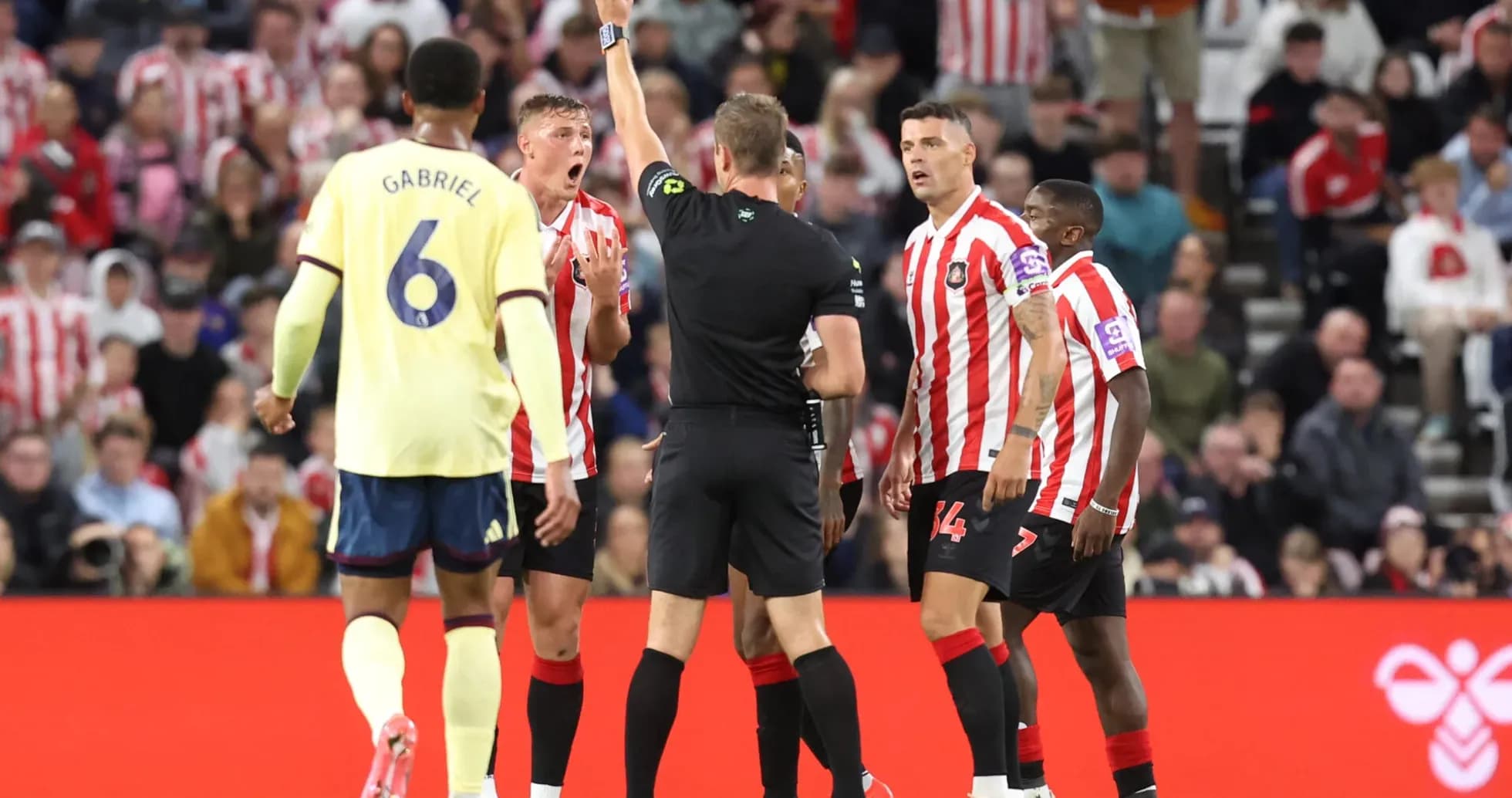
Discipline was always going to be a sub-plot. Sunderland came into the game with a spiky edge: their yellow cards were spread across the match, but with a clear late spike – 30.00% of their yellows arriving between 61–75 minutes and 20.00% between 76–90, plus a remarkable 10.00% between 91–105. More tellingly, their only red card this season had come in stoppage time, with 100.00% of their reds shown between 91–105 minutes. Reinildo, who started at left-back, embodied that edge: 1 red and 1 yellow in total this season, plus 8 fouls committed.
Arsenal’s card profile was calmer but with its own late twist. While they had no reds in the league, 42.86% of their yellows had been shown in the 91–105 minute band, hinting at a side that occasionally frays when closing games out. Christos Tzolis, already on 2 yellows this campaign, and Gabriel, also on 2, are the emotional flashpoints in that back line.
III. Key matchups – Hunter vs Shield, Engine Room
Hunter vs Shield: Arsenal’s front four against Sunderland’s back four
Arsenal’s attacking “hunter” is not a single striker but a collective: Bukayo Saka, Martin Ødegaard, Kai Havertz and Tzolis. Heading into this game, Saka had 3 league goals in total, from 10 shots and 8 on target, plus 1 penalty scored from 1 taken. Ødegaard had 2 goals, 12 key passes and a league rating close to 8.0, effectively the conductor between the lines. Havertz added another 2 goals and 5 shots on target, thriving on late runs into the box.
They were up against a Sunderland defence that, overall, had conceded 5 goals in 4 matches, with just 1 clean sheet in total. At home, Sunderland’s back line had given up 2 goals in 2 games. The individual duel lines were stark:
- D. Ballard, already on 2 yellows, had contested 63 duels this season and won 33, while blocking 2 shots. He is Sunderland’s front-foot centre-back, aggressive in stepping out, but that aggression risks being manipulated by Havertz’s movement and Ødegaard’s passing angles.
- Reinildo, with 8 tackles, 8 interceptions and that solitary red card, had to cope with Saka’s directness. Saka’s 9 dribble attempts (4 successful) and 14 fouls drawn in total this season pointed towards a long night for the Mozambican, especially one-on-one in wide isolation.
- N. Mukiele and K. Danso completed a back four that is physically imposing but can be dragged into lateral spaces by Arsenal’s rotations.
Given Sunderland’s tendency to pick up cards late – 50.00% of their yellows arriving from 61 minutes onwards (61–75, 76–90, and 91–105 combined) – the most dangerous intersection was always going to be Arsenal’s late pressure against a tiring, increasingly desperate home defence.
Engine Room: Xhaka and Sadiki vs Rice and Lewis-Skelly
In midfield, the battle carried a different texture. Granit Xhaka, Sunderland’s heartbeat, had been one of the league’s standout controllers so far: 246 passes at 86% accuracy, 10 key passes, 6 tackles, 2 successful blocks and 5 interceptions in total. He is both metronome and enforcer, with 2 yellows already this campaign and 4 fouls committed.
Alongside him, N. Sadiki provided legs and coverage, freeing Xhaka to step higher at times. Ahead of them, E. Le Fée and N. Angulo offered creativity between the lines, while T. Meunier tucked in from the right.
They faced an Arsenal double pivot of Declan Rice and M. Lewis‑Skelly. Rice’s numbers underline his dominance: 288 passes at 91% accuracy, 6 key passes, 5 tackles, 1 block and 3 interceptions in total. He is also one of the league’s leading assist providers with 2, proof that he is not just a destroyer but a deep-lying playmaker. Lewis‑Skelly, with his mobility and pressing, allows Rice to dictate from the base while still providing vertical thrust.
This duel defined the game’s rhythm. Sunderland’s hope lay in Xhaka’s ability to disrupt Ødegaard’s reception zones and to play early into B. Brobbey’s feet. But Arsenal’s structure, with Rice screening and Ødegaard dropping into the half-spaces, repeatedly tilted the pitch in the visitors’ favour.
IV. Statistical prognosis – xG logic without the numbers
Even without explicit xG data, the underlying metrics point towards the kind of contest we saw.
Arsenal arrived with an overall scoring average of 2.0 goals per match and an overall concession rate of just 0.3. On their travels, they were at 1.5 goals scored and 0.0 conceded. Sunderland, by contrast, were averaging 0.8 goals for and 1.3 against overall, and at home just 0.5 scored per game.
Overlay those patterns with the tactical matchups and disciplinary profiles, and a familiar script emerges:
- Arsenal’s multi-source threat – Saka, Ødegaard, Havertz, Tzolis – attacking a defence that has already shown it can be stretched and is prone to late cards.
- Sunderland’s reliance on structure and set-pieces against a side with 3 clean sheets in 4 and no league game yet in which they have failed to score.
- A penalty subplot in which Sunderland’s season-long record is fragile: 2 penalties taken in total, 1 scored and 1 missed, a 50.00% success rate that underlines their lack of margin for error in rare high-value chances. Arsenal, by contrast, had scored their only penalty of the season, a 100.00% record from the spot.
A 2–0 Arsenal win at the Stadium of Light, therefore, was not an accident of the night but a reflection of the deeper currents of this early season. Sunderland’s 4‑2‑3‑1, anchored by Xhaka and Ballard’s defiance, can keep them competitive, especially at home. But against an Arsenal side whose spine – Rice, Ødegaard, Gabriel – is operating at Champions League level, the margins were always likely to break in one direction.
Following this result, the storylines harden. Arsenal look every inch like a side built to sustain a title challenge, their defensive solidity and spread of goals aligning perfectly with their statistical profile. Sunderland, meanwhile, remain a team of admirable organisation and spirit, but one that must find more cutting edge in the final third and more composure in the final quarter-hour if they are to turn respectable performances into points against the league’s elite.