Sturm Graz vs Fenerbahçe Tactical Analysis: A 4-4-2 Clash
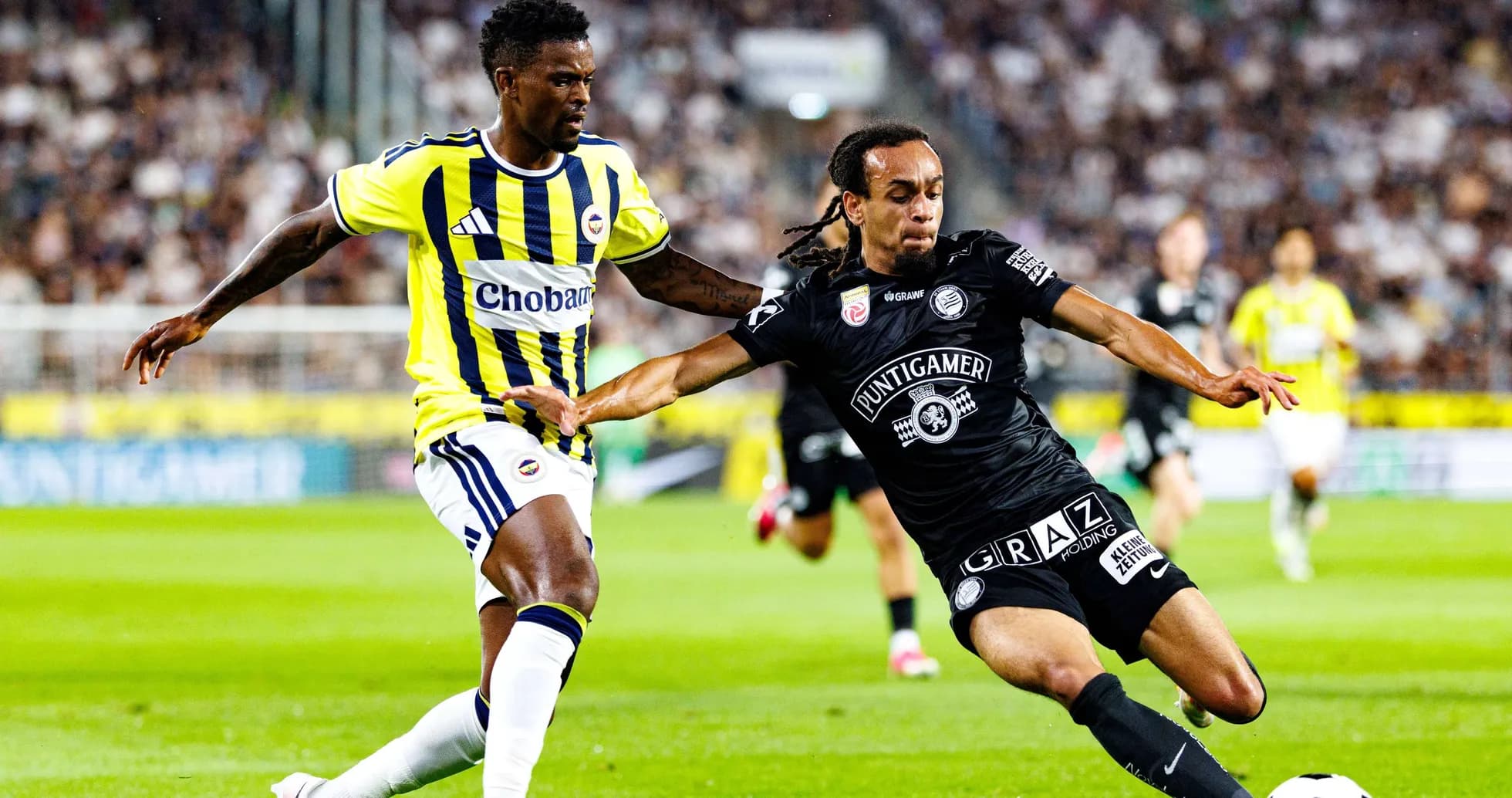
Sturm Graz’s 4-4-2 at Merkur Arena was built around volume and territorial control, but it ran aground against a more efficient and structurally cleaner Fenerbahçe 4-2-3-1 that managed the decisive moments better and protected its box with far greater clarity. The 0-1 scoreline, settled by a 66' penalty from Talisca, sits on top of a game where both sides split possession 50%-50% yet interpreted it very differently.
Sturm's Structure
Sturm’s structure under Fabio Ingolitsch was aggressive and front-footed. The back four of E. Soglo, P. Petrovic, J. Mitchell and A. Malic pushed relatively high, with double pivots S. Seidl and J. Gorenc Stankovic (later replaced by R. Fosso) tasked with compressing the pitch and sustaining pressure. The wide midfielders L. Weinhandl and J. Hödl stepped inside frequently, allowing full-backs to overlap and create crossing angles. That intent is reflected in the shot profile: 19 total shots, but only 6 from inside the box and just 2 on target, with 9 efforts blocked. Sturm consistently reached the final third but struggled to generate clean central looks, often forced into long-range attempts that Fenerbahçe’s block could read and step into.
Up front, the Jatta–Kayombo partnership was designed to stretch Fenerbahçe’s centre-backs and pin the line, but the 61' triple substitution was a tacit admission that the initial plan had stalled. B. Beganovic (IN) came on for S. Jatta (OUT), J. Heil (IN) replaced A. Malic (OUT), and N. Weiper (IN) came on for A. Kayombo (OUT), reshaping the front line with fresher legs and more mobility between the lines. The idea was clear: add more dynamic movement and half-space occupation to unhinge a disciplined visiting back four. However, despite maintaining a high shot volume after these changes, Sturm continued to find Fenerbahçe’s central lane closed, with most efforts arriving under pressure and from suboptimal zones.
Defensive Strategy
Out of possession, Sturm’s 4-4-2 press tried to lock play to one side, with the first line angling passes toward the touchline and the near-side midfielder jumping aggressively. The foul count (12) shows a team willing to break rhythm, but the late yellow card for Jeyland Mitchell on 84' for “Foul” also underlined how often their defenders were forced into recovery actions once Fenerbahçe broke the first line. The home side’s ability to counterpress was decent, but once bypassed, the back four could be exposed against the visitors’ technically secure attackers.
Fenerbahçe's Control
Fenerbahçe’s 4-2-3-1 under Ismail Kartal was more measured and control-oriented. With N. Kante and M. Guendouzi as the double pivot, the visitors built a stable platform that resisted Sturm’s press and created superiorities through the middle. The attacking band of M. Greenwood, M. Asensio and K. Aktürkoğlu operating behind Talisca gave them multiple ball-carrying and combination outlets. Despite having fewer total shots (11), Fenerbahçe’s quality of chance creation was markedly higher: 8 of those 11 efforts came from inside the box, and 6 were on target. That contrast with Sturm’s 6 in-box attempts illustrates a sharper ability to penetrate into dangerous central areas rather than settling for volume from range.
The penalty on 66' that Talisca converted was the logical product of this pattern: repeated entries into the box, forcing the Sturm back line into last-ditch defending. Once in front, Kartal immediately shifted the risk profile of his side. The 73' change, with I. Yuksek (IN) for N. Kante (OUT), and the 77' substitution of V. Muriqi (IN) for Talisca (OUT), signalled a move toward more physical reference up front and additional midfield legs to manage transitions and protect the lead. Earlier, M. Muldur (IN) for N. Semedo (OUT) at 62' and Fred (IN) for M. Asensio (OUT) plus O. Aydin (IN) for M. Greenwood (OUT) at 63' had already freshened the wide and central lanes, allowing Fenerbahçe to maintain compactness without sacrificing counter-attacking threat.
Defensive Approach
Defensively, Fenerbahçe were content to allow Sturm sterile possession in front of their block. The visitors committed 13 fouls and collected three yellow cards (Nélson Semedo 40', Archie Brown 45', Kerem Aktürkoğlu 89', all for “Foul”), reflecting an approach that accepted tactical infringements to prevent Sturm from turning territory into clear chances. Their back four, shielded by the double pivot, kept central spaces tight, channelling Sturm’s attacks wide and trusting their box defence to deal with crosses and speculative shots. The low count of blocked shots (2) compared to Sturm’s 9 also underlines how Fenerbahçe’s structure prevented the hosts from shooting in crowds; instead, many of Sturm’s efforts came from distance without needing last-ditch blocks.
In goal, M. Gunok (Fenerbahçe) was asked to make only 2 saves, a testament less to passive goalkeeping and more to the effectiveness of the block in front of him in forcing low-quality attempts. On the other side, D. Khudyakov (Sturm Graz) had to produce 5 saves, mirroring Fenerbahçe’s superior shot quality and their ability to reach the heart of the box. The goalkeeper workload differential encapsulates the tactical story: Fenerbahçe protected their area better while consistently reaching Sturm’s.
Match Summary
With both teams posting similar passing volumes and accuracy — Sturm Graz at 383 passes, 311 accurate (81%), Fenerbahçe at 397 passes, 318 accurate (80%) — the match was not about who could keep the ball, but about what each side did with it. Sturm’s possession was geared toward pressure and volume, but lacked the final-third precision to break a compact 4-2-3-1. Fenerbahçe’s was more selective, focused on progressing into high-value zones and then managing the game state after going ahead.
Ultimately, the tactical balance favoured the visitors: a disciplined mid-block, efficient box occupation, and well-timed substitutions allowed Fenerbahçe to convert parity in possession into superiority in chance quality and, crucially, on the scoreboard. Sturm’s structural bravery and shot volume could not compensate for the absence of clear, repeated access to the most dangerous spaces.