Sturm Graz Defeats Hearts 2-0: A Tactical Breakdown
Heart Of Midlothian’s 0-2 home defeat to Sturm Graz at Tynecastle Park was defined less by volume of possession and more by what each side did with it. Over 90 minutes, Hearts’ 64% of the ball and 473 passes could not be converted into scoreboard pressure, while Sturm, with just 36% possession and 268 passes, repeatedly punched through in transition and from structured wide attacks to take full control of this UEFA Champions League 2nd Qualifying Round tie.
Hearts set up in a 4-3-3 under Wouter Vrancken, with A. Schwolow in goal behind a back four of H. Milne, S. Kingsley, M. Fagan-Walcott and J. Altena. The midfield trio of S. Guendouz, O. McEntee and B. Spittal was tasked with circulating possession and feeding a front three of C. Miller, C. Braga and A. Kyziridis. The structure produced territorial dominance and an 8–2 advantage in corners, but the attacking patterns were too often in front of Sturm’s block, generating 15 total shots yet only 4 on target and 8 from inside the box.
Sturm Graz, by contrast, deployed a compact 4-4-2 under Fabio Ingolitsch, with D. Khudyakov in goal and a disciplined back line of E. Soglo, J. Mitchell, A. Vallci and J. Heil. The midfield four of J. Hodl, J. Gorenc Stankovic, L. Weinhandl and S. Seidl operated with clear vertical triggers: once the ball was recovered, the first look was forward into the channels for S. Wlodarczyk and S. Jatta. This plan yielded 17 total shots, 13 of them inside the box, and 9 on target – a stark contrast in chance quality to Hearts’ more sterile pressure.
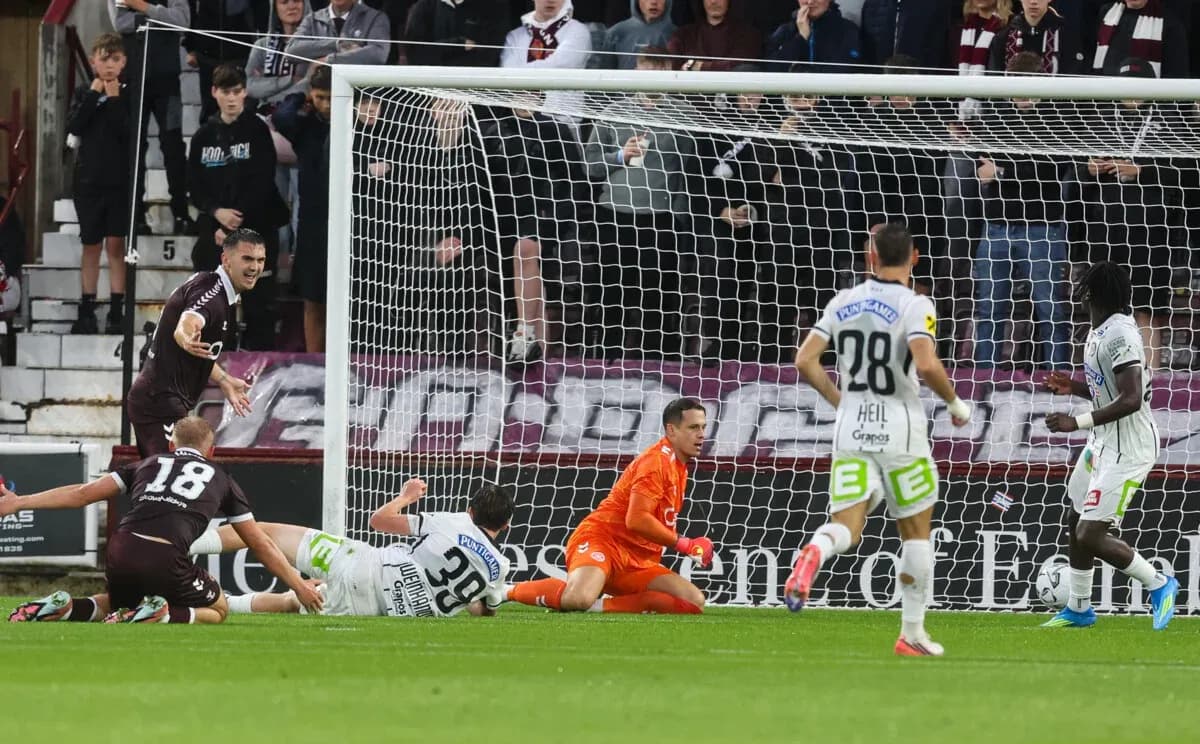
The early tactical warning for Hearts came on 28 minutes, when a potential goal by Seedy Jatta was disallowed by VAR. It underlined Sturm’s threat in behind despite limited possession. Hearts’ high defensive line and full-backs stepping aggressively into midfield created spaces that the Austrian side repeatedly targeted with direct passes into the front two. Although the goal was cancelled, the pattern foreshadowed the second-half breakthrough.
Vrancken’s first adjustment came in first-half added time at 45+2', with S. Findlay (IN) coming on for S. Kingsley (OUT). The change suggested either an early injury issue or a desire for more physicality and directness from left-back, but it did not fundamentally alter Hearts’ approach: they continued to build slowly, relying on combination play between the lines rather than more aggressive verticality.
Sturm’s in-game management was sharper. At 46', R. Fosso (IN) replaced L. Weinhandl (OUT), adding fresh legs and ball-carrying capacity in midfield to help launch transitions. The visitors accepted their out-of-possession role, committed 15 fouls to disrupt Hearts’ rhythm, and used that physical edge intelligently – only one booking, Albert Vallci’s Yellow Card for “Foul” on 61', betraying any disciplinary cost.
The decisive phase arrived in the mid-second half. With Hearts still pushing numbers forward and their rest defence stretched, Sturm finally converted their superiority in transition into goals. On 64', S. Seidl struck for 0-1, assisted by J. Gorenc Stankovic, a move that encapsulated the visitors’ plan: regain, find the holding midfielder, then release a runner into a vulnerable zone. Just four minutes later, at 68', E. Soglo surged forward from left-back to make it 0-2, this time unassisted, capitalising on the spaces Hearts left as they chased an equaliser.
Hearts reacted with a triple substitution at 69' to inject attacking impetus and re-balance a midfield that was being overrun in transition. P. Kabore (IN) came on for C. Miller (OUT), A. Ba-Sy (IN) replaced S. Guendouz (OUT), and T. Renaud (IN) entered for B. Spittal (OUT). The reshuffle pointed towards more direct running and fresh energy between the lines, but the underlying structural issues remained: a high line, full-backs advanced, and insufficient counter-pressing protection after turnovers.
Ingolitsch continued to manage the game astutely from the bench. At 72', B. Beganovic (IN) came on for S. Wlodarczyk (OUT), offering fresh pressing from the front. Four minutes later, at 76', A. Malic (IN) replaced the already-scoring E. Soglo (OUT), shoring up the left side and preserving legs in the back four. At 77', G. Mamageishvili (IN) entered for J. Hodl (OUT), adding control and work rate in midfield as Sturm shifted into more of a containment mode.
Hearts’ final roll of the dice came on 80', when J. McCart (IN) replaced A. Kyziridis (OUT), a move that suggested a back-three or at least a more aggressive use of centre-backs to sustain pressure in the attacking half. Yet Sturm’s compact 4-4-2 block, now reinforced with fresh defenders and midfielders, continued to funnel Hearts into low-probability shots from outside or wide areas.
The goalkeeping performances underscored the tactical story. A. Schwolow (Heart Of Midlothian) faced 9 shots on target and made 7 saves, a workload that reflected how often Sturm’s transitions and penalty-box incursions led to clear efforts on goal. D. Khudyakov (Sturm Graz), by contrast, was called into action only 3 times, a testament to how effectively the visitors’ structure kept Hearts’ 15 shots to low-quality areas despite long spells of defending.
Statistically, the contrast between volume and efficiency was stark. Hearts’ 64% possession, 473 total passes and 80% pass accuracy (377 accurate) speak to their ability to control the ball, but their 4 shots on target from 15 attempts reveal a lack of penetration and final-third clarity. Sturm’s 36% possession and 268 passes at 68% accuracy (182 accurate) look modest, yet they generated 17 shots, 13 inside the box, and 9 on target, converting that into two goals and repeatedly forcing Hearts’ goalkeeper into action.
Discipline also tilted in Sturm’s favour in terms of control: they committed more fouls (15 to Hearts’ 10) but picked up only a single yellow card, for Albert Vallci’s “Foul” at 61', showing a calculated aggression that broke up play without tipping into chaos. Hearts, despite trailing and chasing the game, did not receive a single card, underlining that their main issue was not reckless defending but structural exposure and an inability to turn possession into high-quality chances.
In tactical terms, this match will be remembered as a clinic in how a well-drilled 4-4-2 can outplay a possession-heavy 4-3-3 in European knockout football: Sturm Graz accepted their defensive role, maximised transitions and penalty-box presence, and left Tynecastle Park with a 0-2 advantage that fully reflected their superior game management and attacking efficiency.