
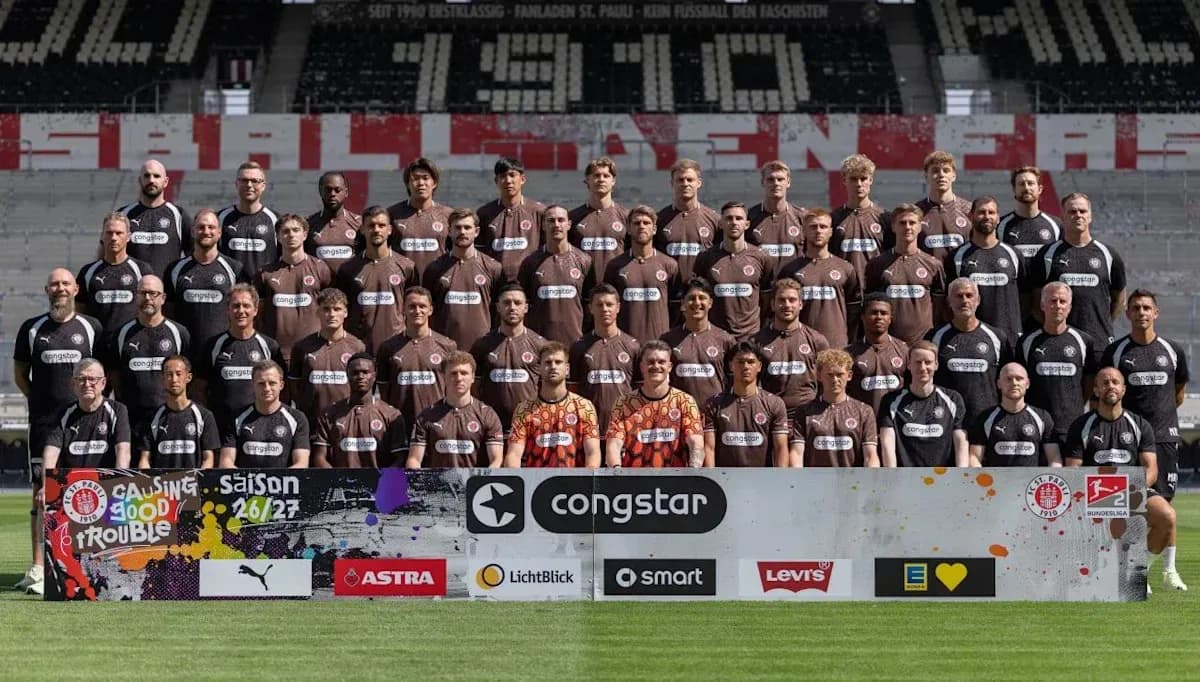
St. Pauli: New Coach, Ambition, and a Rebuilding Challenge
The party didn’t last long at the Millerntor. After the emotional high of survival in 2024/25 – the club’s first successful top-flight stay since 1995/96 – St. Pauli crashed straight back through the trapdoor. Six wins, eight draws, twenty defeats. Bottom of the Bundesliga in 2025/26 and out with a thud rather than a fight.
Relegation rarely comes alone. Head coach Alexander Blessin was dismissed within weeks of the season ending, and the squad that had dragged the club back into the big time began to splinter. The summer in Hamburg has been about exits, farewells and, quietly, a reconstruction job that has to work fast.
Yet walk around the Millerntor and you don’t feel a club in mourning. You feel a club bracing for another swing.
Irvine era ends, spine ripped out
The headline departure is also the most emotional. Jackson Irvine, captain, heartbeat, and symbol of the club’s resurgence, has gone. The Australian, who made 153 appearances, scored 15 goals and supplied 21 assists, didn’t just wear the armband – he wore the club. Promotion in 2023/24, a deep bond with the community, and a presence that anchored the dressing room.
Then, almost out of nowhere, came the request to leave. His move to Cerezo Osaka was confirmed less than a week before the first league fixture. The timing stung. The surprise was real.
He is not alone in leaving. Goalkeeper Nikola Vasilj, 167 appearances and 43 clean sheets, has joined Al-Diriyah on a free. Karol Mets, another long-serving piece of the backline with 91 games, has gone to Bochum, also for nothing. Manolis Saliakas, 120 appearances on the right, moves to Olympiacos for €1.3 million. Hauke Wahl, a rock with 105 games, joins Wolfsburg for €2 million. Daniel Sinani, 70 appearances, heads to Sampdoria on a free.
That’s not just turnover. That’s a core being torn out.
Hrgota the headline act in a lean, targeted rebuild
St. Pauli’s response has not been a scattergun spree. It has been calculated, almost stubbornly so.
Up front, they’ve landed a proven operator: Branimir Hrgota, signed on a free from Fürth. For years he was Fürth’s reference point in attack, their all-time leading scorer across the top two German divisions with 69 goals and 41 assists in 238 appearances. He knows the grind of the 2. Bundesliga, he knows what promotion looks like, and he knows how to carry a team’s hopes without shrinking.
His 16 goals and 7 assists in 2020/21 dragged Fürth into the Bundesliga for only the second time in their history. That’s not a project signing. That’s a statement that St. Pauli still intend to look up, not down.
At the back, Marcus Mathisen arrives from Magdeburg, again on a free. He brings experience and a profile that fits a three-man defence: robust, reliable, and comfortable enough to help build from the back in Marcel Rapp’s system.
The most important addition, though, stands on the touchline.
Marcel Rapp: a coach who knows how to climb
Marcel Rapp walks into the Millerntor with something that can’t be bought: a recent promotion on his CV. At Holstein Kiel, the 47-year-old engineered the club’s first-ever rise to the Bundesliga in 2023/24 – the very same season St. Pauli stormed to the title. He understands the tension of a promotion race, the psychology of a long second-division campaign, and how to get a squad to punch above its weight.
Rapp is expected to stick with a three-at-the-back structure, mirroring the broader tactical trend that has served St. Pauli well in recent years. His pre-season offered a glimpse of the tweaks rather than a revolution.
And those early signs? They suggest there’s still bite in this side.
Pre-season: goals, a reality check, and one worrying injury
The summer tour started in familiar territory. A city clash with Altona 93 produced a wild 2-6 win for St. Pauli, the kind of open, attacking game that flatters forwards and keeps coaches slightly uneasy. Next came a 1-3 victory over Regionalliga Nord outfit Kickers Emden – not perfect, but controlled enough to underline the gap in quality.
The third game had more soul than stakes. Against Babelsberg, a club with whom St. Pauli share a famous fan friendship, Rapp’s side rolled to a 1-4 win. The standout: Abdoulie Ceesay, who rattled in a first-half hat-trick and looked like a man ready to seize the new season.
Momentum carried into the first European test, a 2-1 win over Croatian side Gorica with goals from Louis Oppie and Ricky-Jade Jones. Then came the first major setback: Ceesay limped off with a capsule-ligament injury in his right ankle. For a forward line already undergoing change, it’s a blow that alters early-season planning.
The penultimate friendly delivered a sharp reminder of the level St. Pauli want to get back to. Against Bournemouth, a Premier League and Europa League club, the Hamburg side briefly led through Kaars in the 22nd minute in Austria. Then the game flipped. Four goals conceded in 27 minutes, a 4-1 defeat, and a clear picture of how punishing lapses can be against top-tier opposition.
Their Millerntor bow came against newly promoted LaLiga side Deportivo de La Coruña. Twice St. Pauli went in front, first through Taichi Hara and then again via Kaars. An 84th-minute equaliser from the Spaniards made it 2-2 and left a slight sting, but also underlined that this rebuilt side can go toe-to-toe with teams coming off a promotion high of their own.
Pre-season didn’t deliver a perfect record. It did deliver evidence: this is still a team capable of scoring, still a team with an edge.
How Rapp’s St. Pauli might line up
Rapp’s blueprint points clearly to a 3-4-2-1. With Eric Smith’s fitness in doubt ahead of the opener against Fürth, there’s a strong chance Tomoya Ando or Adam Dzwigala will slot into the back three alongside Nemeth and Mathisen, with Voll behind them in goal.
The midfield pivot is likely to revolve around Fujita in the centre, partnered by either Rasmussen or Metcalfe. Out wide, Pyrka and Oppie look set to patrol the flanks, with Lars Ritzka and Erik Ahlstrand ready to rotate or stiffen things up in the middle when needed.
Up front, the combinations are still fluid. Hrgota is expected to be one of the two support forwards, working off Kaars at the top. The second slot should rotate between Jones and Hara in the early weeks, with Ceesay re-entering the conversation once he returns from injury.
On paper, the predicted XI – Voll; Nemeth, Mathisen, Ando; Pyrka, Rasmussen, Fujita, Oppie; Hrgota, Jones; Kaars – has balance. Experience at the back, legs in midfield, and enough firepower to hurt opponents if the system clicks.
Crucially, despite the exits, there is still a recognisable core. There are still options.
Promotion talk, pressure, and a brutal 2. Bundesliga
History offers a warning. The last time St. Pauli went down before this relegation, in 2010/11, it took 13 long years to climb back. The club has never been a yo-yo side; every promotion has been hard-earned, every return to the top flight a slog. Their quickest bounce-back is four seasons, achieved twice in the 1990s and early 2000s.
This time, the club is trying to compress that timeline. The squad, even after the departures, is one of the strongest in the division by market value. Only VfL Wolfsburg boast a more expensive group, and the gap is nearly €200 million – a reminder of the financial muscle the relegated giants bring.
The flip side is obvious: expectation. Wolfsburg will be cast as title favourites. Behind them, the race for second and third is shaping up as a scrap. Hannover are lurking. Heidenheim, fellow relegation travellers, will not be shy about targeting an immediate return.
St. Pauli don’t have the luxury of easing into this season. They’re too big a target, too valuable a squad, too loud a club.
And yet, there is a sense that this relegation could be different. Pre-season showed a team still capable of punching up, still willing to take risks, still armed with players who can decide games. The recruitment has been sharp rather than flashy. The coach knows how to navigate this league.
A top-six finish feels like a realistic floor. If Hrgota settles quickly, if Rapp’s structure beds in, if the spine stays fit and Ceesay returns with the same explosiveness he showed against Babelsberg, St. Pauli have a genuine shot at the top three.
The question is not whether they can compete. It’s whether they can turn that potential into the kind of relentless, week-after-week consistency that separates promotion contenders from the rest.



