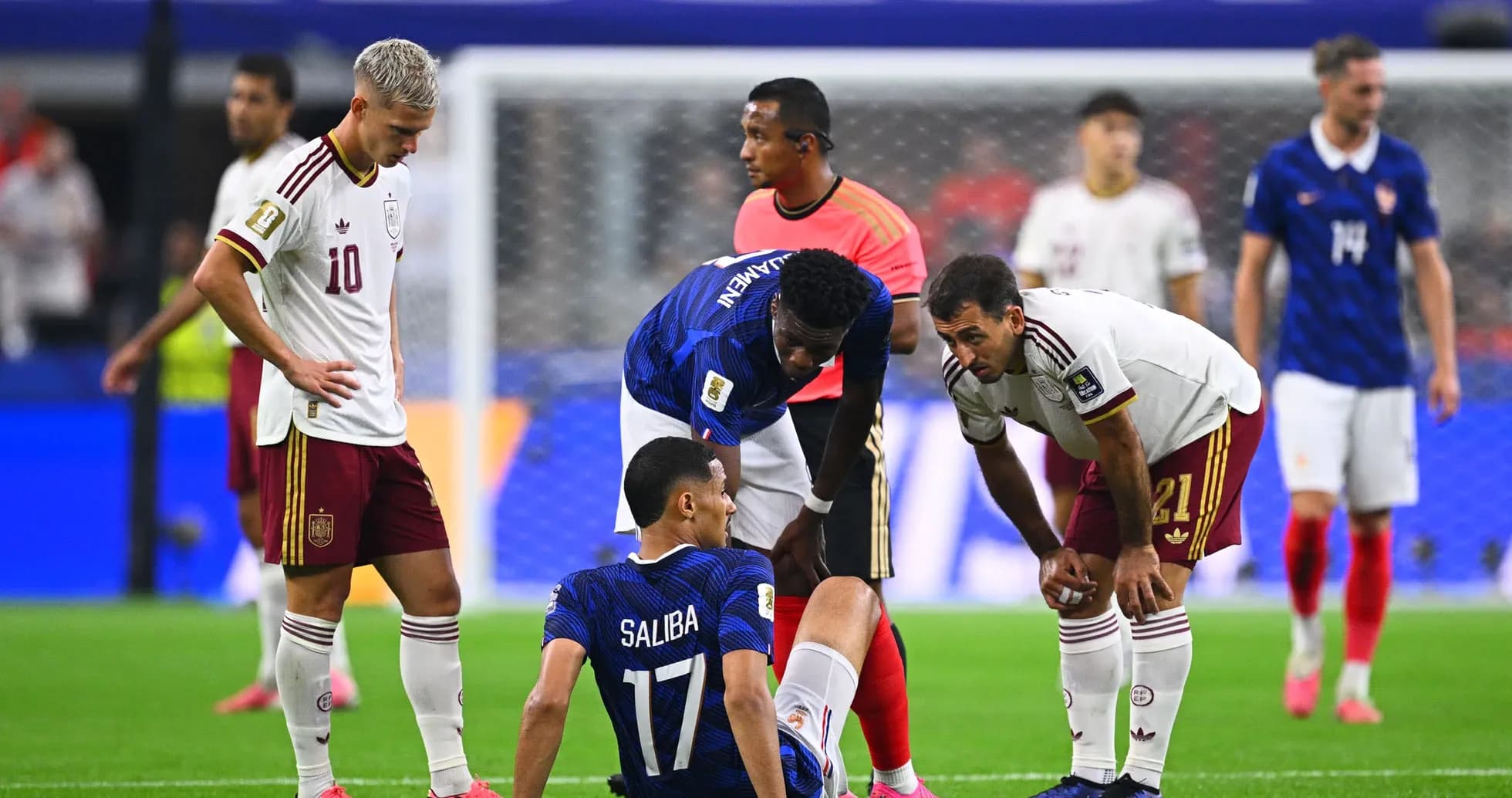
Spain Defeats France 2-0 in World Cup Semi-Final
France and Spain mirrored each other structurally in a 4-2-3-1 at Dallas Stadium, but the tactical execution and efficiency in both boxes decided a World Cup Semi-finals that finished 0-2 in Spain’s favour. Spain controlled marginally more of the ball (51% to 49%) yet translated that slight edge into far greater penalty-area clarity and a superior xG profile (1.63 to France’s 0.3). France’s possession and passing volume (473 passes, 396 accurate, 84%) never converted into sustained threat; Spain’s similar passing load (500 passes, 428 accurate, 86%) was paired with more incisive occupation of the half-spaces and smarter management of transitions.
Both sides’ 4-2-3-1s were built around a double pivot, but the behaviour of those pivots defined the contest. For France, Aurélien Tchouaméni and Adrien Rabiot were asked to screen central spaces and launch early transitions towards Kylian Mbappé, Ousmane Dembélé and Bradley Barcola. However, France’s attacking midfield line often became disconnected from the lone forward: the front four frequently received with their backs to goal and little third-man support from deep. The result was a lot of sterile circulation—Total Shots were equal at 10-10, but France managed only 4 efforts inside the box and generated just 0.3 xG, underlining how rarely they accessed high-value zones.
Spain’s double pivot of Rodri and Fabián Ruiz (later supported by Pedri and Mikel Merino) operated with far more vertical clarity. Rodri anchored in front of Pau Cubarsí and Aymeric Laporte, allowing full-backs Pedro Porro and Marc Cucurella to advance and create width. That width stretched France’s back four and opened interior lanes for Dani Olmo and Lamine Yamal to receive between the lines. Spain’s 5 shots inside the box, combined with a higher xG, reflected a plan built on patiently engineering central overloads and then exploiting the weak side.
Key Structural Battle
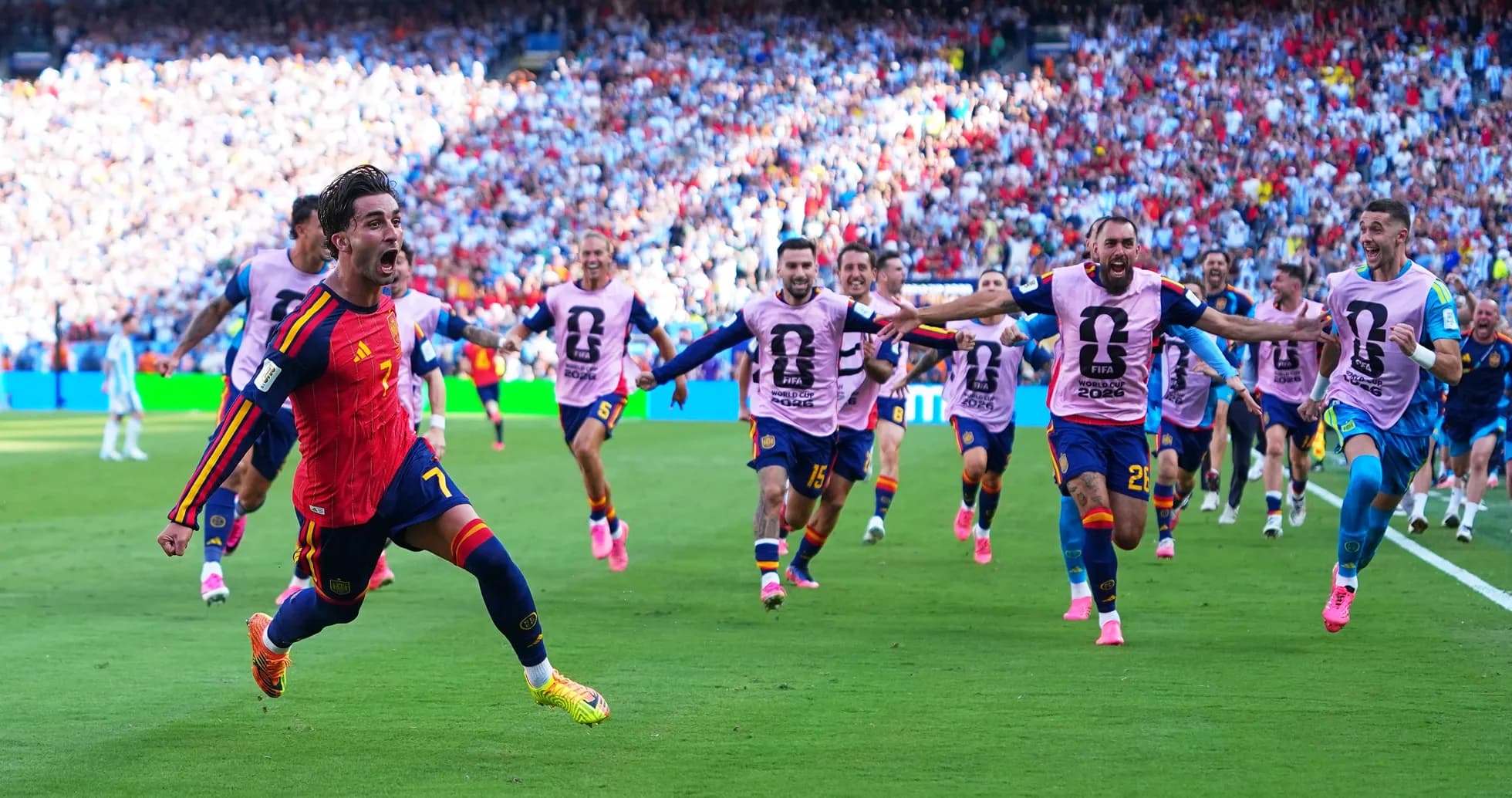
The key structural battle was down France’s right and Spain’s left. Jules Koundé had to manage Cucurella’s overlapping runs while tracking Yamal drifting inside. With Barcola high and narrow as a wide midfielder, France often left Koundé exposed in 1v2s. Spain’s second goal, a “Normal Goal” from Pedro Porro assisted by Dani Olmo at 58', was the clearest expression of this pattern: Spain worked the ball to the right-back arriving in advanced territory, exploiting the fact that France’s wide midfielder line did not always recover into a flat four. Spain’s full-backs were not just auxiliary defenders; they were decisive attacking outlets, with Porro’s advanced positioning rewarded on the scoresheet.
France’s defensive line had to be reshaped early. At 30', Maxence Lacroix (IN) came on for William Saliba (OUT), forcing Didier Deschamps to adjust his central pairing. While the substitution did not immediately destabilise France, it limited their ability to build from the back with the same familiarity. Saliba’s distribution from the right side of central defence had been important in finding Dembélé and Olise early; with Lacroix, France became more conservative, further shrinking the supply line to Mbappé.
Substitutions and Tactical Adjustments
The French bench was used aggressively to chase the game. At 46', Manu Koné (IN) replaced Adrien Rabiot (OUT), and at 57' Désiré Doué (IN) came on for Bradley Barcola (OUT). Later, Theo Hernández (IN) replaced Lucas Digne (OUT) and Rayan Cherki (IN) replaced Michael Olise (OUT), both at 72'. These changes tilted France towards a more attacking posture, with Theo offering higher and more direct runs from left-back and Cherki and Doué adding dribbling and creativity between the lines. However, Spain’s compact 4-2-3-1 block, anchored by Rodri’s positional discipline, absorbed the extra French attackers without conceding space centrally. France’s 7 corners and 10 total shots show territorial pressure, but Spain’s structure forced most of that threat into low-probability situations, reflected in France’s minimal xG.
Discipline also shaped the midfield intensity. France committed 11 Fouls to Spain’s 12, but crucially saw two key players booked: Adrien Rabiot received a Yellow Card for “Foul” at 9', and Kylian Mbappé was booked for “Violent conduct” at 86'. Rabiot’s early caution constrained his ability to press aggressively from midfield, giving Spain’s pivots more time to turn and play. Mbappé’s late booking was more a symptom of frustration in a game where he was largely kept away from prime finishing positions. For Spain, Marc Cucurella’s Yellow Card for “Foul” at 31' did little to blunt his influence; he continued to step high in support of the press and to overlap on the left.
Goalkeeper Performance
In goal, the numbers underline how the game state unfolded. Mike Maignan (France) registered 0 saves, a reflection not of Spanish wastefulness but of the clinical nature of their finishing and the way their best chances were converted rather than parried. Unai Simón (Spain), by contrast, made 3 saves, matching France’s 3 Shots on Goal and preserving a clean sheet when France did manage to break Spain’s lines. Both goalkeepers posted identical goals prevented values (0.07), suggesting that the difference lay less in extraordinary shot-stopping and more in Spain’s superior shot quality and France’s inability to test Simón from truly dangerous positions.
Statistically, the match was finely balanced in volume but not in value. Both teams had 10 Total Shots, but Spain’s 3 Blocked Shots to France’s 2 indicate a more proactive defensive reaction at the edge of their own box. France’s 4 Offsides versus Spain’s 5 show both teams trying to stretch the last line, yet Spain’s timing and final pass were more coherent, as evidenced by the 1.63 xG. The passing metrics—France’s 473 passes (396 accurate, 84%) and Spain’s 500 (428 accurate, 86%)—confirm that this was not a game of domination by possession but of superior spacing and decision-making in advanced zones.
Ultimately, the tactical verdict is that Spain’s 4-2-3-1 was more integrated front-to-back. Their double pivot controlled rhythm, their full-backs provided decisive width, and their attacking midfielders consistently occupied dangerous pockets between France’s lines. France, despite comparable possession and passing accuracy, never solved the problem of connecting their midfield platform to Mbappé in high-value areas. The 0-2 scoreline and the xG gap capture a semi-final where structure, not spectacle, separated the sides.