Spain Dominates Austria 3-0 in World Cup Round of 32
Spain’s 3-0 win over Austria at SoFi Stadium in this World Cup Round of 32 tie was a near-perfect expression of territorial control and structured dominance. The 65%-35% possession split, a 23-5 shot count, and a 9-0 margin in corners translated a clear strategic superiority into a comfortable scoreline, with Spain leading 1-0 at half-time and accelerating after the break as Austria’s resistance and compactness eroded.
I. Executive Summary
Spain imposed a textbook positional game, using their midfield to suffocate Austria’s build-up and lock the game into the Austrian half. The final 3-0 reflected both the volume and quality of chances: Spain generated 10 shots on target from 23 attempts and posted 2.84 xG against Austria’s 0.32. Austria, by contrast, failed to register a single shot on target and were forced into a reactive, foul-heavy game plan that never truly disrupted Spain’s rhythm.
II. Scoring Sequence & Disciplinary Log
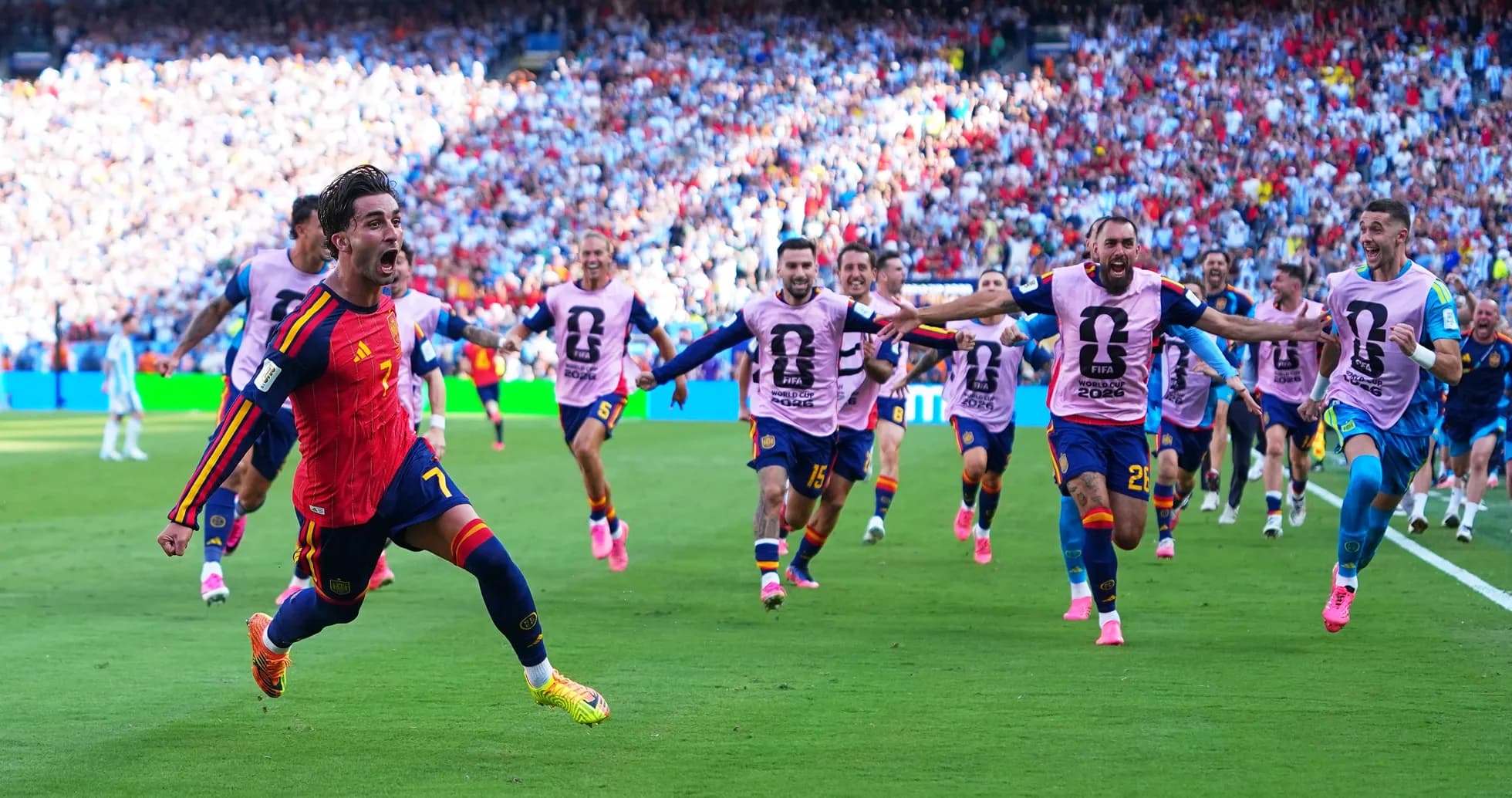
The breakthrough came on 36': Mikel Oyarzabal (Spain) finished a move assisted by Marc Cucurella, rewarding Spain’s sustained pressure and wide overloads. That goal set the tone for the rest of the contest, with Spain going into the interval 1-0 up and fully in control.
Austria’s double change at 46' — Carney Chukwuemeka (IN) came on for Nicolas Seiwald (OUT), and Florian Grillitsch (IN) came on for Xaver Schlager (OUT) — was a clear attempt to add more ball-playing and vertical passing in midfield, but it did not alter the shot pattern. Spain continued to dictate tempo and territory.
On 60', Austria reshaped again in attack: Marko Arnautović (IN) came on for Michael Gregoritsch (OUT), while Saša Kalajdžić (IN) came on for Romano Schmid (OUT), moving towards a more direct, target-man oriented front line. Yet within six minutes, Spain punished the risk. At 66', Pedro Porro (Spain) struck Spain’s second, assisted by Alex Baena, a goal that underlined Spain’s capacity to progress from deep and exploit half-spaces against an increasingly stretched Austrian block.
Spain then turned to game management. At 71', Mikel Merino (IN) came on for Dani Olmo (OUT) and Ferran Torres (IN) came on for Alex Baena (OUT), refreshing the attacking and midfield lines while maintaining the same positional structure. Austria’s frustration surfaced in discipline: at 83', Stefan Posch (Austria) received a yellow card — Foul — emblematic of Austria’s reliance on defensive interventions to stem Spain’s circulation.
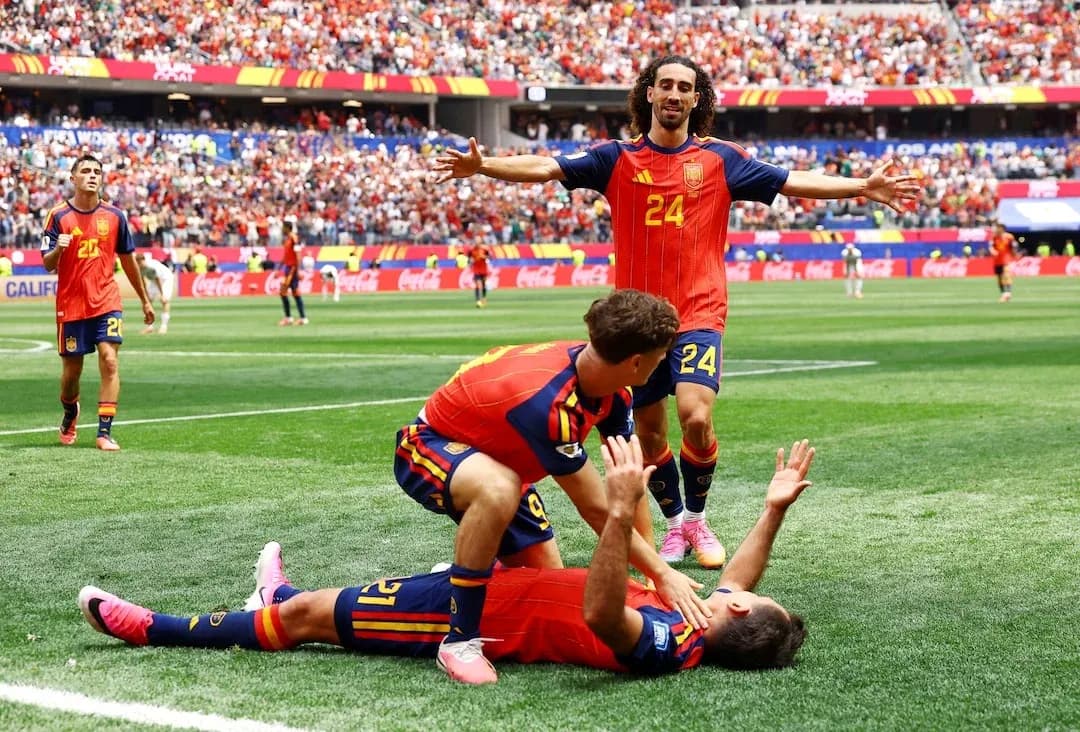
Spain continued to rotate intelligently: at 85', Pablo Gavi (IN) came on for Lamine Yamal (OUT), while Austria replaced the booked Posch with Alexander Prass (IN) for Stefan Posch (OUT), slightly adjusting their defensive profile on the flank. The contest was effectively settled at 89', when Oyarzabal (Spain) scored again, once more assisted by Cucurella, a repeat connection that highlighted Spain’s left-sided synergy and Austria’s inability to close that corridor.
Two final Spain substitutions at 90' — Marc Pubill (IN) came on for Aymeric Laporte (OUT), and Fabián Ruiz (IN) came on for Pedri (OUT) — were about protecting key players and preserving energy with the tie already won.
Card summary (locked):
- Austria: 1 yellow (Stefan Posch — Foul)
- Spain: 0 cards
- Total: 1 card
III. Tactical Breakdown & Personnel
Spain’s structure was built on control through the middle and width from the full-backs. Rodri anchored the midfield, with Pedri and Lamine Yamal providing between-the-lines options and Dani Olmo and Alex Baena rotating into pockets to overload Austria’s central and half-space zones. The 629 total passes, with 570 accurate at 91%, show how consistently Spain recycled possession to unbalance Austria’s shape rather than forcing low-percentage entries.
Marc Cucurella’s role was pivotal: repeatedly advancing from left-back, he both provided width and served as a creative outlet, delivering two assists for Oyarzabal. This reflected Spain’s clear left-sided bias, using Cucurella’s overlaps and Oyarzabal’s intelligent movements inside to pin Austria’s right side deep and wide, opening central lanes for late arrivals.
Pedro Porro’s goal at 66' highlighted the symmetry of Spain’s full-back usage: with Austria narrowing to protect the middle, Spain’s right-back could attack the space outside Austria’s compact block. The seven blocked shots and 15 attempts inside the box underline how relentlessly Spain forced the ball into dangerous central zones, with Austria often only able to get a last-ditch foot in.
Defensively, Spain’s pressing and rest-defense were so effective that Austria were limited to just five shots, none on target, and only one from outside the box. Austria’s 346 passes (284 accurate, 82%) show they were not completely unable to keep the ball, but their sequences were mostly in deeper zones, under pressure, and with little progression. The 15 fouls conceded and five offsides reflect a side oscillating between emergency defending and hopeful vertical balls to forwards who were too often isolated.
In goal, Unai Simón (Spain) was largely untested; Spain’s statistics list zero goalkeeper saves, consistent with Austria’s zero shots on target. At the other end, Alexander Schlager (Austria) made six saves, an indication that while Spain scored three, they also forced the Austrian goalkeeper into multiple interventions that prevented an even heavier scoreline. The fact that Austria’s goals prevented value is negative, at -0.57, suggests that, relative to the quality of Spain’s chances, Austria still slightly underperformed in shot-stopping.
Austria’s in-game tactical tweaks — more creative midfielders at 46', double striker and directness at 60' — never broke Spain’s control. The lack of corners (0) and the absence of sustained territorial pressure underline how rarely Austria established themselves in Spain’s defensive third.
IV. The Statistical Verdict
The match statistics tell a coherent story: Spain’s 2.84 xG versus Austria’s 0.32 aligns closely with the 3-0 scoreline and underlines that this was not a smash-and-grab but a structurally dominant performance. Spain’s 23 total shots to Austria’s five, with 10 on goal against zero, and a 9-0 advantage in corners, frame a one-sided territorial and chance-creation profile.
Spain’s passing superiority — 629 passes, 570 accurate (91%) — was not sterile; it translated into 15 shots inside the box and seven blocked efforts, showing constant penetration into high-value zones. Austria’s 346 passes, 284 accurate (82%), were respectable in isolation but mostly confined to deeper, non-threatening spaces, reflected in their low xG and lack of shots on target.
Discipline also mirrored the flow: Spain committed just eight fouls and received no cards, maintaining control without desperation. Austria’s 15 fouls and single yellow for Stefan Posch — Foul — reflected a side often chasing shadows and forced into late challenges.
In sum, the data and the tactical patterns are aligned: Spain controlled possession, territory, and chance quality, managed the game intelligently through substitutions, and advanced from the Round of 32 with a performance that was both aesthetically coherent and statistically emphatic.