South Africa's Women’s Africa Cup of Nations Hopes Resurrected
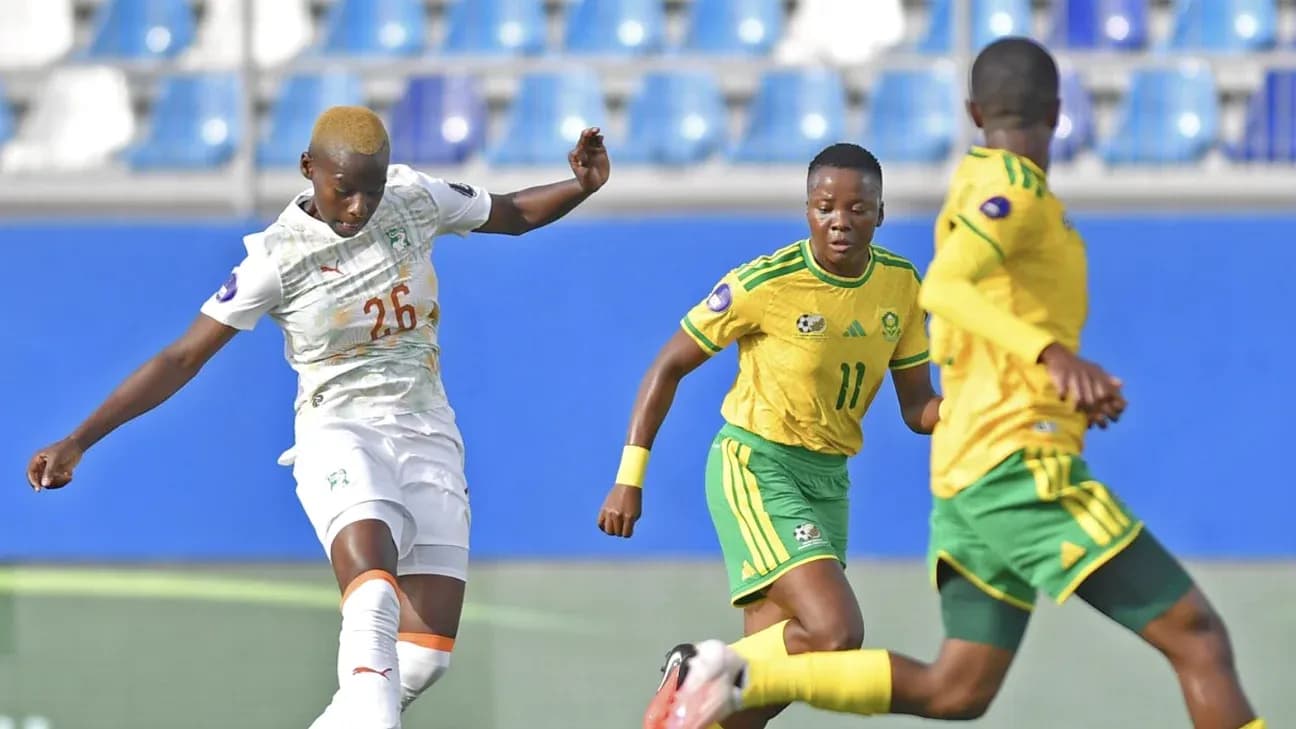
South Africa clung to their Women’s Africa Cup of Nations hopes in Casablanca, dragged back from the brink by two strikers who have heard every doubt and every whisper about their futures.
Banyana Banyana’s 2-2 draw with Ivory Coast was chaotic, flawed, and at times deeply worrying. It was also alive. And in a group that has turned unforgiving very quickly, that matters.
Torn Apart, Then Woken Up
For 45 minutes, South Africa looked like a side drifting out of this tournament.
Ivory Coast did not dominate the ball; they didn’t need to. They simply waited, then sliced through on the counter. Once. Then again. Both times, the same outcome: Grace Sery racing clear, South Africa’s backline scrambling in vain, the net rippling.
Sery struck first on 18 minutes, then again on 36, each goal a near carbon copy in its ruthlessness and South Africa’s disarray. Banyana were stretched, slow to react, and repeatedly exposed in transition.
Only one moment in that first half hinted at the quality that made South Africa African champions. Linda Motlhalo slipped a clever ball in behind for Thembi Kgatlana, the kind of pass she used to feast on. Kgatlana burst through, but Aramatou Diakité read it well and smothered the chance.
That was it. One flash. Then the lights went out again.
Kgatlana, so often the heartbeat of this attack, drifted on the fringes. Isolated. Anonymous. The questions that have followed her — has she peaked in Banyana colours, has the edge dulled? — did not feel unfair at half-time.
Kgatlana Answers Back
The second half told a different story.
With better support around her, Kgatlana suddenly looked like herself again: sharp, decisive, unforgiving. The Tigres UANL forward has missed the understanding she once had with Jermaine Seoposenwe, whose retirement last year left a creative void in the front line. Nobody has truly filled that link role since.
On Friday night, Ronnel Donnelly stepped into that space and refused to shrink.
The 22-year-old Mamelodi Sundowns striker has worn more criticism than most, especially given her limited minutes at club level. Yet Desiree Ellis has kept calling her up, kept backing her. In Casablanca, the reason was there for all to see: she occupies defenders, wins duels in the air, and gives her partner room to breathe.
Shortly after coming on, Donnelly carved out space for herself in the box but couldn’t get a clean shot away. Instead of the move dying, South Africa recycled the ball, kept Ivory Coast pinned back. It found its way to Kgatlana on the left.
This time, there was no hesitation.
She cut inside, opened her body, and drilled her finish home. A lifeline with just under 20 minutes plus stoppage time to play. A statement, too. Give her support, and she still delivers when the game burns hottest.
Donnelly’s Moment, Magaia’s Finish
The goal shifted everything. South Africa suddenly played higher, braver, more compact. Ivory Coast, who had looked so comfortable at 2-0, began to retreat.
The pressure finally told deep into stoppage time.
Donnelly, again, made the difference. Rising to meet a ball forward, she flicked a clever header into space, exactly where a poacher should be. Hildah Magaia was already on the move.
Magaia did not hesitate. One touch to set herself, then she lashed in the equaliser. From nowhere, Banyana were level at 2-2.
It wasn’t pretty. It wasn’t controlled. But it was full of fight — and right now, that keeps the door to the quarter-finals just about open.
Group B on a Knife Edge
The draw leaves Ivory Coast on four points from two games, with a goal difference of +3 after their 4-1 dismantling of Burkina Faso in their opener. Tanzania sit just behind them, with three points and a +1 goal difference after beating South Africa 2-1 in their first match.
South Africa’s situation is far more precarious: one point from two games, a goal difference of -1, and no margin for error. Burkina Faso, still on zero points, are the next and final opponents in Group B.
Nothing less than a win will do for Banyana Banyana on August 4. Even that may not be enough on its own. With head-to-head records serving as the primary tiebreaker for teams level on points — ahead of goal difference — every duel, every decision in that final round will carry weight.
The stakes stretch beyond this tournament, too. The four semi-finalists will qualify directly for the 2027 FIFA Women’s World Cup in Brazil. The two best losing quarter-finalists will still have a route through African playoffs to the Inter-Confederation Playoff. The path is narrow, but it exists.
Selection Questions, and a Bold Option
Ellis now faces a clear tactical question: play it safe, or unleash the attacking quartet that almost turned Ivory Coast over?
When Donnelly, Kgatlana, Magaia and Lebogang Ramalepe combined late on, South Africa finally looked like a side capable of unsettling strong opposition. Donnelly’s physical presence, Kgatlana’s movement, Magaia’s ruthless finishing and Ramalepe’s energy from wide areas gave Banyana a different edge.
If Ellis wants to start on the front foot against Burkina Faso and chase not just a win but goals, that front four is an obvious option. It would be a gamble. It might also be their best shot.
South Africa’s backs are firmly against the wall now. There is no more room for slow starts, no more space for passengers, no more time to wait for combinations to click.
They escaped Casablanca with a point and a pulse.
The question is whether that late surge was a final flicker, or the spark of a resurgence that can carry them into the knockout rounds.