Slovan Bratislava's Tactical Mastery in 2-0 Win Over Mjallby AIF
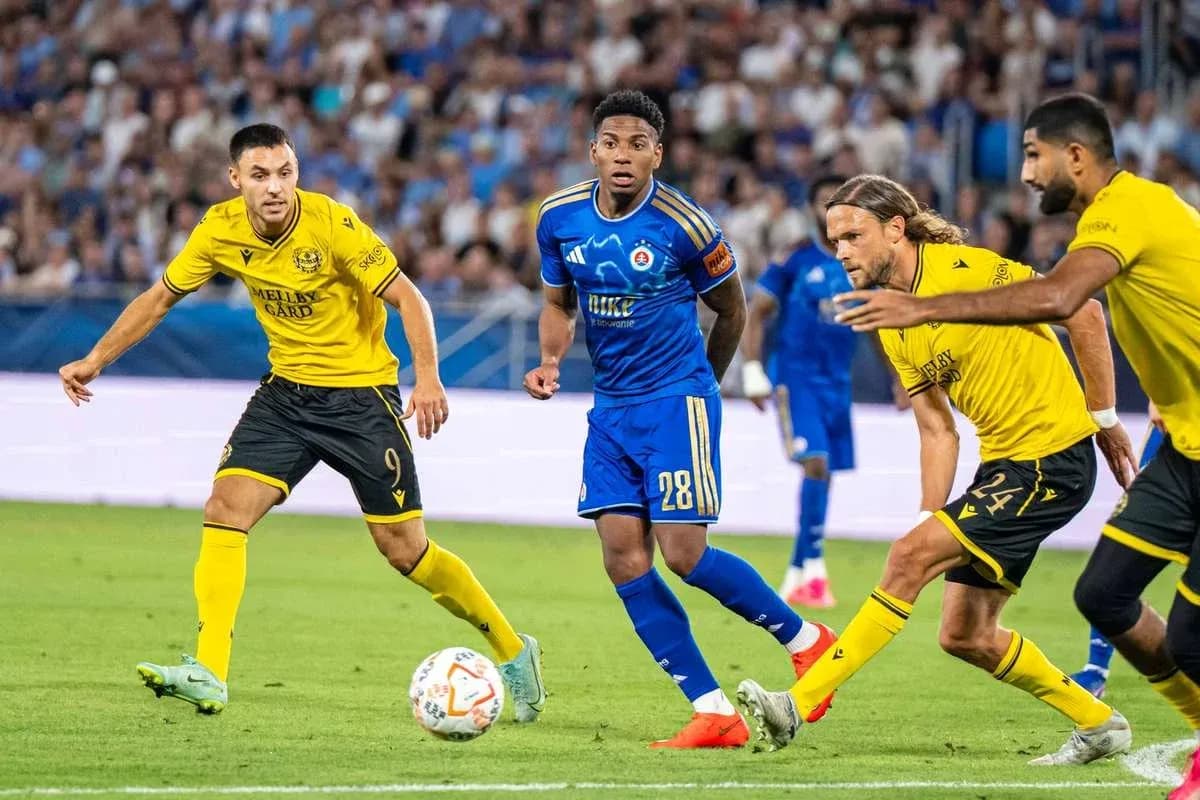
Slovan Bratislava’s 2-0 win over Mjallby AIF at Tehelne Pole Stadion was a controlled, structurally coherent performance built on a clear tactical edge after half-time rather than raw dominance in the numbers. With possession split 50–50 and both sides registering relatively few shots on goal (4 for Slovan, 2 for Mjallby), the difference came from how Yaya Toure’s 4-1-4-1 adapted in-game to exploit the spaces around Mjallby’s 3-4-3, especially down the flanks and in transition once the first goal broke the deadlock.
Slovan’s starting 4-1-4-1 gave them natural width against Mjallby’s back three. Full-backs C. Blackman and S. Cruz could step high to pin the wide midfielders V. Granath and J. Gustavsson, while P. Pokorny sat as the single pivot screening in front of K. Bajric and S. Markovic. Ahead of him, A. Mustafic and R. Ibrahim operated as the dual interiors, with S. Camara and M. Kianga supporting central striker M. Kukharevych from the half-spaces and wide channels.
First Half
In the first half this structure produced territorial control but not penetration: Slovan had more shots overall (4 on goal, 7 off target) but Mjallby’s compact 3-4-3 blocked central access and forced longer efforts, reflected in Slovan registering zero blocked shots but also failing to turn possession into clear chances. Mjallby’s front three of J. Kjaer, J. Bergstrom and A. Samuelsen tried to press out-to-in onto Slovan’s centre-backs and pivot, but with only 2 shots on goal and 4 off, they rarely converted turnovers into real threat.
The disciplinary pattern underlined the territorial picture. Slovan committed 15 fouls to Mjallby’s 9 and picked up three yellow cards, two of them for midfielders (Rahim Ibrahim for “Foul” at 44', Suleiman Camara for “Simulation” at 58', and Alen Mustafić for “Foul” at 62'). That volume of fouling, particularly in central areas, pointed to Slovan’s willingness to counter-press aggressively whenever their higher line was exposed. By contrast, Mjallby’s two bookings — Tom Pettersson for “Foul” at 43' and Villiam Granath for “Foul” at 50' — came as they struggled to contain Slovan’s runners once the home side increased tempo after the break.
Tactical Shift
The key tactical shift arrived immediately at half-time. At 46', Toure replaced M. Kianga with T. Barseghyan (“T. Barseghyan (IN) came on for M. Kianga (OUT)”), injecting a more direct, line-breaking profile on the flank. Within a minute of that adjustment, the structure paid off. At 47', S. Camara scored for Slovan Bratislava, assisted by S. Cruz, for 1-0. The move encapsulated Slovan’s plan: full-back Cruz advancing from the 4-1-4-1 base to deliver from wide, with Camara attacking the box from a wide-forward starting position against Mjallby’s stretched back three.
Mjallby tried to respond by rebalancing their 3-4-3. On 56', they made a double change: “A. Youssef (IN) came on for I. Hoffmann (OUT)” and “T. Miettinen (IN) came on for L. Svanberg (OUT)”. This was an attempt to freshen both the defensive line and the midfield band, but it also subtly altered their wide coverage. Removing a defender (Hoffmann) and introducing a midfielder (Youssef) pushed them towards a more aggressive 3-4-3/3-2-5 in possession, yet it left more space for Slovan’s wide counters.
Toure then doubled down on energy and verticality between 59' and 76'. At 59', “A. Yirajang (IN) came on for M. Kukharevych (OUT)” and “C. Martinez (IN) came on for R. Ibrahim (OUT)”, reconfiguring the attacking line with fresher legs and more dynamism between the lines. Later, at 76', “D. Matsuoka (IN) came on for A. Mustafic (OUT)”, adding another midfielder with the capacity to manage tempo and press. These changes collectively turned Slovan’s 4-1-4-1 into a more fluid, almost 4-3-3 shape in possession, with Yirajang and Camara interchanging across the front.
Second Goal
The second goal at 78' was a direct product of this re-energised front line and the persistent threat from the right. A. Yirajang scored for Slovan Bratislava, again assisted by S. Cruz, to make it 2-0. The repeat provider pattern was significant: Cruz, as right-back in the 4-1-4-1, consistently found room outside Mjallby’s left-sided defender in the back three, exploiting the channel that their wing-back and wide centre-back could not jointly protect once Mjallby were chasing the game.
Mjallby’s later substitutions — “L. Tidstrand (IN) came on for V. Granath (OUT)” and “O. Lindberg (IN) came on for J. Kjaer (OUT)” both at 72', then “M. Agnarsson (IN) came on for V. Gustafson (OUT)” at 87' — were aimed at refreshing both flanks and the forward line. However, with only 2 shots on goal across the match and no recorded increase in attacking output after these changes, their 3-4-3 never truly destabilised Slovan’s defensive block.
The final substitution for Slovan at 83' — “L. Hofstadter (IN) came on for S. Camara (OUT)” — was a classic game-management move, sacrificing some direct running for an extra layer of control and fresh pressing in the wide channel to protect the 2-0 lead.
Match Statistics
Statistically, the match was closer than the scoreline might suggest, but the tactical execution tilted it clearly in Slovan’s favour. Both sides finished with 50% possession, underlining that this was not a one-sided siege but a contest of structures and efficiency. Slovan’s 4 shots on goal versus Mjallby’s 2, combined with a 7–4 advantage in shots off target, show that the home side consistently reached better shooting positions, even without a high volume of blocked efforts (0 for both teams).
From a defensive standpoint, Slovan’s 15 fouls and 3 yellow cards indicate an aggressive, front-foot approach to protecting their lead, often stopping transitions at source. Mjallby, with 9 fouls and 2 yellows, were less disruptive and could not impose sustained pressure despite having 4 corner kicks to Slovan’s 2.
With no recorded data for goalkeeper saves, passing volumes, accuracy, or xG, the clearest objective indicators remain shots and discipline. Within that limited statistical frame, Slovan Bratislava’s ability to convert a marginal shooting edge into two goals, while keeping Mjallby to just two efforts on target, reflects a side that used its 4-1-4-1 structure and substitution strategy more intelligently than their opponents’ 3-4-3. In the context of a UEFA Champions League 3rd Qualifying Round tie, this was a tactically mature home-leg performance: controlled risk, targeted wide overloads, and timely in-game adjustments that turned parity on paper into a decisive 2-0 advantage on the pitch.