
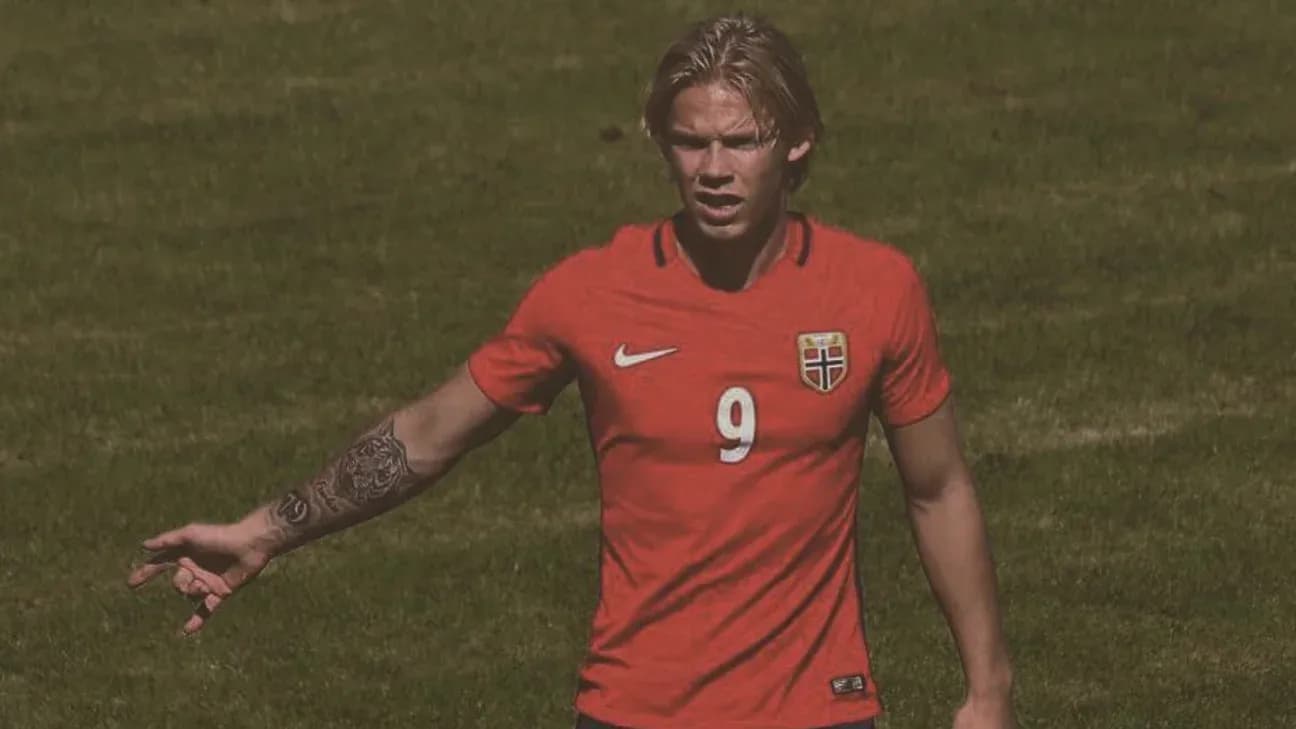
Sebastian Pedersen Joins Orlando Pirates: From Haaland's Shadow to Spotlight
Erling Haaland’s “cousin” has landed in Soweto.
The joke has been doing the rounds on social media, but there’s no family tree to back it up. What links Erling Haaland and Orlando Pirates’ new striker Sebastian Pedersen is not blood, but a shared footballing path: two Norwegian centre-forwards, fighting for the same shirt in the same youth national teams.
From Haaland’s Shadow to Buccaneer Spotlight
Pedersen and Haaland were regular names on Norway’s U18 and U19 team sheets, often listed together but rarely seen together on the pitch. The pattern was simple: if one came on, the other went off. Same role, same zone, same battle for minutes.
Those youth days now feed into the intrigue around Pirates’ latest signing.
“Orlando Pirates Football Club is pleased to announce the signing of striker Sebastian Pedersen from Norwegian side Sogndal Fotball,” the club confirmed on Sunday, unveiling a 27-year-old forward on a two-year deal, with an option for a further season.
He joins Abdeslam Ouaddou’s squad as the Buccaneers gear up for a season in which they must defend their Premiership crown and replace key attacking departures. The club’s own description of their new man is telling: a product of “one of Norwegian football’s great talent factories,” a “blonde bomber” who has worn his country’s colours from U15 all the way to U21.
This is not a raw prospect. This is a forward shaped by a system that consistently produces top-level professionals.
A One-Touch Finisher, Not a Bulldozer
Pirates have not gone shopping for a battering ram. They’ve gone for a penalty-box operator.
“In terms of his style of play, Pedersen is considered a one-touch finisher rather than a bulldozer,” the club noted. His record backs that up: 51 goals in his last 117 matches, and 59 goals with 9 assists in 166 club appearances overall.
He thrives on service. He finishes moves rather than starting them. That profile matters for a Pirates side that, despite lifting the Premiership title, often lacked a ruthless edge in the six-yard box.
Pedersen can also operate from the flanks, particularly off the left. On paper, that ticks two of the three roles Relebohile Mofokeng used to fill before his departure. Yet early indications from the club suggest they see Pedersen primarily as a central striker, not as a wide creator. The message is clear: he’s here to finish chances, not to float between the lines.
Clearing Up the Marcus Confusion
The Pedersen surname has already caused a stir.
Norway’s 2026 World Cup squad featured Torino right-back Marcus Holmgren Pedersen, and some fans rushed to link him to the new Pirates man. Wrong Marcus.
Sebastian does have an older brother named Marcus Pedersen, and he, too, has represented Norway. His international career came much earlier: nine caps between 2013 and 2015, with one goal to his name.
Now 36 and last seen in Norway’s lower leagues, he is far removed from the international stage, but his career was more than respectable. A classic journeyman forward, he wore the colours of Vitesse in the Netherlands, had a loan spell at Barnsley, and turned out for Vålerenga in Norway and Odense Boldklub in Denmark. Like his younger brother, he could play through the middle or off the left.
His most productive spells came at Strømsgodset, where he enjoyed two stints between 2009–2010 and 2015–2019. In many ways, Sebastian follows a familiar family template: mobile, versatile, and comfortable leading the line or drifting wide.
The Missing Piece Up Front?
Pirates have not signed Haaland. They don’t need to. What they needed was a specific type of striker.
With Tshegofatso Mabasa gone and the final months of his Pirates contract spent on loan at Stellenbosch, the champions leaned heavily on Evidence Makgopa and Yanela Mbuthuma to carry the load. Both brought important qualities: Makgopa’s back-to-goal play and Mbuthuma’s tireless pressing gave structure to the attack.
What they didn’t bring was a prolific return. Makgopa finished last season with six goals, Mbuthuma with five. Useful numbers, not title-winning centre-forward figures for a club of Pirates’ stature.
Pedersen’s record, while not explosive, is consistent. His 59 goals in 166 club games show a striker who understands where to be and how to finish. The caveat is obvious: most of that work has come in Norway’s second tier, the OBOS-ligaen. At the highest domestic level, the Eliteserien, he has just one goal in 12 appearances, spread over 275 minutes.
So the question is not whether he can score. It’s whether he can translate that second-tier efficiency into a top-flight environment in South Africa, with different defenders, different rhythms, and different pressure.
A Calculated Gamble
This is a targeted signing, not a headline-grabbing gamble.
Pirates have identified a profile they have lacked: a penalty-box specialist with a proven, if not elite, scoring record, still in his prime years, and schooled in a rigorous European development system. They know they need more goals from their No. 9. They know they can’t rely solely on structure and work rate.
Pedersen arrives with the tag of a “one-touch finisher” and the experience of once sharing a dressing room with Erling Haaland, even if he rarely shared the pitch with him. In Norway’s youth ranks, when one came on, the other made way. In Soweto, there will be no such rotation.
This time, the stage is his alone.



