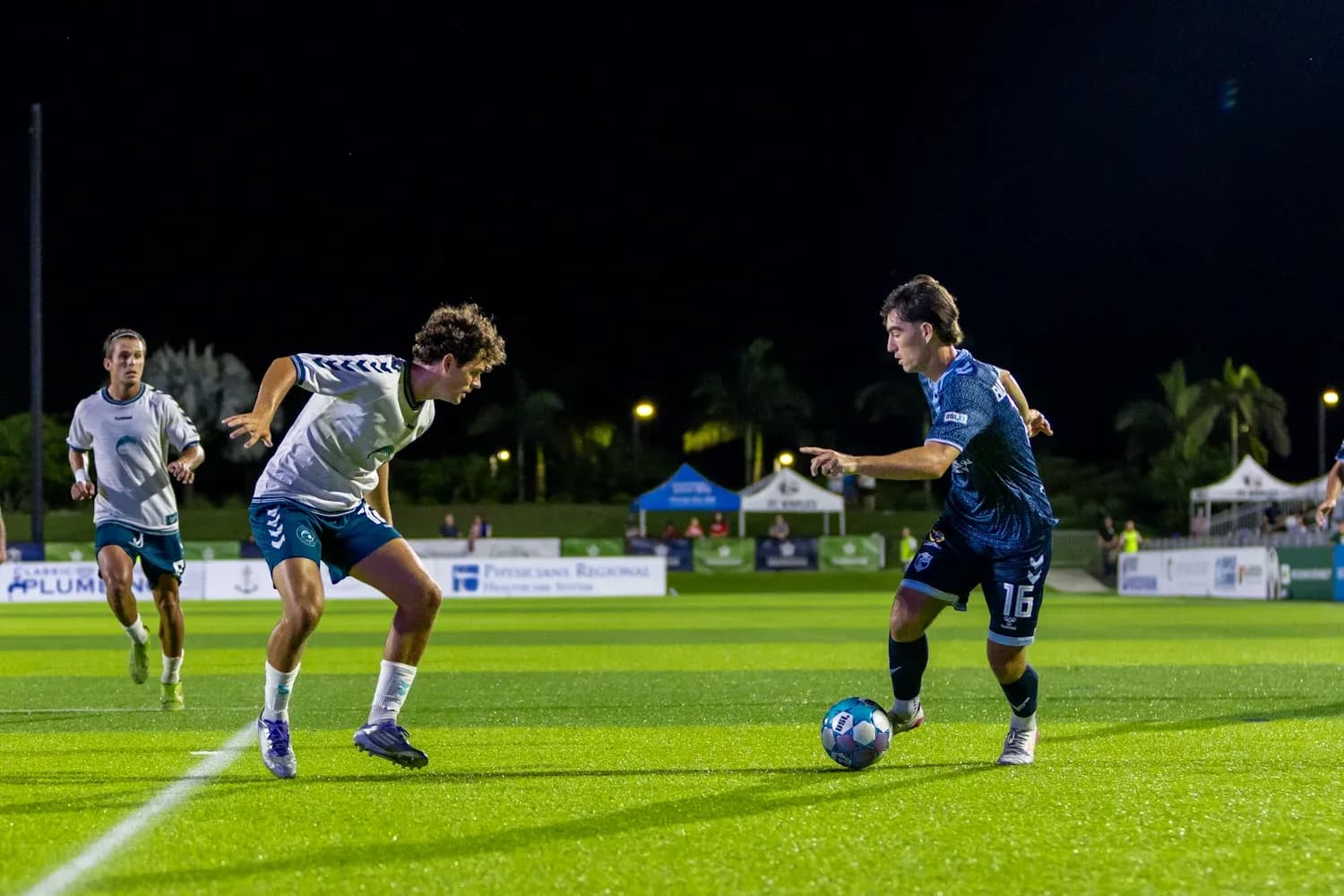
Sarasota Paradise Defeats Naples 2–0 in Group 7 Clash
The lights have long since cooled at Paradise Coast Sports Complex, but the imprint of this Group 7 clash lingers: Naples undone 0–2 by Sarasota Paradise, a result that crystallizes the contrasting identities of two fledgling USL League One Cup projects.
I. The Big Picture – Group 7 tension and clashing identities
Following this result, the table tells a stark story. Naples sit 5th in Group 7 with 2 points and a goal difference of -3, their overall record reading 1 win, 1 draw and 2 losses across 4 matches in total competition play. Sarasota Paradise, by contrast, climb to 4th on 3 points, with a goal difference of -2 and an overall return of 1 win and 3 losses from their 4 matches in total.
The statistical DNA of both sides had already been clear heading into this game. Naples were an open, high-variance side: in total this campaign they have scored 3 goals and conceded 7, an overall goals-against average of 2.3 per match, with both their home and away attacking averages locked at 1.0. Sarasota Paradise were more conservative, grinding through low-scoring contests: in total they had 2 goals for and 4 against, with an overall goals-for average of 0.7 and an overall goals-against average of 1.3.
On their travels, Sarasota’s numbers were quietly solid: 2 goals scored and 2 conceded across 2 away matches, an away attacking average of 1.0 and an away defensive average of 1.0. Naples at home, by contrast, had been fragile: 2 goals scored and 3 conceded in 2 home games, with a home attacking average of 1.0 and a home defensive average of 1.5. The 0–2 scoreline simply exaggerated those existing tendencies.
II. Tactical Voids – Discipline, structure, and missing edges
Neither side came into this fixture with a published list of absentees, but the structural voids were tactical rather than personnel-based. Naples’ starting XI – with J. Grant leading the line alongside the likes of G. Miglietti and C. Garcia – suggested an intent to play front-foot football. Yet their season statistics underline a side that struggles to manage game states and defensive balance.
Naples have failed to keep a single clean sheet in total this campaign, at home or away. They have already failed to score once overall, and that failure arrived again here. Their disciplinary profile is particularly telling: 40.00% of their yellow cards arrive between 46–60 minutes, with another 20.00% in the 31–45 range and 20.00% in the 76–90 window. Crucially, their only red card in total has come in the 46–60 period. It paints a picture of a team that loses control around the restart, pressing too aggressively or reacting emotionally when the match tightens.
Sarasota Paradise, for their part, fill a different void: they are a side that lives on the edge without quite tipping over it. In total, 37.50% of their yellow cards arrive in the 76–90 minute band, with 25.00% between 46–60 and smaller clusters earlier in the match. They push the line late, but they have yet to see a red card in any minute range. That capacity to flirt with chaos while avoiding self-destruction was evident in a composed away performance that yielded a clean sheet and a two-goal margin.
III. Key Matchups – Hunter vs Shield, and the Engine Room battle
Hunter vs Shield
Naples’ “hunter” was not a single talismanic scorer but a collective front line of Grant, Miglietti and Garcia, supported by J. Osorio and H. Gay from deeper positions. Their challenge was to break down a Sarasota defense whose away numbers suggested resilience: only 2 goals conceded in 2 away fixtures heading into this game, with that away defensive average of 1.0.
The duel was defined by Sarasota’s back line: R. Burlew, D. Watters, R. Valentine and H. Backstrand, shielded by A. Rodriguez. This unit had already survived a 0–2 away win in their biggest away victory, and they reproduced that template in Naples. The visitors’ compactness denied Grant the spaces he thrives in, while Miglietti and Garcia were repeatedly funneled into crowded central zones.
With Naples’ biggest home win in total being a 2–1 scoreline and their heaviest home defeat a 0–2, Sarasota essentially forced them into their worst-case scenario again. The “shield” won the duel: Naples’ home attacking average of 1.0 was reduced to zero on the night.
Engine Room – Control vs Disruption
The midfield battle pitted Naples’ trio of Osorio, Yoder and Cerro against Sarasota’s blend of craft and energy in E. Bryant, M. Tainio and J. Bender. Sarasota’s season-long issue has been goals – just 2 in total before this match – but their engine room has been built to suffocate rather than sparkle.
Naples’ card profile, with that 40.00% yellow spike between 46–60 minutes, hints at a midfield that often chases the game after half-time. Sarasota’s own yellow surge late (37.50% between 76–90) suggests a side that raises intensity to protect leads. That is exactly how this fixture unfolded in tactical terms: Sarasota’s midfield tightened the screws as the match wore on, accepting late bookings to break rhythm and prevent transitions, while Naples lacked the composure and variety to play through them.
Out wide, the direct running of S. Karani and the work rate of D. Brulinski gave Sarasota constant outlets, stretching Naples’ defensive block and preventing their full-backs – particularly J. Cisneros and M. Torrellas – from committing fully to the attack. That robbed Naples’ forwards of the overloads they needed.
IV. Statistical Prognosis – xG shadows and defensive solidity
Without explicit xG numbers, the shot and chance quality must be inferred from patterns. Sarasota’s season profile – low-scoring but defensively sound, especially away – suggests they rarely concede high-quality chances in transition. Their single clean sheet in total before this match came away from home; now they add another shutout on their travels, reinforcing the idea of an away game model built on compact lines and selective risk.
Naples, conversely, have conceded 7 goals in total with an overall defensive average of 2.3 per match and no clean sheets. Even at home they concede 1.5 goals per game on average, and the 0–2 here simply extends a trend rather than creating an anomaly. Their inability to translate possession into high-quality chances – combined with a tendency to pick up cards at key moments – suggests their underlying xG conceded is likely higher than their xG created in most fixtures.
Following this result, the prognosis is clear. Sarasota Paradise have a sustainable away blueprint: concede few, manage the card line late, and trust the front four of Bender, Bryant, Karani and Tainio to conjure just enough. Naples, by contrast, must recalibrate. Their attacking average of 1.0 in total is not enough to offset a porous defense and erratic discipline. Until they find a way to protect their back line and reduce that 46–60 minute disciplinary spike, every match – home or away – will feel like a tightrope walk with no net.