Sabah FA vs Hapoel Beer Sheva: UEFA Champions League Play-offs Preview
Sabah FA host Hapoel Beer Sheva at the Tofiq Bahramov Stadium in Baku in a UEFA Champions League Play-offs second leg that will decide who advances to the group stage, making this a season-defining tie in sporting and financial terms for both clubs.
Head-to-Head Tactical Summary
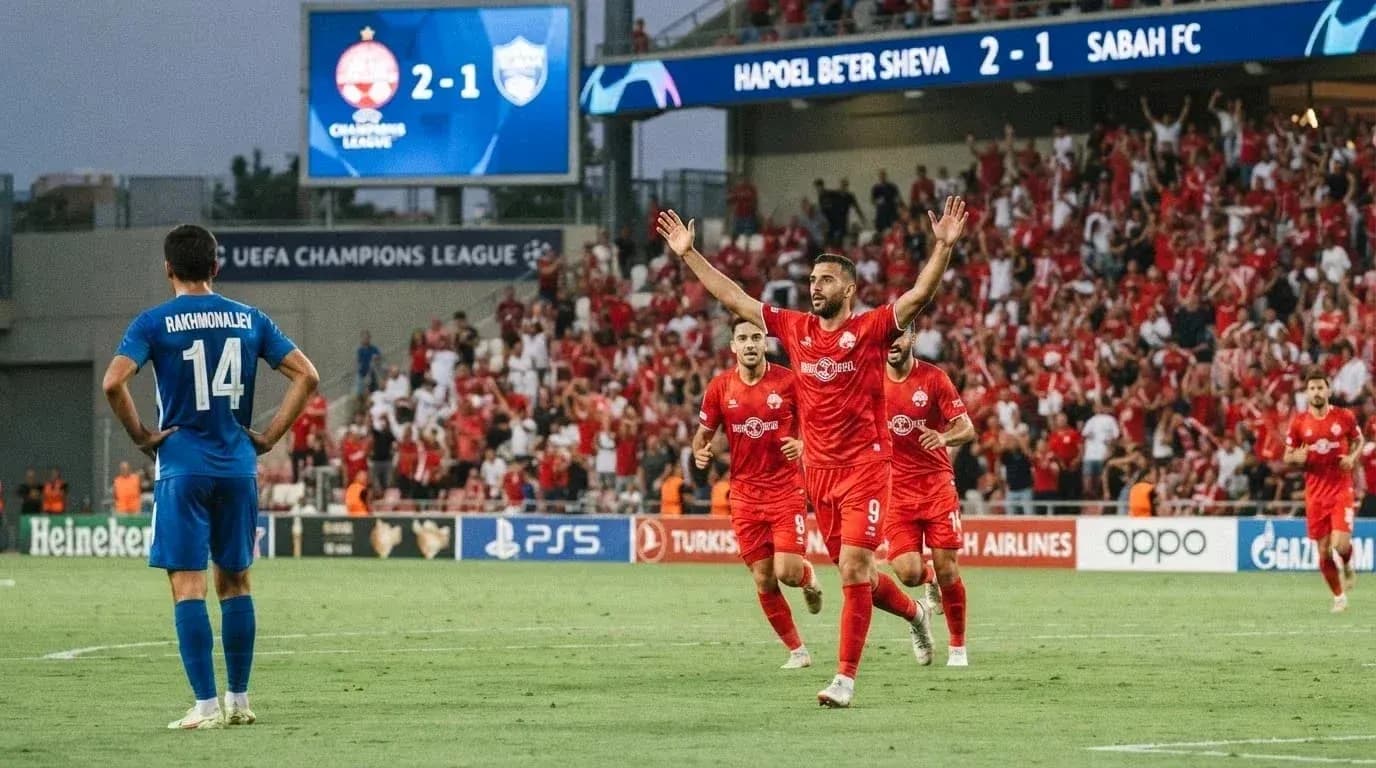
The only previous meeting between these sides came in the first leg of this Play-offs tie on 19 August 2026 at the Superbet Arena - Giulesti in Bucharest, where Hapoel Beer Sheva, as the home team, beat Sabah FA 2-1. The half-time score was 1-1 before Hapoel Beer Sheva edged the second half to take a narrow aggregate lead into this return match in Baku.
Global Season Picture
- League Phase Performance: There is no group-stage standings data available yet for either Sabah FA or Hapoel Beer Sheva in the 2026 UEFA Champions League, underlining that both are still in the qualifying Play-offs phase and playing to secure their place in the main group stage.
- Season Metrics: In the league phase of this Champions League campaign so far, Sabah FA have played 7 matches, winning 5 and losing 2, scoring 13 goals and conceding 5. They average 1.9 goals scored per match and 0.7 conceded, with 4 clean sheets and no games without scoring, indicating a consistently productive attack and generally solid defence. At home they have been dominant: 3 home matches, all wins, with 7 goals scored and none conceded, averaging 2.3 goals for and 0.0 against. Hapoel Beer Sheva have played 5 matches, winning 4 and losing 1, with 8 goals scored and 3 conceded, averaging 1.6 scored and 0.6 conceded per match, plus 3 clean sheets and no games without scoring. At home they have 3 wins from 3, scoring 5 and conceding 1; away they have 1 win and 1 loss, scoring 3 and conceding 2. Both sides have shown strong defensive structures and reliable attacking output, with Sabah slightly more explosive at home and Hapoel Beer Sheva slightly more controlled overall. Disciplinary profiles show Sabah FA picking up yellow cards fairly evenly across both halves and a late red once in added time, while Hapoel Beer Sheva tend to accumulate most of their yellow cards between minutes 46 and 90 and have had one red card just after half-time, suggesting both teams play on the edge in high-intensity periods.
- Form Trajectory: Sabah FA’s form line of WWWWLWL across this Champions League campaign reflects a very strong start with four straight wins, followed by a loss, another win, and then a defeat, indicating a recent dip in consistency just as the stakes have risen. Hapoel Beer Sheva’s form string LWWWW shows an initial setback followed by four consecutive victories, pointing to an upward trajectory in performance and confidence heading into this decisive second leg.
Tactical Efficiency
Across this Champions League run, Sabah FA’s attacking efficiency is underlined by 13 goals in 7 matches, with an especially potent home output of 7 goals in 3 games and no failures to score, suggesting a front line that benefits significantly from home conditions and an aggressive approach. Defensively, conceding only 5 goals in 7 matches, and none at home, highlights a compact structure that has so far protected their own stadium effectively, backed by 4 clean sheets overall. Hapoel Beer Sheva’s attack has been slightly more measured but still effective, with 8 goals in 5 matches and a similar 1.6 goals per game to Sabah’s overall average, while their defence has been marginally tighter in away contexts than Sabah’s away record, conceding 3 goals in total and averaging 0.6 per match. Both teams have shown tactical discipline, with Sabah’s use of 4-2-3-1 in most matches pointing to a balance between central stability and attacking width, while Hapoel Beer Sheva’s consistent 4-3-3 signals a structured pressing and wide-oriented attack. In this second leg, Sabah’s need to overturn a 2-1 deficit should push them to lean into their high home scoring rate, but they must maintain their usual defensive control to avoid conceding an away goal that would significantly increase the required margin. Hapoel Beer Sheva, with their recent winning streak and proven ability to edge tight matches like the first leg, are likely to prioritise compactness and transitional attacks, trusting their defensive efficiency and clean-sheet record to manage the aggregate advantage.
The Verdict: Seasonal Impact
The outcome of this second leg will heavily shape both clubs’ 2026 campaigns. For Sabah FA, overturning the 2-1 first-leg deficit and reaching the Champions League group stage would validate their strong home form, elevate the club’s profile, and secure a major financial boost that could accelerate long-term squad building; failure to progress, despite their impressive underlying metrics and fortress-like home record, would represent a missed opportunity and might force a recalibration towards domestic objectives and future European qualification. For Hapoel Beer Sheva, converting their narrow first-leg advantage and strong recent form into group-stage qualification would reinforce their status as a growing force in European competition, provide a stable platform for squad retention and reinforcement, and keep them on an upward competitive trajectory. Conversely, elimination at this stage, after four straight wins and a home victory in the first leg, would feel like a significant setback, turning the focus to how well they can channel the disappointment into domestic dominance and another push for Europe in the following year. In strategic terms, this Play-offs tie functions as a binary fork in the season: group-stage qualification opens a multi-month European narrative and revenue stream, while defeat compresses ambitions back into domestic fronts and reshapes how both clubs will measure success in 2026.