
Ruben Amorim Reflects on Manchester United Failures and Milan's Future
Ruben Amorim doesn’t flinch when the subject turns to Manchester United. He doesn’t reach for excuses, or point at the chaos behind the scenes. He goes straight to the point.
“I made a lot of mistakes.”
For a coach once hailed as one of Europe’s sharpest young minds, the numbers at Old Trafford were brutal. The worst win ratio of any United manager in history – 32 per cent in the Premier League. The highest goals conceded per game, 1.53. The lowest clean-sheet rate, 15 per cent. The statistics read like a charge sheet from a club that never truly felt like his.
United sacked Amorim in January, cutting short a turbulent spell that had soured long before the final decision. Tensions with the board spilled into public view after a match at Elland Road, when he appeared to challenge the club’s hierarchy in front of the cameras and suggested others should focus on their own jobs. For a club obsessed with optics, that was a line crossed.
The end felt inevitable. The fallout, costly. United were left with a compensation bill of £15.9million to cover Amorim and his backroom staff – Carlos Fernandes, Adelio Candido, Emanuel Ferro and Jorge Vital. Only when AC Milan moved for him did that figure ease, a financial coda to a footballing experiment that had gone badly wrong.
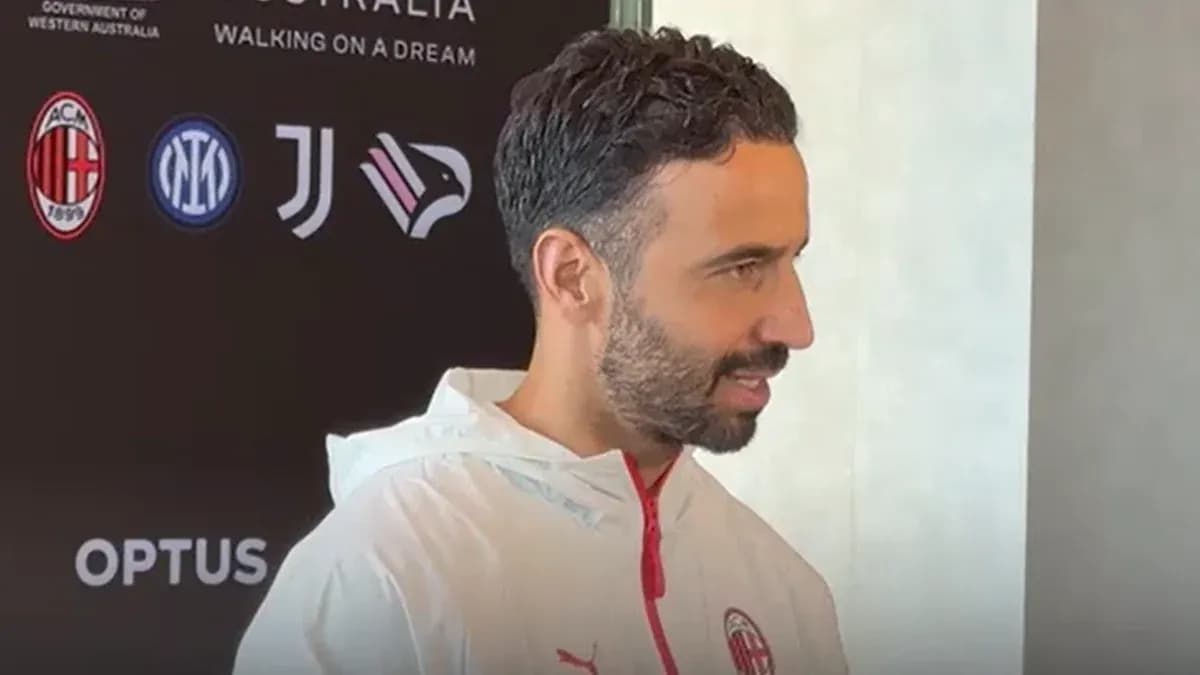
And yet, in Melbourne on Milan’s pre-season tour of Australia, Amorim spoke about that failure with a clarity that many managers never reach.
‘Not just my success, but my failures’
Milan, he insists, knew exactly what they were getting.
“They appointed me because they felt I was the right guy for the way I want to play,” he told Sky Italia. “They want to play the same way, but I think they signed me not just for my success, but also for my experience with a top club like Manchester United and the reflections I shared in our meetings with Mr Cardinale.”
Those meetings with owner Gerry Cardinale were not just about trophies and tactics. They were about scars.
“They understood that I was prepared for this job, not just because of my past success, but also because of my failures. I think it helped a lot in those meetings.”
The word hangs there: failures. Many managers would dress it up. Amorim doesn’t. Asked what went wrong at United, he refuses to rewrite history, but he does reframe it.
“The first thing is that it doesn’t matter anymore. That is the feeling. There’s a history, then something happens, the context changes, and you focus on the next challenge.
“I learned a lot. It would be hard to point to one thing, but the important thing that I clearly know is that I made a lot of mistakes. When you do this kind of reflection, and you understand that it was not just their fault, but also my fault, I think you can be a better coach and a better man.”
That line tells you more about where he is now than any statistic from his time in Manchester.
From Old Trafford scars to San Siro dreams
Amorim doesn’t hide the pride he felt walking out at Old Trafford.
“I was really honoured to be the manager of Man United at the time,” he says. The emphasis, though, is firmly on “at the time”. That chapter is closed. The new one is painted red and black.
“Now I’m at Milan. I spoke with some people at the club, like Massaro and Baresi and we exchanged messages. That is the most important thing. To understand what kind of club I am and what the history of the club is.”
If United was a superclub he had to learn on the fly, Milan is a world he has known since childhood.
“For me, it was easier this time, because I’ve been a Milan fan since I was a boy. I understand the culture of the club and their history.”
That connection matters. At United, he walked into a club still wrestling with its identity, weighed down by the shadow of past eras and constant noise around ownership and direction. At Milan, he steps into a structure he describes as “fantastic”, with a staff and organisation already aligned.
“We have many things in a good place. The staff is in a good place; the organisation is fantastic.”
He talks about Milan not as a finished product, but as a project on the brink of something.
“They chose me for a reason, and one of the reasons is that I like to look at teams that are struggling. I know it’s tough, but we want to rebuild something.”
That word again: rebuild. At United, the rebuild never quite started. At Milan, it is the job description.
A coach shaped by failure
Strip away the numbers and the headlines, and Amorim’s United stint becomes something else: an education. A harsh one, but an education all the same.
He speaks now like a coach who has been through the fire and come out with fewer illusions. The experience at Old Trafford didn’t just bruise his reputation; it sharpened his self-awareness. He no longer talks about projects in abstract terms. He talks about context, culture, history – and his own responsibility when things go wrong.
“That is the past. Our goal is to be the new future,” he says of Milan.
There is no attempt to airbrush what happened in England. No need to. The failure has become part of his pitch.
If Milan is indeed, as he hints, the job he dreamed of as a boy, then the stakes are obvious. This is not a stepping stone. It feels like a destination.
“If this is my final destination, I’ll be pleased because it’s a dream to coach this club.”
From Manchester to Milan, from mistakes to another giant in need of direction, Amorim has his second shot at the elite. The question now is simple: are those Old Trafford scars the making of the coach Milan believe they’ve hired – or the warning sign of what comes next?



