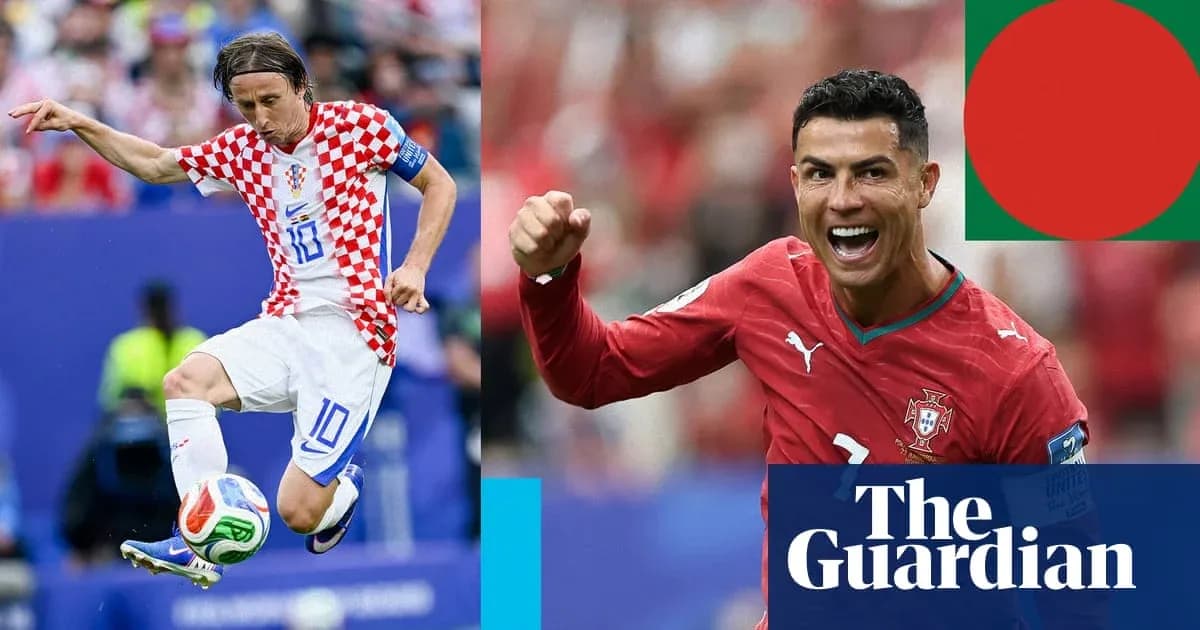
Ronaldo and Modric: A Legacy of Longevity in Football
Can you remember what you were doing on 1 March 2006?
You might have been at Anfield, watching England edge Uruguay 2-1. You might have seen Switzerland put three past Scotland at Hampden Park. Or you might have been tuned into a game in Basel that, in hindsight, felt like a hinge in modern football: Luka Modric making his Croatia debut in a 3-2 win over Argentina, Lionel Messi scoring his first international goal.
On the same night, Cristiano Ronaldo struck twice in a 3-0 Portugal win over Saudi Arabia, a 21-year-old winger already imagining how far his career might take him. He could hardly have guessed it would one day lead him to live and work in that same country.
Messi and Ronaldo have dominated the conversation ever since, their rivalry stretching across leagues, continents and generations. In the background, less noisy but no less enduring, Modric has been there too. Not with the same avalanche of goals or viral moments, but with a quieter kind of authority: the metronome, the organiser, the man who passes more often than he scores and yet never seems far from the centre of the story.
Together, they belong to an almost impossibly small club. Only four men in history have reached 200 international caps. Ronaldo and Modric are two of them. The identity of the other is a good quiz question; the scale of the achievement is not up for debate.
Now, at 41 and 40 respectively, Ronaldo and Modric stand on the brink of their 232nd and 202nd appearances for Portugal and Croatia as they meet in the last 32 of the World Cup. It may be the final time these giants of the 21st century share a pitch, their careers once again intersecting on the biggest stage.
Their loyalty to their national teams demands respect. When Modric first pulled on the Croatia shirt in 2006, Ronaldo already had 29 caps. Two decades on, that gap has grown by only one. Year after year, tournament after tournament, both have turned up. No strategic retirements, no long sabbaticals. Just an almost stubborn refusal to say no when their countries called.
On-Field Story
Their on‑field story together began in England in 2008‑09. Modric at Tottenham, Ronaldo at Manchester United, both playing the full 120 minutes of the Carling Cup final. United won it on penalties. It was a snapshot of what would follow: Modric probing between the lines, Ronaldo driving at defenders, both given identical player ratings but living very different roles.
They crossed paths again in the 2010‑11 Champions League quarter‑finals, by which time Ronaldo had swapped Manchester for Madrid. Real Madrid went through, as they so often did in the six seasons the pair would eventually share a dressing room at the Bernabéu.
Those years in white defined an era. With Modric knitting together midfield and Ronaldo finishing moves with ruthless regularity, Madrid won the Champions League four times and reached the semi‑finals in the other two campaigns. It was dominance built on many things – coaching, recruitment, depth – but the understanding between the playmaker and the finisher sat at the heart of it.
If there was a single image that captured their partnership, it came in Cardiff in 2017. Juventus were pushing, the final still alive, the tension rising. Modric found space on the right, slipped to the byline and cut the ball back. Ronaldo arrived, as he so often did, at exactly the right moment to make it 3-1 to Madrid. A simple finish, a devastating goal, the product of a relationship honed over hundreds of games.
That was one of 222 matches they shared a pitch. No central midfielder has played alongside Ronaldo more often than Modric. The number tells its own story: of trust, of tactical compatibility, of two very different footballing personalities finding a shared language.
Now they meet again, older, slower, but still carrying the weight of nations and the echo of all those nights in club colours. One chases yet another deep run with Portugal, the other tries to stretch Croatia’s golden era a little further.
They have spent almost two decades defining what longevity at the top looks like. The question now is how many more nights like this they have left.