
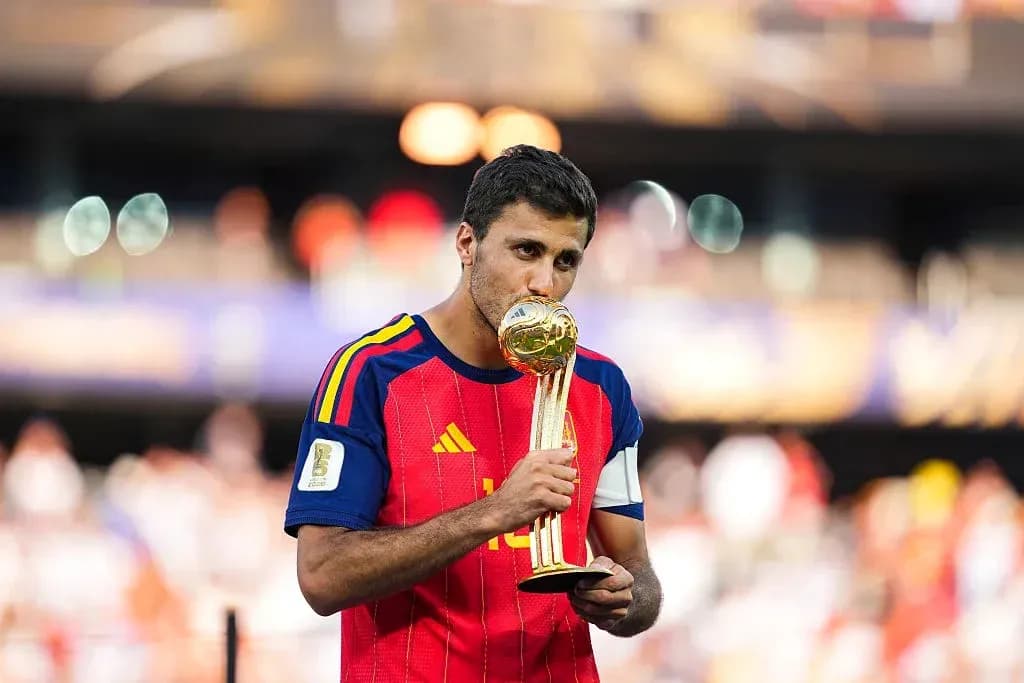
Rodri's Journey from Injury to World Cup Glory
Rodri stood in the mixed zone with a World Cup medal around his neck and the Golden Ball under his arm, but his mind was somewhere else entirely – back in September 2024, on a treatment table, wondering how long his knee would hold him back.
On Sunday, he was the heartbeat of a Spain side that outlasted Argentina 1-0 in extra time to become world champions. The tournament’s best player, officially and unmistakably. The metronome who dictated a final, and a month, on his own terms.
Yet when the cameras closed in after the final whistle, Rodri’s thoughts turned not to the trophy, but to the journey.
“We're a bit shocked right now, even myself,” he told Fox Sports, still trying to process the scale of it all. “I cannot express with words. I think now we're like in a cloud but, for me, it's been a very tough time.”
The tough time began with that serious knee injury last September, a blow that stalled his momentum and repeatedly tested his resolve. Setback followed setback. Fitness became a daily negotiation rather than a given. Every training session came with a question mark.
Rodri turned that uncertainty into fuel.
He spoke not like a man basking in glory, but like someone offering a manual for survival to the next generation.
“I just want the new generations to see my example as an opportunity. When you go down, you can rise again. This is my philosophy for my entire life.
“Of course, sometimes things go well, things go wrong, but always the positiveness.”
Spain’s triumph in the final reflected that mindset. They did not shrink in the face of Argentina’s pedigree or the occasion. They went after it.
“I said to the lads before the game, ‘we have to go for the game.’ We need to face them, we have to look to their eyes. We want this game.”
That line summed up Spain’s approach. No retreat. No deference. A team led by a midfielder who refused to let injury define his ceiling, now refusing to let an opponent dictate the script.
“And then life gives you the World Cup or not,” Rodri added, “but we were brave and I was brave in that moment I was down, so I want to thank all the people that helped me.
“But I want to thank myself, to be honest, in those moments.”
It was a rare, raw admission, stripped of cliché. In a sport that often hides vulnerability behind platitudes, Rodri laid out the reality: recovery is lonely, and resilience is built in silence long before the fireworks and confetti.
On this night, under the lights and with the world watching, that private battle ended with a World Cup in his hands and a message aimed squarely at those who will come after him: when everything buckles, what do you do next?



