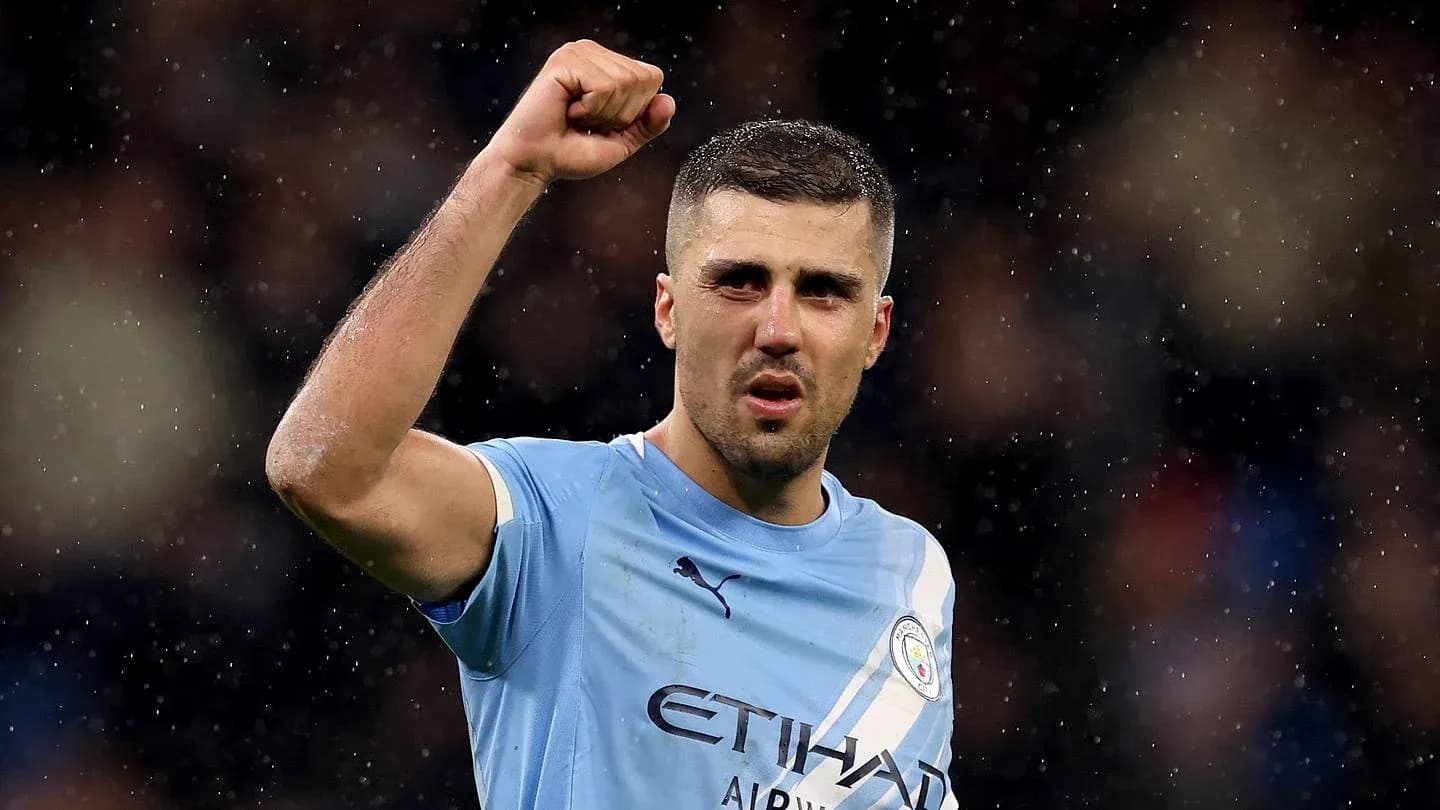
Real Madrid Targets Rodri as Pérez Breaks Transfer Norms
Real Madrid have moved from observers to aggressors in the Rodri saga. The European giants have opened direct talks with Manchester City over a deal for the Spain captain, who suddenly sits at the top of their midfield wish list.
This is not a tentative enquiry. Club-to-club conversations are underway, with president Florentino Pérez giving the green light and Madrid ready to put more than €50 million ($57 million) on the table for a player who has just a year left on his contract in England.
It marks a sharp turn in a summer that has already ripped up the old script at the Bernabéu.
Mourinho’s Madrid Needs a Metronome
Pérez secured re-election in early June, then wasted no time in detonating the first bombshell: José Mourinho back in the Madrid dugout, charged with dragging the club out of a period of drift.
The transfer market has reflected that urgency. Marc Cucurella, Bernardo Silva, Ibrahima Konaté and Denzel Dumfries have all arrived, with RB Leipzig prodigy Yan Diomande set to follow for a fee north of $100 million. It is a heavy, decisive spend.
Yet one obvious hole remained. Since Toni Kroos walked away in 2024, Madrid have lacked a true deep-lying controller. The team has been packed with energy and talent, but no one to dictate the tempo from the base of midfield in the way elite Champions League sides now demand.
Rodri fits that brief perfectly. Madrid-born, tactically immaculate, and arguably the outstanding holding midfielder of his generation.
Not long ago, that didn’t seem to matter.
From Election Symbol to Primary Target
For much of the summer, Rodri’s name was more political slogan than realistic objective in Madrid.
The 30-year-old featured heavily in the campaign of Pérez’s rival, Enrique Riquelme. The renewable energy magnate went so far as to promise members their fees back if he failed to deliver both Rodri and Erling Haaland from Manchester City. It was audacious, headline-grabbing stuff.
Pérez, by contrast, kept his distance. Reports painted him as firmly against a move for Rodri, wary of being seen to follow his opponent’s manifesto and traditionally reluctant to invest in older, more defensive-minded players—especially those tied so closely to a rival’s pitch.
On paper, the logic was hard to fault. On the pitch, the logic never really held.
Rodri is not just another holding midfielder. He is a World Cup-winning captain, a 2024 Ballon d’Or winner, and the kind of all-weather organiser Madrid have lacked since Kroos’s departure. His skill set answers a specific tactical need; his birthplace adds a layer of emotional resonance.
Still, the president resisted. Then came the World Cup.
World Cup Golden Ball and a Familiar Madrid Weakness
In North America, Rodri didn’t just lead Spain to the 2026 World Cup. He dominated it. The midfielder broke passing records and walked away with the tournament’s Golden Ball, reaffirming his status as the best in the world in his role.
Madrid have always been susceptible to World Cup stardust. This time is no different.
In the space of a few weeks, the internal mood shifted. Reports in the last week indicate Pérez is now fully open to a deal. Verbal discussions with City are underway, the initial reluctance replaced by a pragmatic realisation: there is no obvious alternative on the market who combines Rodri’s pedigree, availability and tactical fit.
The pressure of squad construction has done what politics could not. It has changed Pérez’s mind.
Can €50 Million Really Move Manchester City?
On the face of it, Madrid’s position is strong. Rodri has only one year left on his contract. Pep Guardiola is stepping away from Manchester City this summer. The spine of a great era is starting to loosen.
If Rodri refuses the extension currently on the table, City’s leverage drops fast. They have this window and January to secure a fee before the risk of losing him for nothing becomes real.
Madrid know this. Their opening stance—around €50 million—is significantly less than what they are paying for Diomande, and below what City have already spent this summer on new midfield option Elliot Anderson. It is also a fraction of what Rodri would cost with three or four years left on his deal.
Yet this is no bargain-bin negotiation. City are parting with the man widely regarded as the best in his position. Even with the contract ticking down, they will resist any sense of being strong-armed.
Age and health tilt the scales slightly towards Madrid. Rodri is now beyond 30 and will miss the start of next season after back surgery on a persistent problem. Despite playing every game for Spain at the World Cup, he sat out 24 matches for City across the 2025–26 campaign with various injuries. Any buying club must factor in both his brilliance and his mileage.
Still, this is not a normal player. This is the anchor of a treble-winning side and the heartbeat of Spain’s new world champions.
The Pull of the Bernabéu
Rodri has never hidden his admiration for Madrid. Speaking to Cadena SER in 2024, he described a call from Real Madrid—“the best club in history, the most successful”—as an honour that demands attention.
That sentiment now meets a rare alignment of circumstances: a contract running down, a managerial era ending at City, a new regime at the Bernabéu desperate for control in midfield, and a president suddenly willing to cross his own red lines.
Mourinho’s Madrid already looks harder, more combative, more direct. With Rodri at the base, it could also become something else: a team that dominates not just with emotion and individual brilliance, but with a cold, relentless grip on the rhythm of games.
For City, the choice is stark. Cash in now on a fading contract and an increasingly injury-managed star, or gamble on persuasion and risk losing him for nothing.
For Madrid, the calculation is simpler. If you believe you are one midfield general away from reshaping the team’s identity, how long can you afford to wait?