Real Madrid vs Oviedo: A Clash of Extremes in La Liga
Under the lights of the Estadio Santiago Bernabéu, this was a meeting of extremes in La Liga’s Regular Season - 36: second-placed Real Madrid, already shaped by a season of relentless attacking, against bottom side Oviedo, fighting against gravity. The 2–0 full-time scoreline felt like the natural conclusion of a broader structural mismatch rather than a single-night surprise.
Heading into this game, the table framed the narrative. Real Madrid sat 2nd on 80 points, with a towering overall goal difference of 39, built on 72 goals scored and 33 conceded across 36 matches. At home they had been ruthless: 15 wins from 18, just 1 draw and 2 defeats, with 41 goals for and only 14 against. Oviedo, by contrast, arrived in Madrid in 20th place with 29 points and a goal difference of -30, their 26 goals for and 56 conceded underlining a season of constant strain. On their travels, Oviedo had lost 12 of 18, conceding 39 times and scoring 17.
I. The Big Picture – Structures and Intent
Alvaro Arbeloa leaned into Real Madrid’s dominant seasonal DNA by rolling out a 4-4-2 that was more about fluidity than rigidity. T. Courtois anchored the side behind a back four of T. Alexander-Arnold, R. Asencio, D. Alaba and A. Carreras. In front, a midfield line of F. Mastantuono, E. Camavinga, A. Tchouameni and B. Diaz offered a blend of control and incision, while G. Garcia and Vinicius Junior formed a front two designed to stretch and destabilise.
This shape dovetailed perfectly with their season-long attacking profile. Overall, Real Madrid averaged 2.0 goals per game, rising to 2.3 at home. Their goals-for minute distribution revealed a late-game surge: 26.03% of their goals had come between 76-90 minutes, with another 20.55% between 31-45 and 19.18% between 46-60. This is a side that builds pressure and then overwhelms.
Oviedo’s Guillermo Almada Alves Jorge shifted from their more common 4-2-3-1 to a 4-3-3, likely an attempt to compress the central lanes and counter in wide spaces. A. Escandell started in goal behind a back four of N. Vidal, E. Bailly, D. Costas and R. Alhassane. The midfield trio of N. Fonseca, S. Colombatto and A. Reina was set up to screen and disrupt, while the front three of I. Chaira, F. Vinas and T. Fernandez aimed to exploit any Madrid over-commitment.
Yet structurally, Oviedo’s season had been defined by defensive fragility, especially away. Their overall goals-against average was 1.6 per game, ballooning to 2.2 on their travels. Critically, 25.00% of their conceded goals came in the 76-90 minute window, with another 17.86% between 61-75. They are at their most vulnerable precisely when Real Madrid are at their most ruthless.
II. Tactical Voids – Absences and Discipline
Both squads came into this fixture with notable absentees that reshaped their tactical options.
For Real Madrid, D. Ceballos (coach’s decision), Eder Militao and A. Guler (both muscle injuries), D. Huijsen (lacking match fitness), A. Lunin (illness), F. Mendy (muscle injury), Rodrygo (knee injury) and F. Valverde (head injury) were all ruled out. The absence of Militao and Huijsen removed two ball-playing centre-back options, making D. Alaba’s presence even more central to build-up. Without Valverde and Guler, Madrid lost two of La Liga’s most productive midfield engines in terms of progression and chance creation, forcing Arbeloa to lean more heavily on E. Camavinga’s tempo-setting and B. Diaz’s line-breaking runs.
Oviedo were also depleted. L. Dendoncker and O. Ejaria were sidelined by injury, B. Domingues by a knee injury, while J. Lopez and K. Sibo missed out through red-card suspensions. Those red cards fit an established disciplinary pattern: Oviedo’s season red-card distribution shows 40.00% of their dismissals between 76-90 minutes and 20.00% between 91-105, pointing to a side that often loses emotional control late in games. Their yellow-card curve is similarly back-loaded, with 23.38% between 61-75 and 16.88% between 76-90.
Real Madrid, by contrast, have carried their aggression with more control. Their yellow cards cluster between 31-45 (19.12%) and 61-75 (22.06%), but their red cards, while present, are spread more thinly, with single spikes at 31-45, 61-75 and 76-90 (each 14.29%) and a late pocket (28.57%) between 91-105 and undefined ranges. This hints at a team that can flirt with the edge but rarely tips over en masse.
III. Key Matchups – Hunter vs Shield, Engine Room
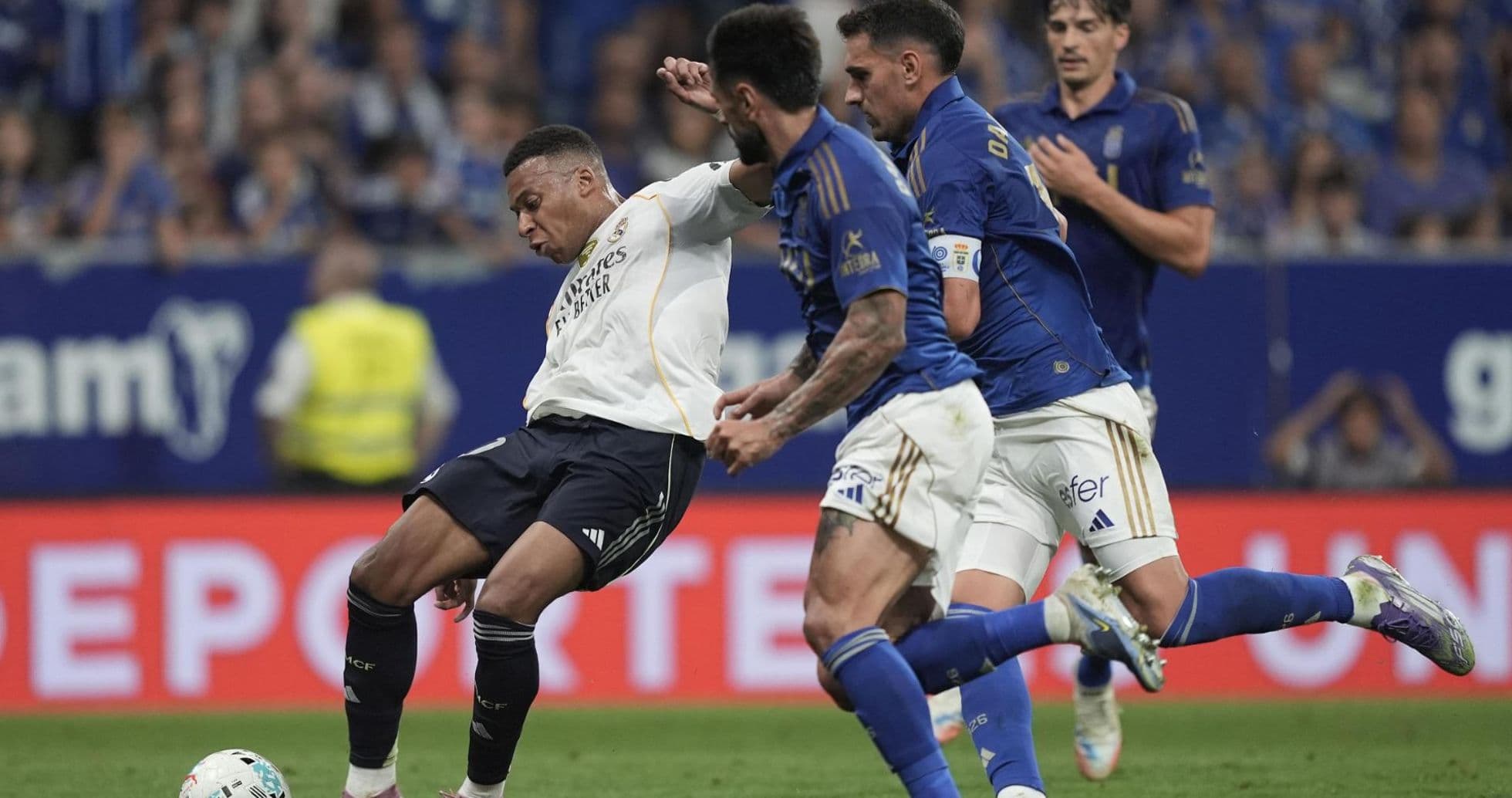
The headline duel in narrative terms was always going to involve Real Madrid’s attacking royalty. K. Mbappe, La Liga’s top scorer with 24 goals and 5 assists in 29 appearances, did not start but lurked on the bench as the ultimate escalation option. His penalty record this season is not flawless: he has scored 8 but missed 1, a reminder that even the deadliest hunter is not automatic from the spot.
Alongside him, Vinicius Junior – who did start – brought 15 league goals and 5 assists into this contest, underpinned by 190 dribble attempts and 86 successes. His capacity to receive wide and drive diagonally at E. Bailly and D. Costas was central to Madrid’s plan to destabilise Oviedo’s last line.
On the other side, Oviedo’s offensive hope rested heavily on F. Vinas. With 9 goals and 1 assist in 32 appearances, plus 484 duels contested and 254 won, he represents both their primary outlet and their first line of resistance. Yet his disciplinary profile is double-edged: 5 yellow cards, 1 yellow-red and 2 straight reds this season. Against a back line marshalled by D. Alaba and shielded by A. Tchouameni, his challenge was to occupy, irritate and yet remain on the pitch.
In midfield, the “Engine Room” battle pitted E. Camavinga and A. Tchouameni against N. Fonseca and S. Colombatto. Camavinga’s role was to recycle and accelerate, while Tchouameni anchored transitions. Oviedo’s trio needed to compress space between the lines to deny B. Diaz and F. Mastantuono the pockets they thrive in. Given Real Madrid’s season-long pattern of scoring 20.55% of their goals between 31-45 and 19.18% between 46-60, the central question was whether Oviedo’s midfield could survive the middle third of the match without being torn open.
IV. Statistical Prognosis – xG Logic and Defensive Solidity
Even without explicit xG values, the statistical scaffolding around this fixture points to a predictable balance of chances. Real Madrid’s overall scoring average of 2.0 goals per game, combined with Oviedo’s away concession rate of 2.2, suggests a pre-match expectation of Madrid generating a high volume of quality opportunities, particularly late on. Oviedo’s meagre 0.7 goals per game overall – and just 0.5 at home, 0.9 away – set a low ceiling for their attacking xG, especially against a defence conceding only 0.9 goals per game overall and 0.8 at home.
The critical intersection of time profiles is stark. Real Madrid’s 26.03% goal share in the 76-90 window meets an Oviedo defence that concedes 25.00% of its goals in the same period. Overlay that with Oviedo’s late-card tendency and the script almost writes itself: a game in which Oviedo’s resistance erodes as the minutes tick by, space opens between tired lines, and Madrid’s technical superiority tells.
Following this result, the 2–0 scoreline feels like a conservative reflection of the underlying probabilities. Real Madrid’s defensive solidity, their layered attacking threats from Vinicius Junior and the ever-present spectre of K. Mbappe, and their proven ability to dominate late phases converged on a performance that extended the story their season has been telling all along. Oviedo, meanwhile, once again found that in La Liga’s harshest arenas, structural frailties and disciplinary cracks are ruthlessly exposed.