Rangers vs Ludogorets: A Tactical Analysis
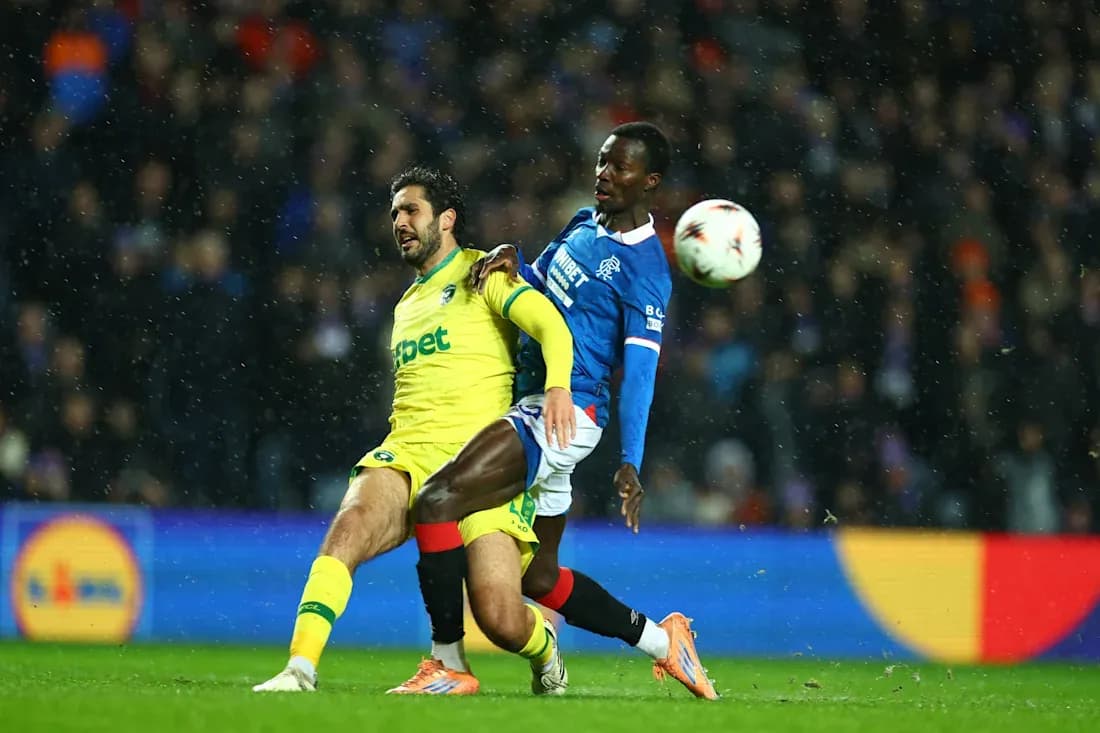
This was a remarkably balanced Europa League tie in terms of ball control, with both Rangers and Ludogorets finishing on 50% possession and almost identical passing volumes (433 vs 431 passes, both at 84% accuracy). Rather than a classic “dominant vs reactive” dynamic, the game became a territorial and rhythm battle. Rangers’ 4-3-3 aimed to impose pressure higher up the pitch, reflected in their 17 fouls and six yellow cards, suggesting an aggressive approach to stopping transitions. Ludogorets’ 4-2-3-1 looked more measured, committing 13 fouls and just one yellow card, trying to stay in the game and exploit moments rather than constantly force the issue.
Offensive Efficiency
Rangers edged the attacking metrics and translated that into the decisive margin. They produced 14 total shots to Ludogorets’ 11, with more efforts on target (7 vs 5) and more work for the visiting defence via corners (6 vs 2). The quality of Rangers’ chances was also superior: an expected goals figure of 1.56 against Ludogorets’ 0.89 indicates that the hosts consistently reached better shooting positions, supported by 10 shots inside the box compared to Ludogorets’ 6.
This points to a game plan built on sustained pressure rather than sheer volume from distance; Rangers only attempted 4 shots from outside the box, similar to Ludogorets’ 5, but created more clear openings in the penalty area. With both teams recording zero “goals prevented” and the goalkeepers making comparable numbers of saves (Rangers 5, Ludogorets 6), the difference lay less in extraordinary keeping and more in Rangers’ ability to generate one more high‑value situation and convert it. Ludogorets’ 11 shots and 0.89 xG show they were competitive but lacked the same cutting edge in central zones.
Defensive Discipline & Intensity
Defensively, Rangers accepted a high‑intensity, foul‑heavy game to protect their lead. Their 17 fouls and six yellow cards, many late in the match and including a time‑wasting caution at 90+3, underline a deliberate willingness to break up play and manage the tempo once ahead. Ludogorets, with 13 fouls and only one yellow card, were less disruptive, relying more on structure than on tactical fouling.
Both goalkeepers were involved but not overrun: Jack Butland made 5 saves, while Hendrik Bonmann registered 6. With blocked shots fairly close (4 for Rangers, 2 for Ludogorets), the hosts combined aggressive front‑foot defending with enough protection in and around the box to restrict Ludogorets to sub‑1.0 xG.
Conclusion
Ultimately, Rangers’ superior chance quality (1.56 xG, 10 shots in the box, 6 corners) and willingness to foul to protect territory outweighed Ludogorets’ more measured but less incisive 0.89 xG display. In a match of equal possession, Rangers controlled the decisive spaces and managed the game better once in front.