Rangers 1–0 Ludogorets: Diomande's Goal Secures Europa League Victory
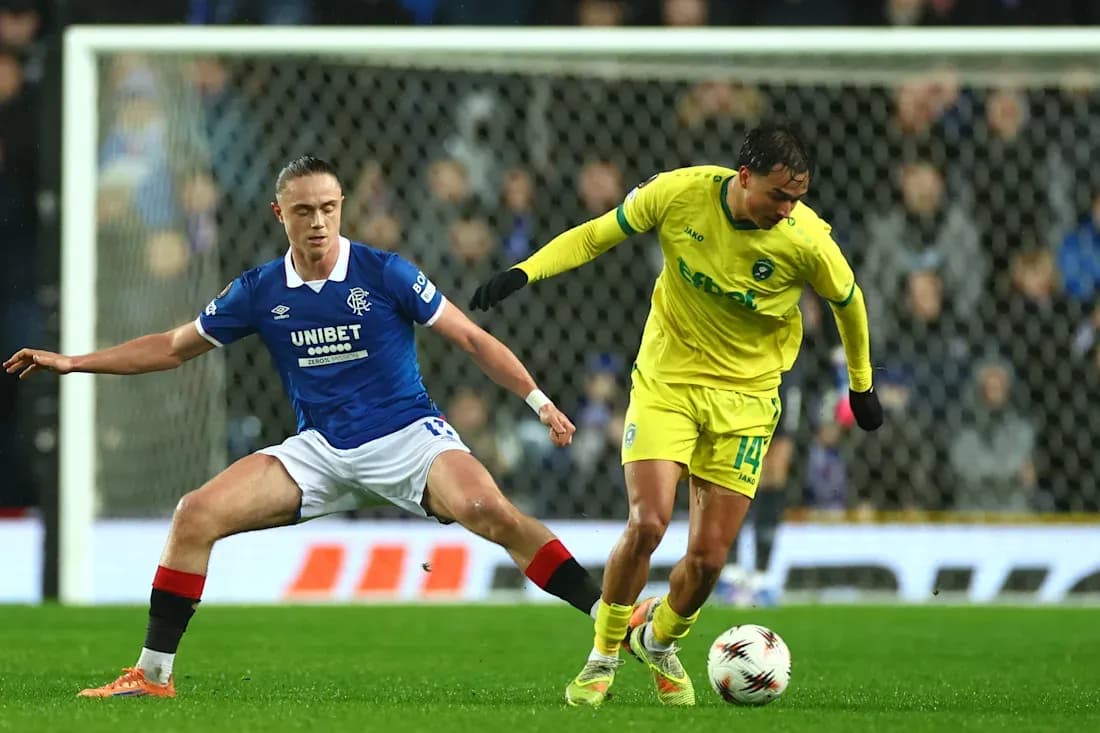
Rangers edged past Ludogorets 1–0 at Ibrox Stadium on 22 January 2026, grinding out a hard-fought UEFA Europa League league-stage victory that offers a sliver of consolation in a difficult continental campaign. Mohammed Diomande’s first-half goal proved decisive in a match where the margins were fine and the statistics almost perfectly balanced. While the result does not dramatically alter Rangers’ lowly position in the overall league table, it lifts them to four points from seven games and halts a damaging run of defeats. Ludogorets, meanwhile, miss a chance to push further clear in mid-table.
First-half analysis
The opening 45 minutes followed the pattern of two sides aware of their fragile European records, cautious but willing to commit numbers forward when opportunities arose. With neither team establishing clear territorial dominance, the contest was tight and competitive rather than expansive.
The breakthrough arrived on 33 minutes, and it was a well-worked Rangers move through the heart of Ludogorets. Mohammed Diomande struck the only goal of the game, finishing after being supplied by Thelo Aasgaard. That combination from midfield underlined Danny Rohl’s 4-3-3 structure, where the central trio were tasked with linking play to a youthful front line.
Rangers carried that 1–0 lead into the interval, matching the visitors in most aspects of play and doing enough to keep Ludogorets’ 4-2-3-1 system from creating clear scoring situations before the break. With no first-half cards or further scoring, the story of the opening period was Diomande’s clinical intervention in an otherwise even contest.
Second half & tactical shifts
The second half quickly became more fractured and ill-tempered as Rangers tried to protect their advantage and Ludogorets chased a route back into the game.
Rangers’ discipline began to fray first. Youssef Chermiti went into the book on 55' for a foul, followed by Mikey Moore’s yellow card for another foul on 61'. Those cautions hinted at a side increasingly focused on disrupting Ludogorets’ rhythm rather than extending their lead.
Ludogorets made the first tactical move on 63', with a double substitution that signalled greater attacking intent. Forward Yves Erick Bile was withdrawn for Matheus Machado, and wide midfielder Erick Marcus made way for Bernard Tekpetey. Swapping an advanced forward and an attacking midfielder for fresh offensive players suggested a push to stretch Rangers’ back four and inject pace into the final third.
Danny Rohl responded a minute later. On 64', he replaced booked forward Mikey Moore with Bojan Miovski, a like-for-like change that freshened the front line while removing a player already on a yellow. At 73', Chermiti, also cautioned, was taken off for Findlay Curtis, another pragmatic decision balancing energy with risk management.
Ludogorets continued to adjust their midfield structure on 73', replacing Pedro Naressi with Ivajlo Chochev, adding fresh legs in the engine room for the final push. The closing stages turned increasingly scrappy. Emmanuel Fernandez (81'), Max Aarons (83') and Nicolas Raskin (88') all received yellow cards for fouls as Rangers dug in to protect the narrow lead.
Stoppage time summed up the tension. At 90+3', substitute Findlay Curtis was booked for time wasting, underlining Rangers’ priority to see out the result, while Ludogorets goalkeeper Hendrik Bonmann was shown a yellow card for a foul in the same minute. Two final changes for the visitors at 90' — Son replaced by Joel Andersson and Caio Vidal by Stanislav Ivanov — offered late adjustments on the flanks but came too late to change the outcome.
Statistical deep dive
The numbers underline just how finely balanced this match was. Both sides finished with 50% of the ball, and their passing metrics were almost identical: Rangers completed 362 of 433 passes, Ludogorets 361 of 431, each with an 84% accuracy rate. Neither team truly controlled possession; instead, the game swung in short spells, with neither able to impose a sustained tempo.
In attack, Rangers were marginally more productive. They attempted 14 total shots to Ludogorets’ 11, with a 7–5 edge in shots on target. The expected goals figures back up the final scoreline: Rangers posted 1.56 xG to Ludogorets’ 0.89, suggesting the hosts carved out the better quality chances, even if they only converted once. Both goalkeepers were credited with solid work — Jack Butland making five saves and Bonmann six — reflecting a contest where both sides found routes to goal but met resistance at the final hurdle.
Discipline was a clear differentiator. Rangers committed 17 fouls to Ludogorets’ 13 and collected six yellow cards compared to just one for the visitors. The flurry of late bookings for the home side illustrates how they increasingly relied on tactical fouling and game management to preserve the lead under pressure.
Standings & implications
In the broader Europa League league-stage table, the win nudges Rangers to four points from seven matches, with a goal difference of -7 (four scored, 11 conceded) and leaves them 32nd. Their home record now reads one win, one draw and two defeats, with just two goals scored at Ibrox in the competition — underlining how rare and valuable Diomande’s strike was.
Ludogorets remain better placed overall, sitting 25th with seven points, a -4 goal difference (11 for, 15 against) and two wins from seven. However, this defeat stalls their momentum and keeps them firmly in the pack rather than pushing towards the upper reaches of the standings. For Rangers, it may be too late to transform their campaign, but this hard-earned clean-sheet victory at least restores some pride and provides a platform for improvement.