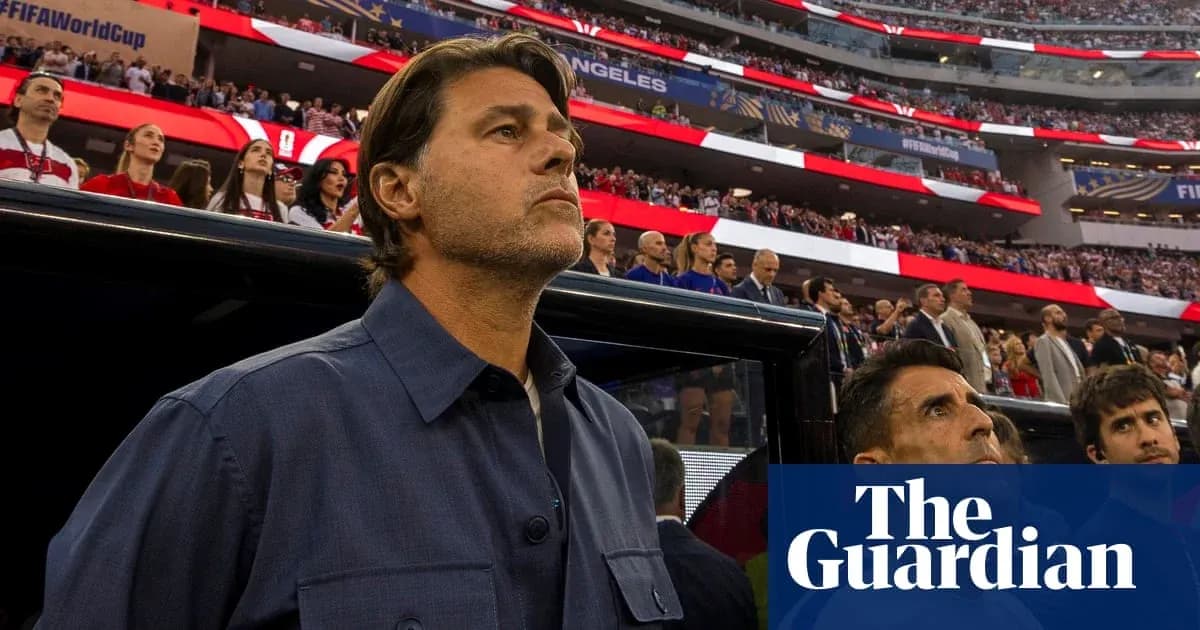
Mauricio Pochettino's Future with US Soccer Until 2030 World Cup
Mauricio Pochettino has been handed a clear message from US Soccer: this project is his to lead all the way to the 2030 World Cup, if he wants it.
Multiple sources familiar with the talks say the Argentine has been offered a contract extension that would keep him in charge of the US men’s national team for the next six years. The offer has been on the table during a three‑month stretch of negotiations, quietly running in the background while the World Cup has pushed the team into the spotlight.
These are not casual conversations. Pochettino and US Soccer CEO JT Batson have both acknowledged the talks in recent weeks, around the same time reports emerged of discussions between Pochettino and Milan. Pochettino played down that noise. Batson did not.
He admitted the federation has fielded “many inquiries” about their head coach, underlining just how quickly Pochettino’s stock has risen on the international stage. When US Soccer moved for him in the first place, Batson said, the coach already had standing offers elsewhere but chose the United States because he believed in the project.
“He’s a big believer in what we’re doing at US Soccer. He’s a big believer in soccer in America, and he’s a big believer in this men’s team,” Batson said back in May, framing the relationship as a long-term alliance rather than a short World Cup fling.
The numbers match that ambition. Publicly available figures place Pochettino among the highest-paid managers in the sport, on around $4m a year before bonuses. Performance incentives drive that figure significantly higher, a structure designed for a coach expected not just to qualify, but to compete.
Right now, he is doing exactly that.
World Cup performance changes the conversation
Pochettino’s 22-month reign has not been without turbulence. Results and performances in the buildup drew mixed reviews, and the question of whether a club man with no prior international experience would stay beyond this World Cup has hovered over the program since his appointment.
The tournament itself has cut through that debate.
The US have delivered their best-ever group stage at a World Cup under the 54-year-old. They brushed aside Australia and Paraguay to secure top spot with a game to spare, then lost a tight, bruising contest to already-eliminated Turkey that did little to dent the overall impression of a team growing into itself.
The reward is a last-32 tie against Bosnia and Herzegovina. By reaching the knockout rounds, Pochettino’s side now sit just two wins away from equalling the country’s best finish in the modern era. The stakes are clear, and so is the timing.
Pochettino has repeatedly said he will not decide on his future until after the World Cup. For now, he wants the spotlight on his players. The contract offer, though, looms over everything: a six-year runway, a home World Cup in 2026, and the promise of continuity through 2030 if he commits.
A coach weighing legacy, not just leverage
For months, fans and pundits have worked on the assumption that Pochettino would walk away once the World Cup ended, returning to the club game that made his name at Tottenham Hotspur. That narrative has started to shift.
“We told the federation we are open,” he said during a media roundtable this week. Then he drew a line. He does not want negotiations to siphon energy from the dressing room, not while the tournament still breathes.
His reasoning for potentially staying goes beyond salary or status. Pochettino has spoken about the chance to build something that lasts, to cement a connection between a still-maturing national team and a fanbase that is only beginning to understand its own scale.
“If the American people start to show passion in our sport too, why not be here being part of something that can create a legacy?” he said. For him, he added, the most important legacy is “the connection between the national team and the fans.”
That is where this story becomes bigger than one contract. US Soccer is betting that the next step in the sport’s growth in the country will be driven by continuity at the top, a clear identity on the pitch, and a coach who can command respect in every dressing room and boardroom he enters.
A federation that wants to act like a heavyweight
The federation’s recent moves back that up. The hiring of Pochettino itself signalled a shift in ambition, a willingness to pay elite money for an elite name. The opening of a $250m training facility in Atlanta, Georgia, pushed that message even further. This is an organisation trying to behave like a major power in the global game, not a peripheral participant.
Keeping Pochettino through 2030 would lock in a decade-long arc: from his appointment, through a home World Cup in 2026, to another tournament four years later with a generation of players raised entirely under his watch.
The question now is whether the man at the centre of it wants to tie himself to that vision.
For the moment, his answer is suspended in the air, somewhere between the training pitch and the knockout rounds. The contract is there. The belief is there. Bosnia and Herzegovina are next.
What Pochettino decides after that could define not just his own career path, but the shape of American soccer for years to come.