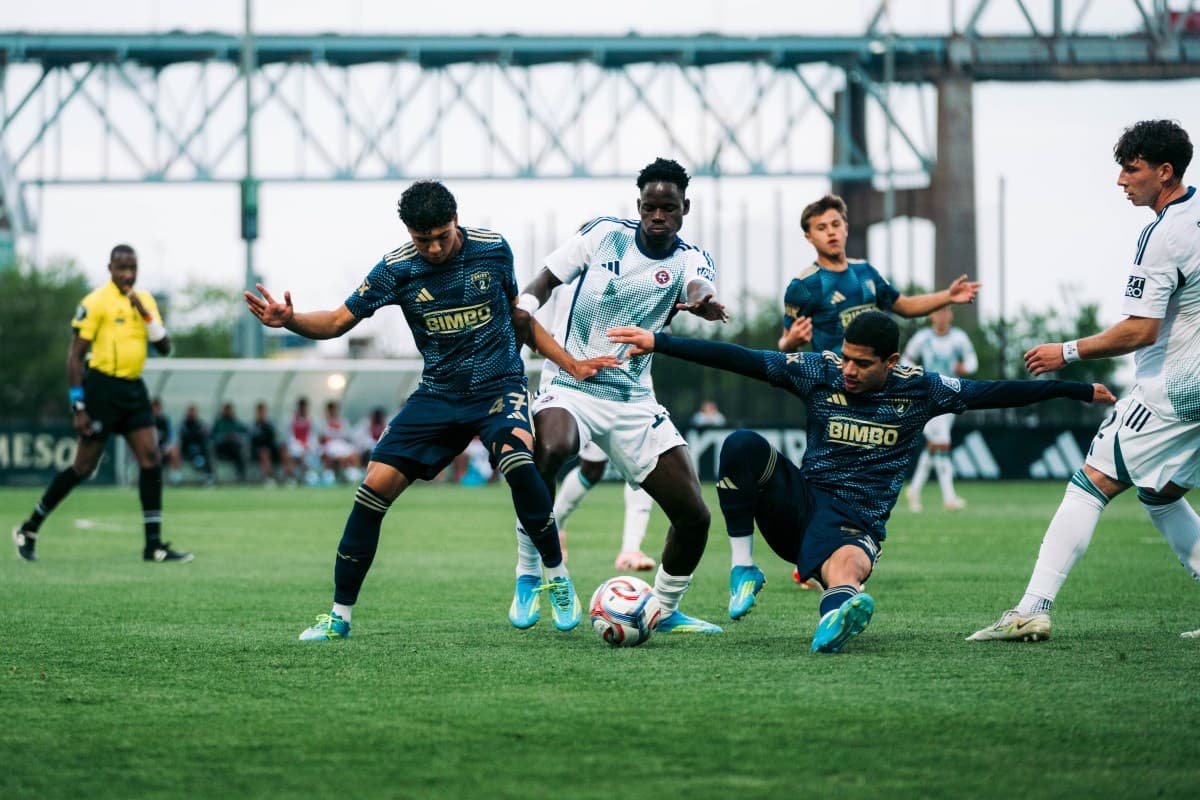
Philadelphia Union II vs New England II: A Tactical Analysis of MLS Next Pro
Subaru Park emptied under the night lights with the scoreboard locked at 0–1, a narrow defeat that told a wider story about two very different developmental machines in MLS Next Pro. Philadelphia Union II, sitting on 14 points with a total goal difference of +2 (12 scored, 10 conceded across league play, though 11–9 in the standings snapshot), ran into a New England II side whose total 17-point haul and total +4 goal difference (13 for, 9 against in the season stats; 11–8 in the standings snapshot) reflects a more ruthless edge in tight games.
This was a meeting of near-equals in the group table: Philadelphia Union II ranked 4th in one conference snapshot (and 8th in the overall promotion picture), New England II 3rd (and 5th in the wider playoff frame). Both are firmly in the promotion conversation, but they arrived with different seasonal DNA. Heading into this game, Union II were a streaky, all-or-nothing outfit: 9 total matches, 5 wins, 0 draws, 4 defeats. New England II mirrored that volatility with 6 wins and 3 losses, also without a single draw. The result at Subaru Park simply extended that pattern: one team edges the margins, the other pays for fine details.
Ryan Richter’s side has built its season on front-foot intent. At home they had played 6 matches, winning 3 and losing 3, scoring 8 and conceding 6. Their total scoring rate was remarkably balanced: 1.3 goals per game at home, 1.3 away, 1.3 overall. But the timing of those goals is revealing. Union II’s total goals-for distribution leans heavily into the first half: 33.33% of their goals come between 31–45 minutes, with another 25.00% in the 16–30 window. There is a secondary surge between 61–75 minutes (25.00%), but strikingly, they have not scored at all between 76–90 minutes in total this season.
Defensively, though, the late game has been their undoing. While they concede at a total rate of 1.0 goals per match both home and away, a full 50.00% of their total goals against arrive between 76–90 minutes, with another 25.00% between 61–75. It paints a stark picture: Union II start brightly, often dominate phases before half-time, but are vulnerable as legs tire and structure loosens in the final quarter of the match.
New England II, by contrast, are less transparent in their minute-by-minute attacking profile – the API offers no distribution – but their macro numbers are telling. At home, they average 1.8 goals per game (11 scored in 6), on their travels only 0.7 (2 in 3). Yet their total scoring average of 1.4 goals per match and total concessions of 1.0 underline a side that, even away, tends to live on small margins and defensive discipline. They had kept 3 total clean sheets heading into this match (2 at home, 1 away) and failed to score only once in total. The 0–1 at Subaru Park fits that template: an away performance built on compactness, one decisive moment, and then control of space.
Richter’s selection was youthful but familiar. P. Holbrook anchored things from the back, with G. Sequera, R. Uzcategui and A. Craig forming the core of the defensive line, J. Griffin and M. De Paula offering connective tissue into midfield. Ahead of them, K. LeBlanc, M. Berthe, W. Ferreira, S. Olivas and M. Jakupovic formed a fluid attacking band, tasked with sustaining the early pressure that the statistics say Union II thrive upon. The bench – M. White, K. Moore, O. Benitez, N. Hasan, O. Pratt, T. Reed and A. Diop – hinted at vertical pace and energy, a nod to the late-game issues that have haunted this side.
For New England II, the XI was equally developmental but more pragmatic. J. Gunn in goal sat behind a defensive spine of G. Dahlin, J. Shannon, C. Mbai Assem and G. Emerhi. In midfield and wide areas, J. Mussenden, A. Oyirwoth, J. Smith, J. Siqueira and C. Oliveira worked around the creative axis of J. Da, the number 10. The bench – M. Tibbetts, S. Sasaki, D. McIntosh, M. Morgan, S. George, S. Mimy and C. Zambrano – provided a full range of like-for-like replacements, allowing New England to protect a lead without losing structural integrity.
The disciplinary backdrop framed the duel in the “engine room”. Union II’s yellow card pattern is front-loaded: 20.00% of their total cautions come between 16–30 minutes, 16.67% between 31–45 and another 16.67% between 61–75, with a notable 13.33% even in stoppage time (91–105). They have also seen total red cards concentrated in two windows: 31–45 and 61–75, one in each (50.00% apiece of their total reds). That hints at a midfield that presses aggressively and sometimes rashly as halves approach their emotional peak.
New England II, on the other hand, accumulate yellows later. Their peak ranges are 46–60 and 76–90 minutes, each accounting for 25.00% of their total yellows, with another 20.83% between 61–75. That profile suggests a team that is comfortable absorbing pressure early, then ramps up intensity and tactical fouling as opponents chase the game. In this match, that pattern would have intersected dangerously with Union II’s late-game fragility: Philadelphia pushing, New England fouling smartly, the clock ticking in the visitors’ favour.
Without explicit xG numbers, the expected goals narrative must be inferred from structural data. Heading into this game, Union II’s total scoring and conceding averages (1.3 for, 1.0 against) describe a side whose xG profile is likely close to parity in most contests – marginal favourites at home only when they convert their early surges. New England II’s total 1.4 for and 1.0 against, combined with 3 total clean sheets and only 1 total match without scoring, indicate a team that consistently manufactures enough chances to justify narrow wins and defends with a level of control that keeps xG against modest.
The “Hunter vs Shield” dynamic, then, tilted towards New England II. Union II’s “hunter” identity is temporal – they hunt in the first half – but their “shield” is weakest exactly when New England’s game management is strongest. With New England perfect from the penalty spot in total (2 scored from 2, 100.00% conversion, no total misses), any clumsy challenge in the box would also have carried outsized risk.
Following this result, the tactical verdict is clear. Philadelphia Union II have the attacking structure and early-game patterns to trouble any opponent in MLS Next Pro, but until they solve their late-game drop-off – in both defensive concentration and attacking punch – they will remain vulnerable to the kind of controlled, one-goal away performances New England II executed at Subaru Park. New England, for their part, leave with confirmation that their compact block, disciplined card profile and reliable finishing are a sustainable blueprint for promotion-level football, even when the margins are as fine as 0–1.