Maresca Takes Charge: Navigating Life After Pep at Manchester City
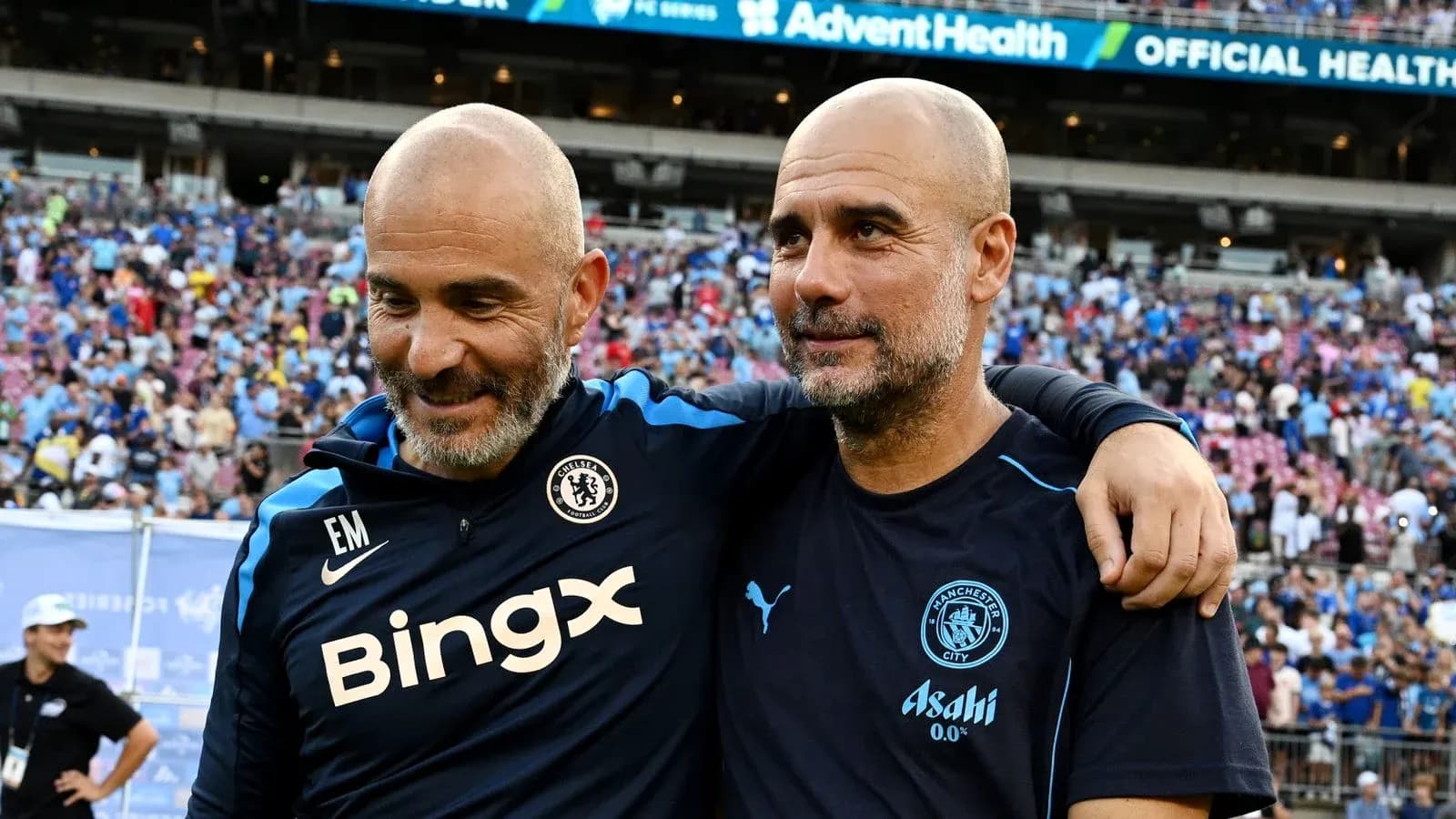
Manchester City have spent more than a decade building a club in Pep Guardiola’s image. Now they are asking Enzo Maresca to keep the machine winning without the man who designed it.
It is not a gentle assignment, whatever the contract says. But the fixture list has at least offered him a soft landing.
A kind opening – but no hiding place
Bournemouth, Crystal Palace, Coventry City. On paper, Maresca could hardly have asked for a more forgiving first three Premier League games.
It’s the sort of run that lets a new manager breathe, lay down patterns, and ease key players back after a draining summer. It also strips away excuses. Drop points there and the questions start early.
The calendar helps with one big issue: fatigue. Rodri, the metronome of City’s midfield and Spain’s near ever-present in their World Cup triumph, has pushed his body to the edge again. Those opening fixtures are winnable even without him, giving Maresca licence to phase his return and avoid a breakdown in October.
But the grace period ends fast. Within weeks, City run into Manchester United and Liverpool. Those games are never just about points. They are early verdicts on whether City remain the standard-bearers of English football or are about to be dragged back into the pack.
Maresca knows exactly what he’s walking into. He called it a “dream situation” when he signed – a squad dripping with talent and depth, a structure honed by Guardiola, a club used to competing on every front. “It provides the consistency I need to do my job effectively,” he said.
That consistency cuts both ways. The expectations are identical to those that faced Guardiola. The job security is not.
Guardiola operated on his own terms, protected by his track record and by the fact City had spent years plotting to bring him to Manchester. Maresca has a strong relationship with chairman Khaldoon Al Mubarak, but he will not be insulated in the same way if results wobble.
Same ideas, sharper edges
Stylistically, City are not ripping anything up. Maresca is not here to turn them into a low block and long ball side.
He, like Guardiola, is obsessed with the ball: dominate possession, control the tempo, press high and suffocate opponents. The differences lie in the details.
Guardiola’s City have often felt like organised chaos. Full-backs stepping into midfield, centre-backs drifting into the half-spaces, wingers tucking in to form a box around Rodri. Positions blurred. Zones shared. Roles constantly interchanging.
Maresca prefers a clearer map. His 4-2-3-1 is more defined, more traditional in shape. Wingers stay high and wide to stretch the pitch. The No 10 becomes a crucial connector, linking midfield to attack and dictating where the ball goes next.
At Chelsea, that role belonged to Cole Palmer, who thrived under Maresca’s guidance. At City, the Italian can turn to Phil Foden or Rayan Cherki if he wants to replicate that structure. Both can operate between the lines, both can receive under pressure, both can unlock a defence with a single touch.
For City’s wide players, the adjustment will be real. Under Guardiola, they have been coached to drift inside, help overload the middle, and combine in tight spaces around Rodri. Under Maresca, the message is likely to be simpler: stay wide, pin the full-back, stretch the game. The rhythm of City’s attacks will change.
How quickly the squad absorb those tweaks will decide whether the early weeks feel like a smooth evolution or a jolt.
A younger core, a new hierarchy
Behind the scenes, City have already been planning for this moment. Under sporting director Hugo Viana, the average age of the squad has dropped sharply, from 29 to just over 25 in a couple of years.
The trade-off is obvious. Fresh legs, yes. But also a leadership gap.
Kevin De Bruyne has gone. Bernardo Silva and John Stones have followed this summer. Those are not just elite players; they were voices in the dressing room, references in the biggest moments.
The spine remains formidable. Rodri and Ruben Dias carry authority. Erling Haaland has grown into more than just a goalscorer, taking on a broader responsibility as the team’s focal point and emotional barometer. Marc Guehi and Josko Gvardiol add maturity and stability at the back. Mateo Kovacic brings experience and calm in midfield.
Recruitment has been aggressive and targeted. Elliot Anderson has arrived from Nottingham Forest for a huge fee, a move aimed at future-proofing the midfield and adding physical robustness. Jeremy Monga has been taken from Leicester as another piece for the years ahead.
City still want a right-back and a winger. They are also watching Lille’s Ayyoub Bouaddi, the Morocco teenager who impressed at the World Cup, though Arsenal are tracking him too.
On the flip side, a cluster of players could go if the offers match City’s valuations: Savinho, Omar Marmoush, Nico Gonzalez, Jack Grealish, Tijjani Reijnders, Rico Lewis. With the World Cup now over, the market will move quickly. Maresca’s squad could look significantly different by the time autumn bites.
His challenge is to rebuild the leadership structure while the club reshapes the personnel. Titles are often decided not by the 11 on the pitch, but by the five or six in the dressing room who set the standards. Those voices now need to emerge under a new manager.
The first post-Guardiola blueprint
Since the Abu Dhabi takeover, City’s long-term plan has been remarkably clear. Everything pointed towards Guardiola. Facilities, staff, playing style across the age groups – all built to attract and then sustain his era.
That era is over. The question that has hovered over the Etihad for years now lands on Maresca’s desk: what is City’s identity when it isn’t simply “Guardiola’s City”?
The culture is non-negotiable. This is a club conditioned to chase silverware relentlessly. Domestic cups, league titles, European runs – anything less than competing deep into those competitions will not be tolerated for long.
Supporters turn up at the Etihad expecting two things: to be entertained and to win. Maresca’s Chelsea side struggled to balance those demands. At City, failure to do so will be judged far more harshly.
Yet the landscape around him offers a sliver of opportunity. Maresca is not the only new face in a big dugout. Andoni Iraola at Liverpool, Xabi Alonso at Chelsea, Michael Carrick at Manchester United – all are stepping into volatile, high-pressure environments with their own question marks.
The Premier League’s natural order is up for renegotiation. For a coach with clear ideas and a squad of this quality, that uncertainty is an opening. It is also a trap. This season will be sink or swim for more than one elite manager.
The shadow of 115 charges
Hovering over all of this is an issue no coach can control.
City still face 115 Premier League charges relating to alleged financial breaches. The case drags on, the timeline for a verdict unclear, the potential consequences serious. Maresca will not be judged on that in a sporting sense, but he will live with it every week in front of the cameras.
Guardiola handled that scrutiny with a mix of defiance and experience. Years at Barcelona, Bayern Munich and City had taught him how to confront, deflect or shut down lines of questioning. He knew the press pack, knew when to fight and when to smile.
Maresca’s battles at Chelsea were almost entirely about football: results, selections, style. This is different. He will be asked to front up on matters that sit above his pay grade yet shape the club’s image. How he manages that – how he protects his players from the noise while keeping his own composure – will colour his first season.
If a verdict arrives within the next 12 months, the spotlight will intensify. Titles, tactics, transfers – all of it will be viewed through the prism of that judgement.
For now, Maresca walks into a dressing room built to win and a league in flux, with a kind fixture list on paper and a storm of expectation in the air.
He has the job he always wanted. The question is whether he can make it his club, not just Pep’s old team running on borrowed time.