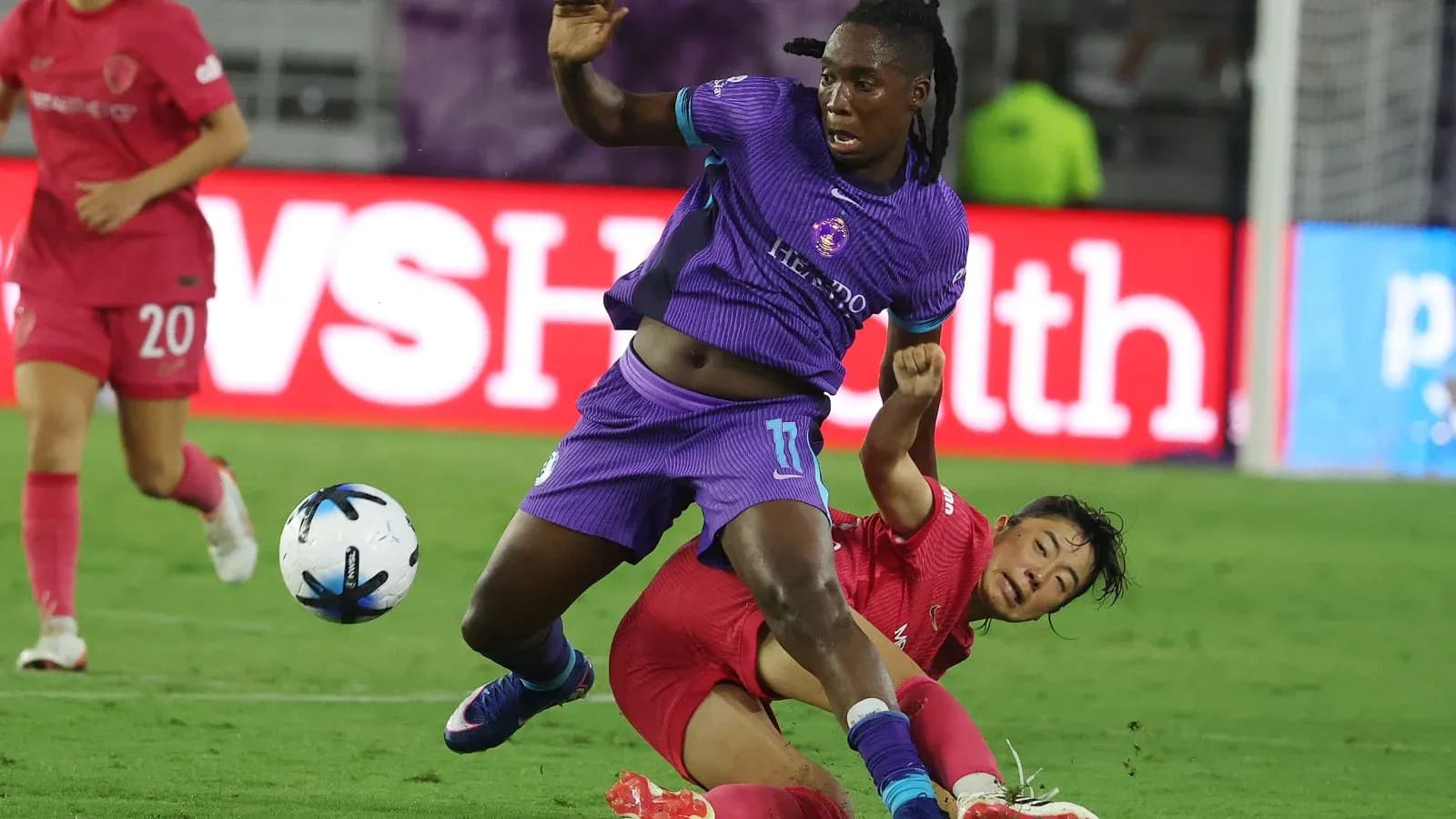
Orlando Pride W Defeats North Carolina Courage W 1–0 in NWSL Clash
Orlando Pride W edged a tight NWSL Women group-stage contest 1–0 over North Carolina Courage W at Inter&Co Stadium, leaning on late individual quality and disciplined low-block defending to overturn a possession deficit. The match stayed goalless through a fragmented, card-heavy first half, before Orlando’s substitutions and structural tweaks gradually tilted the attacking threat away from the Courage’s 4-3-3. Ultimately, Barbra Banda’s 87' strike, created by centre-back Rafaelle Souza stepping into space, decided a game where Orlando accepted less of the ball (44% possession) but maximised territory and penalty-box value against a more pass-oriented Courage side.
I. Scoring sequence & disciplinary log
The only goal arrived on 87', when Barbra Banda (Orlando Pride W) finished a late attack assisted by Rafaelle Souza, breaking a stalemate that had persisted despite North Carolina’s control of possession and shot volume.
Disciplinary incidents, in strict chronological order:
- 21' Summer Yates (Orlando Pride W) — Foul
- 45+3' Oihane Hernández (Orlando Pride W) — Unsportsmanlike conduct
- 45+5' Ally Lemos (Orlando Pride W) — Foul
- 50' Dani Weatherholt (North Carolina Courage W) — Foul
- 90+7' Rafaelle Souza (Orlando Pride W) — Foul
Substitutions followed the same chronological pattern and were central to the tactical story. At 55', Marta (IN) came on for Summer Yates (OUT), and Seven Castain (IN) came on for Solai Washington (OUT), signalling a shift toward more direct attacking profiles between the lines and in the channels. At 64', Julie Doyle (IN) replaced Ally Lemos (OUT), further refreshing Orlando’s midfield legs.
North Carolina answered on 69' with a double change: Allyson Schlegel (IN) came on for Evelyn Ijeh (OUT), and Chioma Okafor (IN) came on for Lauryn Thompson (OUT), aiming to sharpen the front three. On 77', Carly Wickenheiser (IN) replaced Riley Jackson (OUT), injecting a new midfield profile. Late on, at 84', Luana Bertolucci (IN) came on for Angelina Alonso Costantino (OUT), and at 85' Ivy Garner (IN) replaced Ashley Sanchez (OUT), as both coaches tried to tilt a tense closing phase.
II. Tactical breakdown & personnel
Orlando Pride W set up in a 4-2-3-1 under Seb Hines, with Anna Moorhouse in goal behind a back four of Oihane Hernández, Rafaelle Souza, Coriana Dyke and Hailie Mace. The double pivot of Ally Lemos and Haley Hanson was tasked with screening central zones against North Carolina’s 4-3-3, while Solai Washington, Angelina Alonso Costantino and Summer Yates supported lone forward Barbra Banda.
Without the ball, Orlando frequently dropped into a compact 4-4-1-1: the wide midfielders narrowed to protect the half-spaces, forcing North Carolina to circulate in front of the block. The Courage’s 56% possession and 425 total passes (82% accuracy) reflect their ability to build, but Orlando’s structure limited penetration. North Carolina managed 12 total shots, yet only 1 was on target, underlining how effectively Orlando shepherded play into lower-quality zones and forced rushed efforts from distance or under pressure.
Moorhouse registered just 1 save, a testament less to passivity and more to the back four’s control of the penalty area. Rafaelle Souza, in particular, played a dual role: aggressive in duels and willing to step into midfield. Her late assist for Banda came from reading a loose phase and driving forward, exploiting Courage’s advanced fullbacks and the space behind their midfield line. Even with her 90+7' yellow card for “Foul”, her performance defined Orlando’s defensive identity and transition threat.
Offensively, Orlando accepted a more direct, vertical approach. With only 328 passes (80% accuracy) and 44% possession, they prioritised early passes into Banda and the attacking midfield line. The shot profile – 9 total shots, 2 on target, 3 blocked, and 5 inside the box – shows a focus on creating fewer but more central, high-impact chances. Banda’s movement across the front line repeatedly tried to isolate centre-backs Uno Shiragaki and Natalia Staude, and the late goal was the clearest expression of that plan: a central ball progression, quick support, and a decisive finish.
Mak Lind’s North Carolina Courage W, in a 4-3-3, built through Kailen Sheridan and a back four of Ryan Williams, Uno Shiragaki, Natalia Staude and Dani Weatherholt. The midfield trio of Riley Jackson, Shinomi Koyama and Manaka Matsukubo aimed to dominate the ball, rotating to free a spare player between Orlando’s lines. Their 56% possession and superior pass count suggest success in the first two thirds, but the final-third patterns were blunted. Six of their 12 shots came inside the box, yet only one tested Moorhouse, indicating Orlando’s back line consistently got close enough to disrupt the final action.
Sheridan, like Moorhouse, recorded only 1 save, reflecting a match where both defences limited on-target danger. For North Carolina, the single yellow card (Weatherholt on 50' for “Foul”) contrasted with Orlando’s four bookings, illustrating that Orlando were more often forced into last-ditch interventions as they protected their lead and, earlier, disrupted Courage’s tempo.
The substitutions subtly shifted the game’s balance. Marta’s introduction at 55' gave Orlando a more secure outlet between the lines; her ability to receive under pressure helped Orlando advance in shorter combinations rather than purely through long balls. Seven Castain and later Julie Doyle added fresh running, enabling higher pressing in short bursts and supporting Banda in transition. North Carolina’s attacking changes increased energy but did not alter the underlying pattern: possession without sufficient incision.
III. The statistical verdict
On the raw numbers, North Carolina Courage W looked like the more proactive side: more possession (56% vs 44%), more total shots (12 vs 9), more passes (425 vs 328) and slightly better pass accuracy (82% vs 80%). Yet the key attacking efficiency metrics favoured Orlando. Both teams had only 1 shot on target, but Orlando converted theirs through Banda, while North Carolina’s lone effort was comfortably handled by Moorhouse.
Set-piece balance was close (5 corners for Orlando, 4 for North Carolina), and fouls were exactly level at 15–15. The disciplinary profile, however, was asymmetric: Orlando Pride W received 4 yellow cards (Yates, Hernández, Lemos, Rafaelle Souza) to North Carolina’s 1 (Weatherholt), reflecting Orlando’s readiness to break rhythm and accept bookings to protect their structure and, late on, their lead.
With expected goals not provided, the best proxy is shot quality and box occupation: Orlando’s 5 shots inside the area and their ability to generate the game’s decisive chance from a centre-back’s advanced run suggest a slightly higher attacking efficiency than the volume-based Courage approach. In sum, Orlando’s defensive index on the night – restricting on-target shots, winning key duels in the box, and maximising a small number of high-quality chances – outweighed North Carolina’s overall form as a possession-dominant side, justifying a narrow but tactically coherent 1–0 home win.