Olympiakos Piraeus vs NEC Nijmegen: Tactically Tight 0-0 Draw
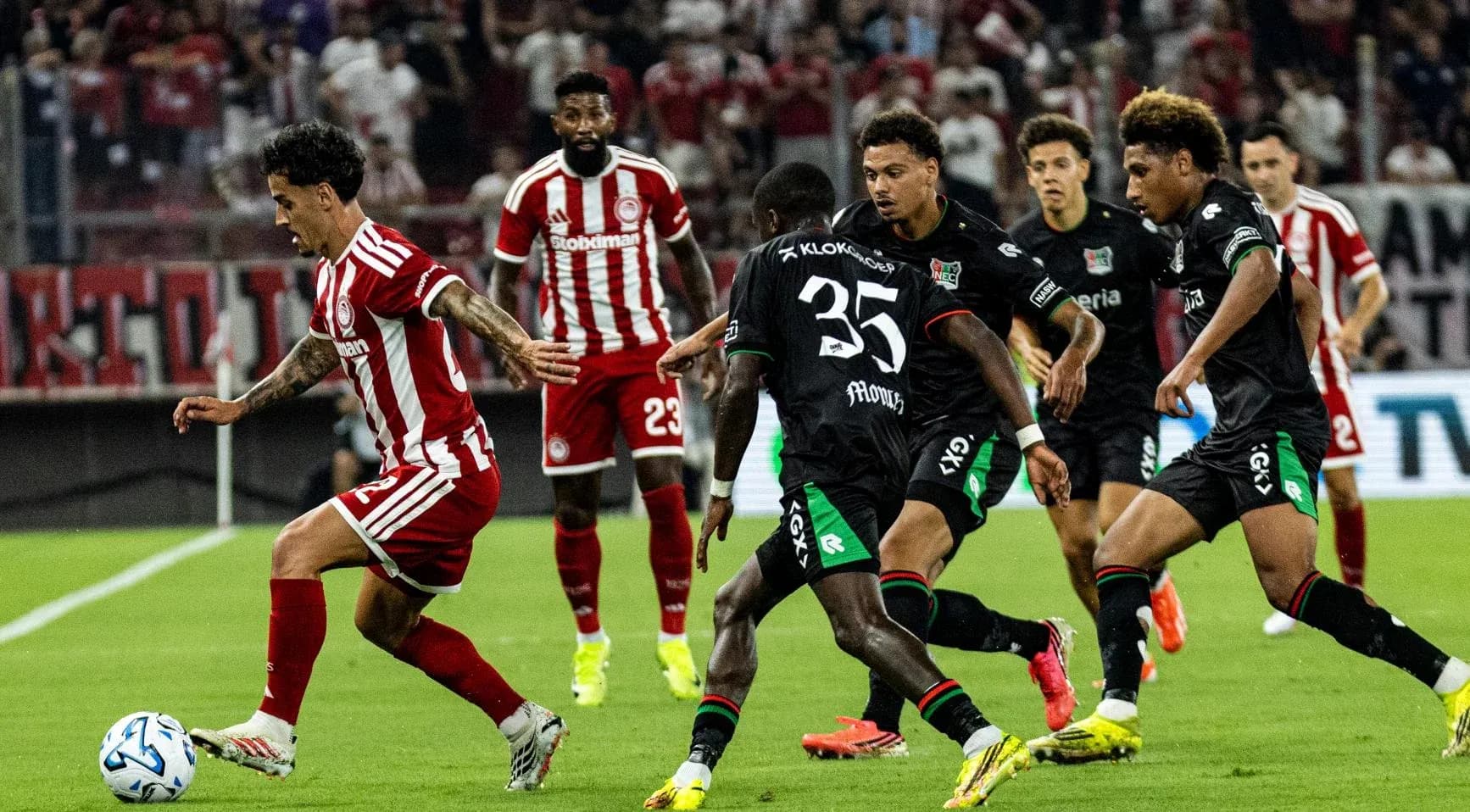
Olympiakos Piraeus and NEC Nijmegen produced a tactically tight 0-0 in the 3rd Qualifying Round of the UEFA Champions League at Georgios Karaiskakis Stadium, a match defined more by structural discipline than by penalty-box chaos. Olympiakos, in a 4-2-3-1 under Luis Mendilibar Jose, carried a slight initiative with 54% possession and the territorial edge, while Dick Schreuder’s NEC, set up in a 3-4-2-1, leaned into compactness, back-five resilience and selective counter-attacking. Both sides created enough half-chances to threaten, but the final pass and finishing detail never fully aligned.
Olympiakos’ base structure was clear: B. Popovic in goal behind a back four of M. Saliakas, P. Retsos, D. Carmo and B. Onyemaechi, screened by the double pivot of Dani García and C. Mouzakitis. Ahead, Rodinei and J. Roca flanked Chiquinho as the central creator, with A. El Kaabi as the lone striker. The 4-2-3-1 aimed to stretch NEC’s three centre-backs horizontally, using full-backs high and wide and inside movements from the wingers to pin the wing-backs. Their 394 total passes, with 264 accurate at 67%, underline a deliberate but not always incisive possession game, often recycling through the pivots rather than breaking NEC’s last line.
NEC’s 3-4-2-1, with G. Crettaz in goal behind T. Storm, P. Sandler and D. Fonville, relied heavily on the midfield four of S. Ouaissa, J. Monteiro, D. Nejasmic and C. Bischoff to compress central spaces. N. Lebreton and B. Linssen operated as support forwards off T. Chery, looking to exploit transitions when Olympiakos lost the ball high. NEC’s 348 passes (254 accurate, 73%) show a more cautious but efficient use of possession, preferring vertical punches rather than long spells of circulation.
The shot profile reflects two contrasting offensive logics. Olympiakos generated 12 total shots, with 5 on goal, 5 off target and 2 blocked. Their 5 attempts inside the box suggest they did manage to get El Kaabi and late runners into dangerous zones, but the mixture of 7 shots from outside the box indicates NEC’s block often forced them into lower-quality efforts. NEC, with 13 total shots, 4 on goal, 5 off target and 4 blocked, actually produced more volume and forced more last-ditch defending from Olympiakos’ back line. Their 7 shots inside the box highlight that the 3-4-2-1 did succeed in finding pockets between full-back and centre-back, particularly when the wing-backs advanced and the two attacking midfielders rotated centrally.
Defensively, both teams’ goalkeepers were decisive within the narrow margins available. B. Popovic (Olympiakos Piraeus) made 4 saves, a solid return that underlines NEC’s ability to test him despite having less of the ball. G. Crettaz (NEC Nijmegen) matched and slightly surpassed that impact with 5 saves, anchoring a back three that was frequently stretched by Olympiakos’ wide play and late box entries. The raw saves numbers, combined with the shots on goal (5 for Olympiakos, 4 for NEC), show that neither side allowed a barrage, but both goalkeepers had to be sharp in key moments.
Mendilibar’s in-game adjustments were aggressive and aimed at sustaining pressure. At 46', G. Martins (IN) came on for J. Roca (OUT), a clear attempt to add creativity and ball-carrying from the left half-space. On 56', Jota Silva (IN) replaced Chiquinho (OUT), while L. Pirola (IN) came in for D. Carmo (OUT), subtly reshaping the left side of defence and adding fresh attacking thrust between the lines. A minute later, at 57', P. Maffeo (IN) came on for M. Saliakas (OUT), likely to provide more overlap and crossing quality on the right. At 64', Z. Smajlovic (IN) replaced P. Retsos (OUT), leaving Olympiakos with a largely rebuilt back line and renewed physicality for the final phase. These changes underline a clear tactical intention: maintain a high tempo, keep full-backs aggressive and push NEC deeper without sacrificing defensive stability.
Schreuder’s substitutions were more about energy management and preserving structure. At 70', E. Mor (IN) replaced S. Ouaissa (OUT), adding dribbling and directness on the flank, while B. Pereira (IN) came on for T. Storm (OUT), refreshing the right side of the back three or wing-back lane. On 74', D. Tadic (IN) replaced B. Linssen (OUT) and I. Hansen-Aaroen (IN) came on for P. Sandler (OUT), tweaks that suggested a desire to maintain NEC’s pressing intensity and hold-up options while keeping the back line mobile. In stoppage time, at 90', W. T. Willumsson (IN) replaced J. Monteiro (OUT), a late injection of legs to help manage the final defensive phase and any last Olympiakos surges.
The disciplinary pattern also shaped the tactical tone. Olympiakos collected 2 yellow cards, both for “Foul”: at 11', David Carmo (Olympiakos Piraeus) — Foul, and at 67', Dani García (Olympiakos Piraeus) — Foul. NEC received 1 yellow: at 90+1', Willum Thor Willumsson (NEC Nijmegen) — Foul. Olympiakos’ earlier bookings, particularly Carmo’s, may have slightly tempered the aggression of their central defence in duels, while Dani García’s caution in midfield came at a phase when they were chasing a breakthrough. NEC’s late card for Willumsson was more about managing the final minutes under pressure.
Statistically, the match was finely balanced. Olympiakos’ 54% possession and 5 corner kicks against NEC’s 46% and 2 corners confirm their territorial edge, but NEC’s 13 total shots to Olympiakos’ 12, plus 4 blocked efforts, show that the visitors were not simply in survival mode. The offside numbers — 2 for Olympiakos, 6 for NEC — hint at NEC’s willingness to push their front three high and gamble on runs in behind, occasionally mistimed against Olympiakos’ line.
In the end, the 0-0 reflects two coherent game plans cancelling each other out. Olympiakos’ structured 4-2-3-1 produced sustained pressure but lacked the final incision, even after a series of attack-minded substitutions. NEC’s 3-4-2-1, supported by disciplined midfield work and G. Crettaz’s 5 saves, successfully absorbed that pressure while still carrying threat on the break. From a tactical standpoint, it was a chess match of structures and adjustments, with both coaches preserving their strategic integrity ahead of the return leg.