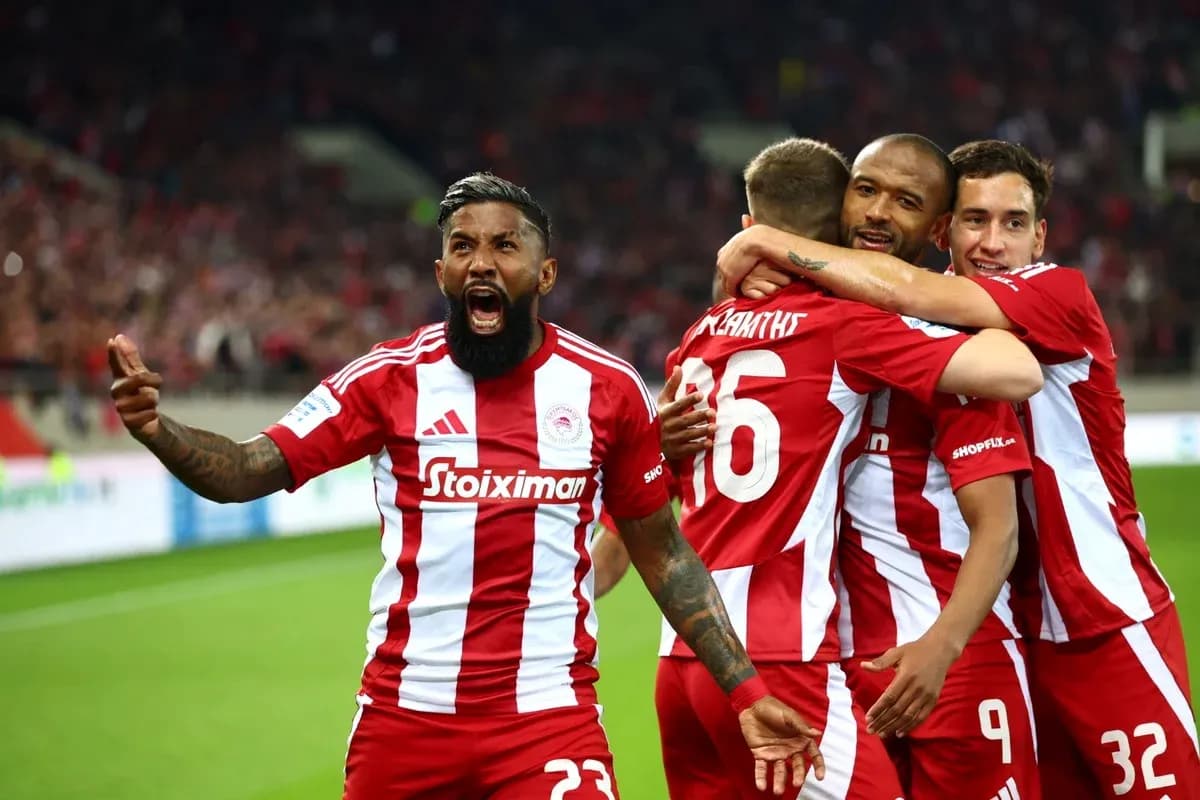
Olympiakos Piraeus vs AEK Athens: Tactical Analysis of 1-0 Defeat
Olympiakos Piraeus set up in a 4-2-3-1 that aimed to dominate territory and possession, and the raw numbers confirm they achieved that structural objective but not the attacking payoff. With 62% of the ball, 487 total passes and 75% accuracy, Luis Mendilibar Jose’s side controlled the rhythm, circulating through the double pivot of Santiago Hezze and Dani García in the first hour before Diogo Nascimento’s late introduction. Yet that volume translated into only 5 total shots, 1 on target and a very low 0.22 expected_goals, underlining a sterile form of dominance.
The positional map explains why. Olympiakos’ back four – Rodinei and Bruno Onyemaechi as full-backs, Panagiotis Retsos and Lorenzo Pirola centrally – often formed a 2+3 rest-defense shape in possession, with one full-back pushing and the opposite side holding. However, AEK Athens FC’s 4-2-2-2 mid-block, anchored by Răzvan Marin and Orbelín Pineda, effectively screened central lanes into Mehdi Taremi and Daniel Podence between the lines. The early goal at 5' from Aboubakary Koita allowed Marko Nikolic’s side to compress space even more, defending deeper and narrower, forcing Olympiakos to funnel attacks into wide areas without penetration.
Ayoub El Kaabi was left isolated against Harold Moukoudi and Filipe Relvas. With AEK’s double pivot staying compact and the wide midfielders Roberto Pereyra and Koita tucking in, El Kaabi rarely received service in dynamic situations. Olympiakos managed only 2 shots inside the box; most of their attempts came from outside (3 shots) and under pressure, reflected in the meagre xG. The 2 blocked shots show AEK’s back line and midfield stepping out aggressively at the edge of the area, particularly Moukoudi and Marin, to prevent clean looks.
AEK’s own attacking approach was selective but more efficient relative to their game plan. Despite only 38% possession and 306 passes at 62% accuracy, they generated 7 total shots, 3 of them blocked and 2 from inside the box, for a slightly higher 0.32 expected_goals. Their 4-2-2-2 morphed into a 4-4-2 without the ball, but in transition it became a 2-4-4, with full-backs Lazaros Rota and James Penrice pushing high and the two nominal attacking midfielders (Koita and Pereyra) driving into the half-spaces around Olympiakos’ pivots. The winning goal epitomised this: Koita attacked early space before the home block could settle, punishing an unbalanced defensive structure.
Discipline and duels tilted subtly in AEK’s favour in terms of disrupting rhythm. They committed 16 fouls to Olympiakos’ 12, accepted as the cost of breaking up combinations and slowing counters. The two AEK yellow cards – Roberto Pereyra at 31' and James Penrice at 67' – both stemmed from tactical fouls, signalling a clear willingness to trade bookings for control of transitions. Olympiakos’ single booking, Dani García at 34', came as he tried to halt an AEK break, but overall the hosts were less disruptive out of possession, allowing AEK to escape pressure phases more often than the raw possession share suggests.
Substitutions from Mendilibar were clearly aimed at adding verticality and creativity but did not significantly alter the underlying shot profile. At 58', Christos Mouzakitis (IN) came on for Dani García (OUT), pushing the structure towards a more attacking 4-1-4-1, with Hezze as lone pivot. One minute later, at 59', Chiquinho (IN) replaced Daniel Podence (OUT), adding a left-footed playmaker between the lines. Later, at 71', Yusuf Yazıcı (IN) came on for Gelson Martins (OUT) and Clayton (IN) for Mehdi Taremi (OUT), further increasing the number of technically gifted forwards on the pitch. Finally, at 83', Diogo Nascimento (IN) replaced Santiago Hezze (OUT), sacrificing defensive stability for another progressive passer.
These changes did tilt the game’s territorial balance even more in Olympiakos’ favour and contributed to sustained late pressure, culminating in Mouzakitis’ disallowed goal following a VAR “Goal cancelled” decision at 90+10'. However, they did not materially increase shot volume or quality, as AEK’s compact block continued to protect the central corridor and the penalty area. The fact that Olympiakos still finished with only 1 shot on target despite this attacking overload highlights how well AEK’s structure coped with the extra forwards.
Nikolic’s in-game management was more conservative but well-timed. At 64', Petros Mantalos (IN) came on for Roberto Pereyra (OUT), adding fresh legs and defensive work in the right half-space. Simultaneously, Mijat Gaćinović (IN) replaced Luka Jović (OUT), shifting AEK towards a 4-2-3-1/4-5-1 hybrid in defensive phases, with Gaćinović able to drop into midfield. At 80', Joao Mario (IN) came on for Aboubakary Koita (OUT) and Zini (IN) for Barnabás Varga (OUT), reinforcing both flanks and the first pressing line. These moves prioritised defensive solidity and counter-presence over additional attacking risk, and the statistical outcome – Olympiakos’ low xG and limited box entries – validates that approach.
Set-pieces offered a potential route back for Olympiakos, with 5 corners to AEK’s 3, but AEK’s aerial structure, led by Moukoudi and Relvas, held firm. The absence of recorded goalkeeper saves and goals_prevented (0 for both teams) suggests that neither Thomas Strakosha nor Konstantinos Tzolakis was heavily worked; the defensive units in front of them absorbed most danger before shots reached goal.
In statistical verdict, AEK’s 1-0 away win at Georgios Karaiskakis Stadium was built on efficiency and structural discipline rather than attacking volume. Olympiakos’ 62% possession, higher pass count and slightly better pass accuracy did not translate into threat, as evidenced by their 0.22 xG, 5 shots and only 2 efforts inside the box. AEK, with 38% possession, generated more total shots (7), more blocked efforts (3 vs 2, reflecting proactive defending at the edge of the area from Olympiakos) and a marginally higher xG at 0.32, capitalising on their early transition window. Fouls (16 vs 12) and yellow cards (2 vs 1) underline AEK’s readiness to foul tactically to protect their structure once ahead. With both sides registering 0 goals_prevented and no recorded goalkeeper saves, this was a match decided not by individual heroics but by AEK’s superior game-state management and the inability of Olympiakos’ possession-heavy 4-2-3-1 to convert territory into genuine chances.