Nottingham Forest vs Tottenham: A Goalless Tactical Battle
The City Ground under early‑season cloud cover, a referee’s whistle cutting through the noise, and two anxious clubs already glancing at the wrong end of the Premier League table. Nottingham Forest versus Tottenham finishes goalless, but the 0-0 hides a dense tactical story of two coaches trying to bend fragile squads into coherent systems.
I. The Big Picture – Two Identities Under Construction
Heading into this game, Forest were 16th with 2 points from 3 matches, their overall goal difference at -1 from 2 goals scored and 3 conceded. At home they had been blunt and cautious: 2 games, no goals scored and 1 conceded, but one clean sheet to cling to. Tottenham arrived in even deeper trouble. They were 18th with just 1 point from 3 matches, their overall goal difference a worrying -5 after failing to score at all and conceding 5. On their travels, they had 1 point from 2 away games, with 0 goals scored and 3 conceded.
Oliver Glasner doubled down on Forest’s early-season identity: a 3-4-2-1 that leans on compactness, wing-back aggression and a front three that must work tirelessly without the ball. Matz Sels anchored a back three of Jair, Nikola Milenković and Murillo, with Ola Aina and Neco Williams as the wide outlets. Xaver Schlager and James McAtee formed the central hinge, leaving Dan Ndoye and Morgan Gibbs-White to float behind lone forward Liam Delap.
Roberto De Zerbi’s Tottenham stayed faithful to a 4-2-3-1 despite their attacking crisis. A. Kinský started in goal behind a back four of Pedro Porro, Jan Paul van Hecke, Micky van de Ven and Destiny Udogie. Rodrigo Bentancur and Sandro Tonali sat as the double pivot, with Sávio, Conor Gallagher and Mathys Tel supporting Omar Marmoush up top. On paper, it was a system built for fluidity and combinations; in reality, it was a side still searching for rhythm and a cutting edge.
II. Tactical Voids – Absences and Disciplinary Shadows
Both teams were shaped as much by who was missing as by who played. Forest were again without N. Savona through a knee injury, reducing Glasner’s rotational options in midfield and forcing him to lean heavily on the Schlager–McAtee axis.
Tottenham’s absences were far more brutal in creative zones. Dejan Kulusevski (knee injury), James Maddison (knock), W. Odobert (knee injury) and Xavi Simons (knee injury) all missed out. That stripped De Zerbi of multiple ball-carrying and chance-creating profiles, placing a heavy creative burden on Gallagher, Sávio and Tel to provide the final ball and dribbling threat between the lines.
Disciplinary trends added another layer to the tactical caution. Forest’s season card profile shows a pronounced spike in yellow cards between 46-60 minutes, where 50.00% of their bookings have arrived, with additional pockets at 16-30, 31-45 and 76-90 minutes (each 16.67%). That pattern has encouraged Glasner to manage second halves with care, often dropping his block slightly after the interval to avoid chaos.
Tottenham’s yellows are more evenly spread but no less telling: 25.00% of their cards have come in each of the 0-15, 31-45, 46-60 and 76-90 windows. It paints a picture of a side that can be rash at the start of each half and in the closing stretch, which in turn forces De Zerbi to think carefully about when to press high and when to protect players already on bookings. Destiny Udogie and Mateus Fernandes, both already carded this season, embody that edge: aggressive, front-foot defenders who can tilt a game’s emotional temperature quickly.
III. Key Matchups – Hunter vs Shield, Engine Room vs Enforcer
With no league goals yet at home, Forest’s “hunter” is less a pure finisher and more a creative spearhead: Morgan Gibbs-White. In total this campaign, he has 1 goal and 1 assist, 7 shots (2 on target), 81 passes at 82% accuracy and 8 attempted dribbles with 4 successful. He is Forest’s leading assister in the league and the one player capable of threading passes through a low block or breaking lines off the dribble.
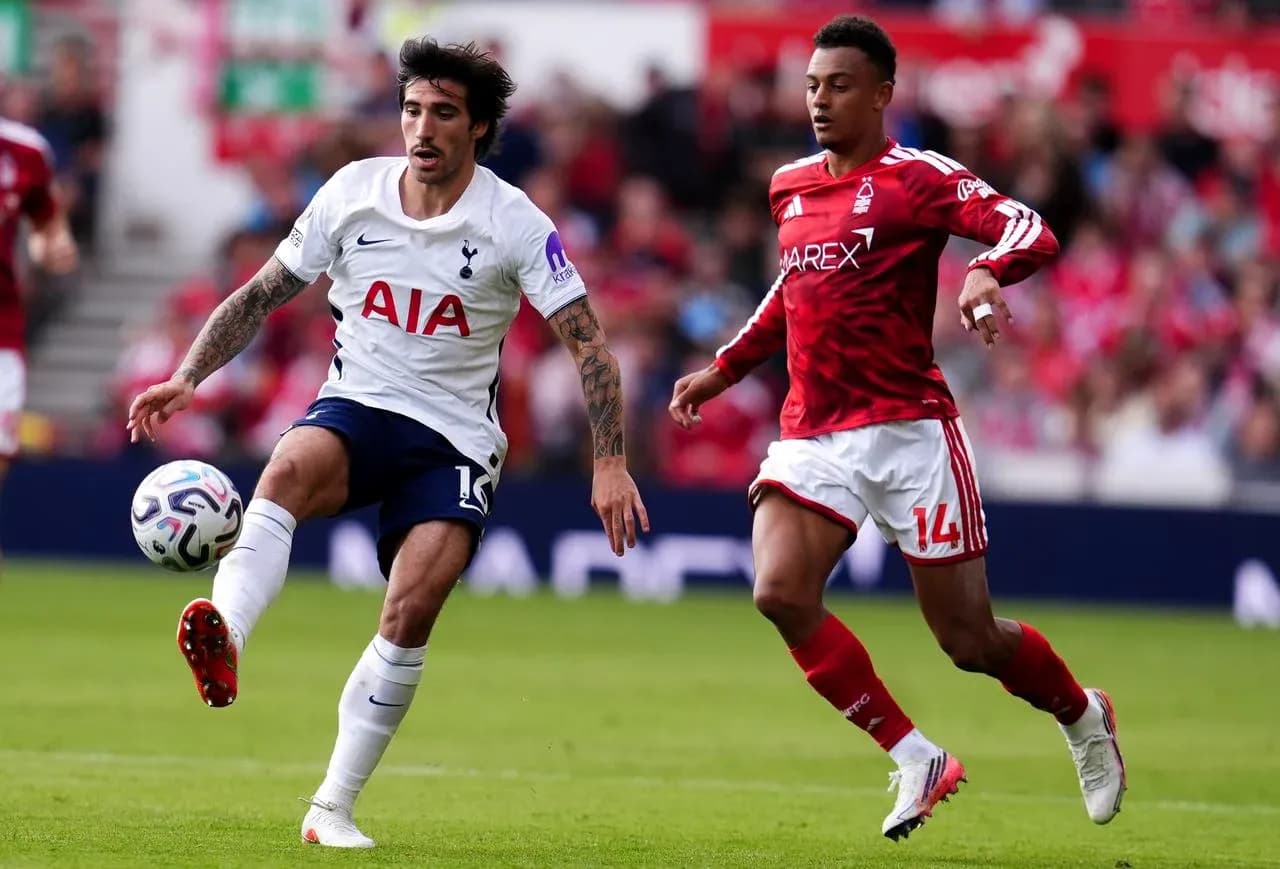
His duel was primarily with Tottenham’s central shield of van de Ven and van Hecke, but structurally with Bentancur and Tonali. Gibbs-White’s habit of drifting into half-spaces tested Tottenham’s spacing between midfield and defence; whenever Bentancur stepped out, channels opened for Delap’s runs or for Ndoye to attack the inside-right lane. Tottenham’s overall defensive record – 5 goals conceded in total, averaging 1.7 per game and 1.5 on their travels – suggests a unit still learning to move as one. The clean sheet here owed as much to Forest’s lack of home cutting edge as to Spurs’ improvement.
In the engine room, Schlager and McAtee against Bentancur and Tonali was the game’s cerebral core. Schlager’s work rate and positional discipline allowed Forest to maintain their 3-4-2-1 shape without the ball, closing central lanes and forcing Tottenham wide. McAtee, more progressive on the turn, tried to break Tottenham’s double pivot with forward carries.
On the other side, Bentancur’s role was to knit short passes under pressure and help Tottenham evade Forest’s mid-block, while Tonali’s distribution from deep was meant to find Sávio and Tel early. Yet with no natural, fit No.10 like Maddison between the lines, Tottenham’s possession often stalled just outside Forest’s box, leaving Marmoush isolated against a back three that could defend narrow and crowd the central channel.
Out wide, the duel between Aina and Udogie was one of controlled aggression. Aina, who has already collected 2 yellow cards this season and features prominently in both yellow and red-card leaderboards, walks a fine line between intensity and indiscipline. Udogie, similarly combative and already booked once this campaign, had to balance his overlapping instincts with the risk of leaving van de Ven exposed to counters from Ndoye or Gibbs-White.
IV. Statistical Prognosis – A Stalemate with Different Lessons
From a season-long statistical lens, the 0-0 felt like an intersection of two different anxieties. Forest’s overall attacking numbers remain modest: 2 goals in total from 3 matches, with an overall average of 0.7 goals per game and 0.0 at home. Yet their defensive base at the City Ground is credible: only 1 goal conceded at home, an overall average of 0.5 per home game, and 1 home clean sheet already. Their penalty record in total is perfect so far, with 1 taken and 1 scored, and none missed.
Tottenham’s story is the inverse: a side that should, by talent, create and score but has 0 goals in total from 3 matches, with an overall average of 0.0 goals per game and 0.0 on their travels. Defensively, they are slowly tightening up, but the numbers still show fragility: 5 conceded in total, averaging 1.7 per game overall and 1.5 away. One clean sheet away offers a sliver of hope, but the lack of attacking return remains glaring.
Following this result, Forest can frame the draw as another small brick in a defensive wall at home, even if their attacking issues at the City Ground persist. Gibbs-White’s influence and the structure of the 3-4-2-1 give them a platform; what they lack is a ruthless edge for Delap and the supporting cast to turn control into goals.
For Tottenham, the clean sheet is a necessary corrective after a -5 goal difference across the opening weeks, but the continued failure to score keeps the pressure firmly on De Zerbi. Until key absentees like Kulusevski and Maddison return, the onus will fall on Sávio, Tel and Gallagher to transform sterile possession into chances. The numbers suggest that once they finally break their scoring duck, their underlying structure may allow them to climb away from the relegation places. But for now, the City Ground stalemate is a reminder: both sides have systems; neither yet has a fully convincing end product.