
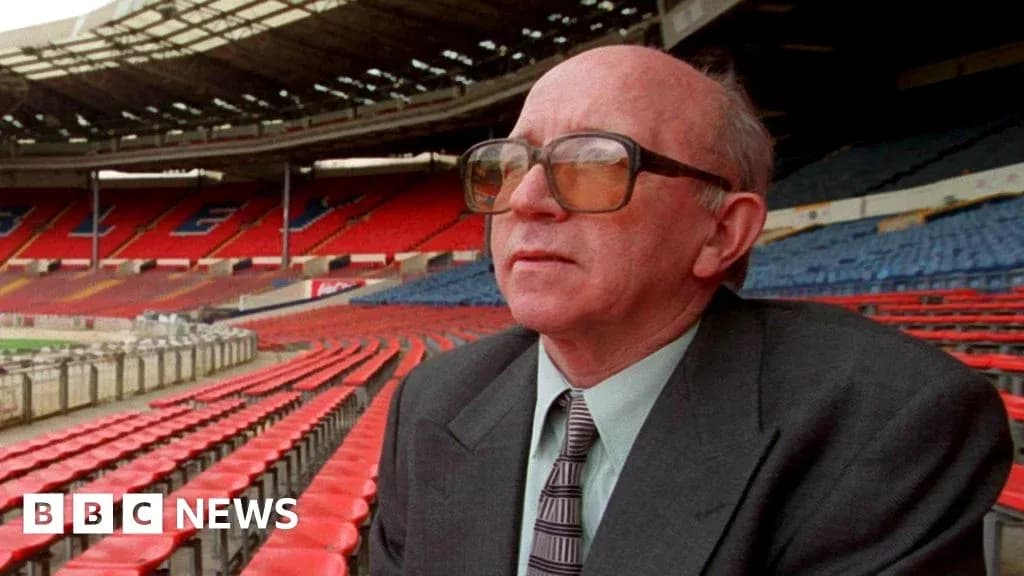
Nobby Stiles Inquest Ordered into Brain Injury of England World Cup Icon
The image of Nobby Stiles dancing across Wembley in 1966, World Cup in one hand and false teeth in the other, is stitched into English football history. Now, almost six decades on, the story of what the game may have taken from him is moving into a courtroom.
A coroner has ruled that an inquest must be held into the death of the former Manchester United and England midfielder, after medical evidence confirmed he died with a traumatic brain injury.
World Cup winner, lifelong battler
Stiles, born in Manchester in 1942, was the archetypal old-school defensive midfielder: tough, relentless, utterly fearless in the challenge. He won 28 caps for England, played nearly 400 times for Manchester United and helped deliver the European Cup to Old Trafford in 1968.
He died in 2020 at the age of 78. Only now will his death be formally examined by a coroner.
Chris Morris, area coroner for Greater Manchester South, told Stockport coroner’s court that Stiles was suffering from chronic traumatic encephalopathy (CTE), a degenerative brain condition linked to repeated head impacts and widely associated with contact sports.
Morris said Stiles’s death was contributed to by high-stage CTE, as well as “stage three limbic predominant age related TDP-43” and small vessel cerebrovascular disease. Crucially, the presence of traumatic injury within the cause of death has triggered the legal requirement for a full inquest.
“On the basis of that cause of death, particularly the inclusion of a traumatic injury included in the cause of death, I'm satisfied an inquest is required into the sad death of Mr Stiles,” Morris told the court.
The hearing will take place on Wednesday at the same court.
A case that never reached the coroner – until now
Morris also revealed that Stiles’s death had not originally been reported to the coroner’s office in 2020.
He described that omission as “for reasons not entirely clear to me”, and confirmed that the investigation only began after Stiles’s family came forward with information and concerns.
Their push has helped move one of English football’s most uncomfortable questions back into the spotlight: what did the game know, and when, about the dangers of heading the ball?
Family campaign at the heart of a growing fight
Stiles’s son, John, has become one of the most prominent voices in that debate. He leads Football Families for Justice (FFJ), a group pressing football authorities to provide better support for former players suffering from neurodegenerative conditions linked to their playing careers.
He is also part of a legal action that could reshape the sport’s duty of care.
Dozens of ex-footballers and their families are suing the Football Association, the Football Association of Wales and the English Football League. The claim argues that these bodies were “negligent and in breach of their duty of care” by failing to protect players from the risks of brain injury associated with heading and concussion.
Lawyers for the former players say football’s authorities knew, or should have known, for decades that repeated heading in training and matches was likely to cause long-term brain damage.
The allegation is stark: that the warnings were there, and that the game carried on largely unchanged.
Football’s defence – and a widening fault line
The governing bodies reject that charge. In March this year, lawyers for The Football Association told the High Court that it has “not been established by science” that heading a ball, or “occasional” concussion, leads to permanent brain damage.
That line goes to the heart of the looming legal and moral battle. Families point to a growing list of former players diagnosed with CTE or other serious brain conditions. Football’s hierarchy points back to the scientific threshold of proof.
Recent inquests have only sharpened the tension.
In January, an inquest into the death of Gordon McQueen, the former Scotland, Manchester United and Leeds United defender, concluded that heading the ball was “likely” to have contributed to the brain injury that played a part in his death at 70.
Now Stiles’s case joins that narrative. Another defender of his era. Another diagnosis involving traumatic brain injury. Another family asking whether the sport that made their loved one a hero also helped to break him.
A defining test for the modern game
For many supporters, Nobby Stiles will always be the snarling, diminutive destroyer who shut down Eusebio, then danced into immortality on the Wembley turf. The inquest ordered this week will look at the cost of that bravery, and whether it was properly understood or managed by the people running the game.
One of English football’s great icons is now at the centre of a legal and medical reckoning that stretches far beyond his own story. The question is no longer whether the sport has a problem. It is how far back the responsibility runs—and what football is prepared to do about it now.



