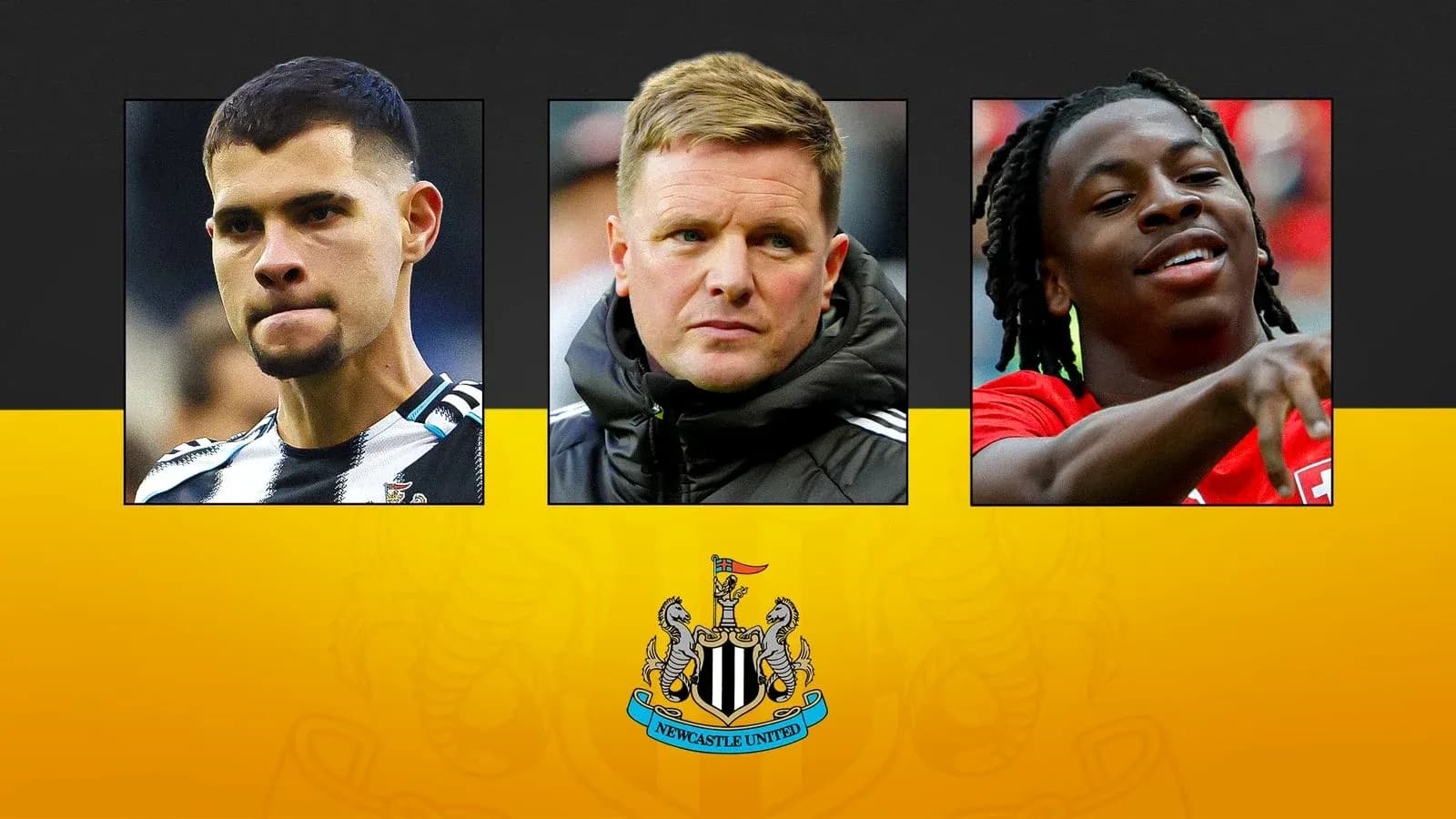
Newcastle's Summer Overhaul: A New Era Begins
The mood around St James’ Park is not so much restless as braced. Newcastle are not tinkering this summer; they are tearing into the squad with both hands, reshaping a team and a transfer strategy in one go before what feels like a pivotal season.
Eight, nine, maybe even 10 positions could be affected. That is not evolution. That is surgery.
And it has already started.
Bruno at the crossroads
At the heart of it all sits Bruno Guimaraes, the captain, the crowd’s conductor and the clearest symbol of where Newcastle want to go – or where they might be forced to accept they are.
He has not handed in a transfer request. There is no formal standoff, no dressing-room drama. What he has done is speak directly to the club and make his position brutally clear: if Arsenal lodge an acceptable offer, he wants to explore that move.
This is not about squeezing out a bigger contract. Bruno is already Newcastle’s highest earner and on strong wages. Arsenal would only nudge that up, not transform it. His motivation is sharper than that. At 28, turning 29 later this year, he wants medals. Titles. He does not believe Newcastle can deliver those in the next couple of years, on or off the pitch, and he sees Arsenal as a route to the honours he craves.
Yet he is not looking to slip out the side door. He wants Newcastle to be properly paid if he goes. Inside the club, the tipping point is understood: around £80m. Hit that number and Newcastle’s hierarchy would have to sit up and listen.
The twist? Arsenal have not made a move. No bid. No formal contact. Newcastle are stunned by how much noise has built around Bruno’s future when everything so far has come through agents and intermediaries. Until an actual offer lands, they insist there is no decision to make. They are desperate to keep him. Officially, he is not for sale.
For now, the captain stays. But the clock is ticking in the background.
Manzambi deal: done, but not done
While Bruno’s future hangs in the air, Newcastle believe they have one of their major incoming deals lined up.
They have agreed a £49m fee with Freiburg for Johan Manzambi, one of the club’s top targets this window. A Newcastle delegation travelled to Germany this week, verbally sealed the deal with Freiburg and shook hands on personal terms with the player.
On paper, it is all there. In reality, nothing is signed.
Manzambi is still at the World Cup with Switzerland, nursing a slight knee issue but playing a central role in a side that has reached the quarter-finals. He has made it clear he will not commit to any contract until his tournament is over.
That delay makes people at Newcastle nervous, and with good reason. The memory of Victor Munoz being hijacked by Liverpool at the last second a few weeks ago is still raw. They have done everything they can to protect this one, but until ink hits paper, they know another club could still swoop.
The risk may be worth it. Manzambi has lit up the World Cup: five goal involvements, the best record for a player of his age since records began. For a club leaning heavily into a younger, high-ceiling model, this is exactly the kind of talent they want to bet big on.
Three or four more to come
Manzambi is only the start. Newcastle are planning another three or four signings once that deal is over the line.
A midfielder remains on the list, with the role becoming even more pressing if Bruno does eventually leave. They also want a new No 1 goalkeeper and have had a long-standing interest in James Trafford, currently at Manchester City. Moves for him are expected in this window.
Full-back is another priority – ideally someone who can play both sides but is comfortable on the left. On top of that, the club are weighing up the wide areas and the forward line.
If Jacob Murphy moves on after a decade at the club, a new winger will be needed. Up front, the situation depends on departures. Should one of Nick Woltemade or Yoane Wissa leave, Newcastle will look to bring in another striker. If both stay, Eddie Howe is prepared to go into the season with a front three of Wissa, Woltemade and Will Osula.
The squad that emerges from this window will look very different to the one that started last season.
A new transfer blueprint
Behind all of this is a clear shift in policy.
Newcastle are now operating within a tighter framework: players aged between 18 and 24, typically costing between £20m and £40m. The recent arrival of Ewen Jaouen at £18m fits that template perfectly.
Manzambi, at £49m, sits just outside it. He is the exception they are prepared to make, not the new normal. Inside the club, there is no appetite to splash £80m, £90m or £100m on a single player. That era is not coming to Tyneside yet.
Instead, Newcastle are leaning towards a Borussia Dortmund-style model: buy younger, cheaper, with high upside; improve them on the training ground; sell at a profit when the time is right; and still stay competitive for trophies.
It is a bet on coaching and recruitment over brute financial force.
Who could be sacrificed?
To complete this reset, some familiar faces are likely to move on.
Nick Pope is expected to leave. Interest from Ipswich has faded, but the expectation remains that he will find a new club.
Murphy, a loyal servant for a decade, could go. Joe Willock is another who may depart. There are no formal offers on the table for any of the three, but Newcastle are open to shifting them to create space and salary room for a revamped squad.
If Pope, Murphy and Willock all exit, they will need replacing. That is the scale of the churn being contemplated.
Steur and the next wave
Not every signing is being asked to change the team overnight.
Sean Steur, 18, is very much one for the future. He will train with the first team, he will get chances, but he is not being pencilled straight into the starting XI. The expectation is that he begins as a substitute, grows physically, adapts to the Premier League and pushes harder a year from now.
This is the kind of profile Newcastle want: young, moldable, with time on his side. They believe they already have enough ready-made Premier League players. What they want now are projects that Howe can elevate.
The lack of European football next season actually helps that plan. With no midweek games, Howe will have full training weeks to work closely with Steur, Bazoumana Toure, Manzambi and others. More time on the grass, less time on recovery. For a coach who thrives on development, that is gold.
Howe’s second act
Eddie Howe is not being dragged into this new model. He is driving it.
After last summer’s disastrous £250m window – big money spent, too many signings failing to deliver, the Alexander Isak saga casting a shadow over the campaign – everyone at the top of the club knows things must change.
Howe, sporting director Ross Wilson and chief executive David Hopkinson are aligned. They want deals done early. They want younger players they can improve. They want to avoid the chaos of last-minute scrambles.
For Howe, this is a chance to lean into his strengths: coaching, detail, marginal gains on the training pitch. With no European schedule, his players should be fresher, the pressure a little lighter, the environment more controlled for new arrivals to settle.
Newcastle are realistic. A top-four or top-five finish looks unlikely. But a push for the European places? That feels firmly within reach, especially if this new, younger side clicks quickly.
PIF’s commitment and the financial reality
All of this unfolds under the watchful eye of Saudi Arabia’s Public Investment Fund. PIF remains committed. There is no suggestion of an ownership wobble.
Yet from the outside, fans see Sandro Tonali, Anthony Gordon, Alexander Isak – and possibly Bruno – leaving for what are perceived as “bigger” clubs and wonder how far Newcastle can really go under current constraints.
The answer lies in the numbers. Breaking into the Premier League’s established top six has proved brutally difficult, not because of ambition but because of financial rules. Newcastle’s commercial revenue sits at around half the level of the so-called big six. Until that changes, they cannot match those clubs on transfer fees and wages without risking sanctions.
They have already felt the sting of that, breaching PSR and taking a fine. The owners do not want a repeat. They will spend as much as they can, but it has to be within a stricter structure.
That means driving up commercial income, pushing new sponsorships, and, in time, exploring a new stadium to unlock greater matchday revenue. Progress is being made, but not quickly enough to close the gap on the elite just yet.
So Newcastle pivot. Smarter recruitment. Younger profiles. A coach trusted to develop talent. A squad turned over in one bold summer.
The question now is not whether this will change Newcastle. It is how far this gamble on youth, value and coaching can carry them in a league where money usually wins.