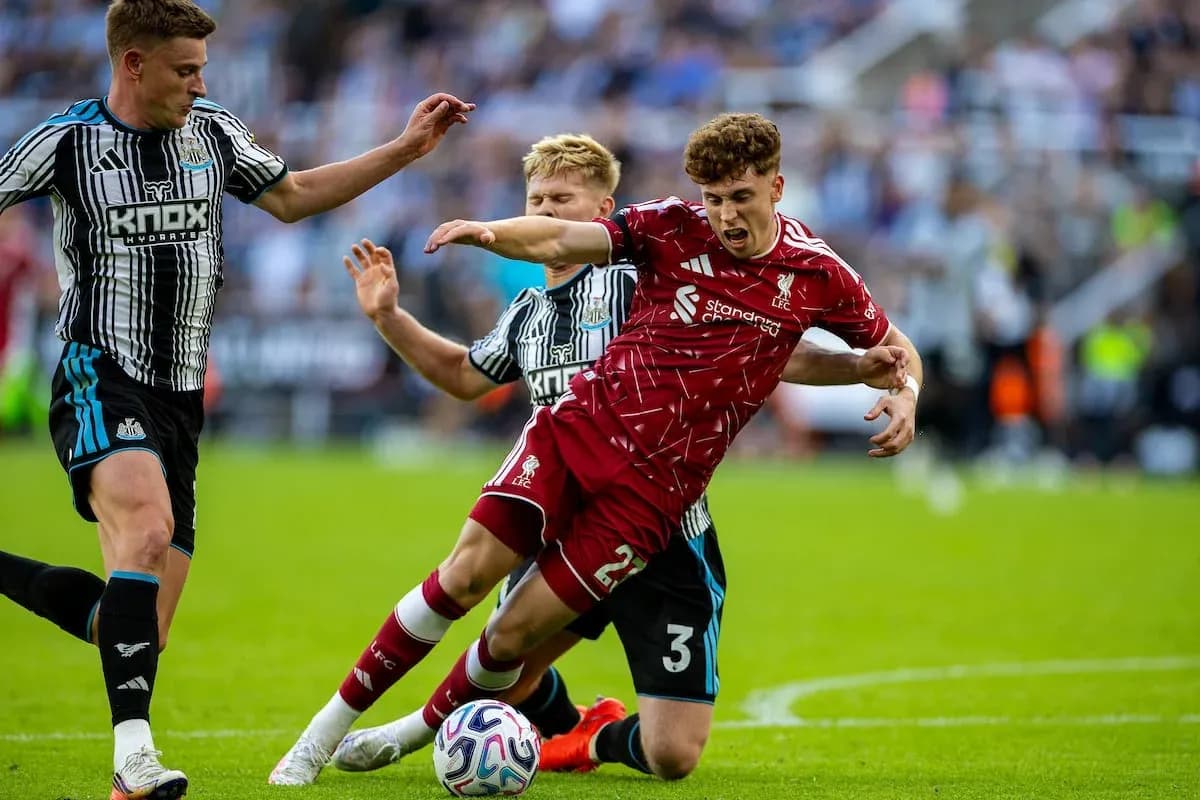
Newcastle and Liverpool: Tactical Rivalry Begins with 2–2 Draw
St James’ Park eased back into Premier League life with a 2–2 draw that felt less like a settled verdict and more like the opening chapter of a tactical rivalry. Following this result, both Newcastle and Liverpool sit on 1 point from 1 match, level on goal difference at 0 after scoring and conceding 2 in total. Yet the way they arrived there – mirroring each other in shape but not in personality – offers a revealing blueprint for what these sides might become across the season.
I. The Big Picture – Same structure, different souls
Both coaches opened their 2026 campaign in a 4-2-3-1, but the systems were built for different purposes.
Matthias Jaissle’s Newcastle leaned into verticality and direct threat. With L. Hornicek behind a back four of A. Dedic, M. Thiaw, S. Botman and L. Hall, the structure looked conventional on paper. In practice, it was a springboard. The double pivot of S. Steur and L. Miley played aggressively on the front foot, stepping into midfield duels to feed a dynamic band of three: A. Elanga from the right, Y. Wissa central, H. Barnes from the left, all servicing the hard-running W. Osula.
Liverpool, under Andoni Iraola, mirrored the 4-2-3-1 but with more emphasis on control and rotations. Alisson anchored a back four of J. Frimpong, J. Jacquet, V. van Dijk and M. Kerkez. Ahead of them, D. Szoboszlai and R. Gravenberch formed a technical double pivot, while R. Ngumoha, F. Wirtz and C. Gakpo supported lone striker A. Isak.
Statistically, the symmetry is striking: both teams have, overall this season, 2 goals for and 2 against, with an average of 2.0 goals scored and 2.0 conceded per match. But the way those numbers are being produced could not be more different.
II. Tactical Voids – Absences and discipline
Both squads were forced to redraw their plans before a ball was kicked.
Newcastle’s midfield lost its most physically dominant presence with Joelinton missing the fixture through injury, while V. Livramento’s hamstring problem removed a natural attacking full-back option. Their absence nudged Jaissle toward a more youthful, technically inclined core in L. Miley and S. Steur, sacrificing some raw power for progression and energy.
Liverpool’s list of absentees was longer: C. Bradley (knee injury), H. Ekitike (Achilles tendon injury), J. Gomez (injury) and G. Leoni (knee injury) all missed out. The knock-on effect was a defensive unit that had to rely heavily on V. van Dijk’s authority and M. Kerkez’s intensity, with J. Frimpong pushed into a high-risk, high-reward role on the right.
Disciplinary trends add another layer. Newcastle have already shown a tendency toward persistent fouling across the full 90. Their yellow cards are spread almost evenly, with 20.00% of bookings arriving in each of the 16–30, 31–45, 61–75, 76–90 and 91–105 minute windows – a sign of a side that never fully releases the handbrake. Individually, J. Murphy, J. Ramsey, L. Miley and Y. Wissa all sit on 1 yellow card in the league, underlining a midfield and wide unit that tackles aggressively and takes risks in transition.
Liverpool’s bookings cluster earlier: 66.67% of their yellow cards so far have come between 16–30 minutes, with 33.33% in the 76–90 window. Iraola’s side is most combustible just as the press is ramping up – and again as legs tire late on.
III. Key Matchups – Hunter vs Shield, Engine Room battles
The most intriguing duel in this contest – and in any future meeting – lies between Newcastle’s emergent attacking “hunters” and Liverpool’s defensive “shield”.
For Newcastle, A. Elanga and J. Willock have already announced themselves as key scorers. Both have 1 goal in total this league season, each carrying a rating of 7.6. Elanga’s 2 shots on target from 2 attempts and 9 duels (winning 5) show a winger who can both stretch and scrap. Willock, despite starting from the bench, contributed 1 goal, 1 key pass and 2 tackles in just 34 minutes, hinting at a late-arriving threat from midfield that can break beyond a tiring back line.
Behind them, W. Osula and Y. Wissa form a creative and physical axis. Osula, with 1 assist and 2 blocked shots, links play and presses from the front. Wissa, already on 1 assist, 4 shots and 19 duels (winning 11), is the embodiment of Jaissle’s high-intensity ethos – a wide forward who will happily turn the game into a fight.
Liverpool’s shield is centred on V. van Dijk and the structure in front of him, but the real defensive pivot is R. Gravenberch. The Dutch midfielder has 1 assist, 47 passes at 91% accuracy, 1 tackle and 2 interceptions in his first outing. He is the man tasked with shutting off the lanes that Elanga, Barnes and the late-arriving Willock want to attack.
In the “Engine Room”, the duel between L. Miley and the Szoboszlai–Gravenberch pairing will define territory. Miley’s debut numbers – 36 completed passes at 83% accuracy, 2 key passes, 1 tackle, 1 block, 1 interception, plus 5 duels won from 7 – suggest a teenager already comfortable dictating tempo and stepping into contact. His yellow card underlines the edge in his game, but also the risk: Liverpool’s midfielders are adept at drawing fouls and exploiting set-piece situations.
Further forward, F. Wirtz and C. Gakpo operate between the lines, looking to drag Botman and Thiaw into uncomfortable zones. With Liverpool having already converted 1 penalty from 1 this season (100.00% success, 0 missed), any clumsy challenge in the box becomes a decisive moment.
IV. Statistical Prognosis – Where the game tilts next
Following this result, Newcastle sit 11th and Liverpool 10th, each with 1 draw from 1 match. Newcastle have, at home, 2 goals for and 2 against; Liverpool have, away from home, 2 scored and 2 conceded. The goal differences are locked at 0 for both – but the underlying dynamics hint at different futures.
Newcastle’s attacking production is already spread: Elanga and Willock scoring, Osula and Wissa assisting, and Barnes yet to ignite. Their discipline profile – yellows across every late-game band – suggests a side that will live on the edge, especially as fatigue sets in.
Liverpool, by contrast, project control and patience. Their early yellow-card spike shows the cost of an aggressive press, but their penalty record and the technical security of Gravenberch and Szoboszlai offer a platform for consistent xG creation, even when open play is stifled.
If this fixture is a template, future meetings between these sides will hinge on two fault lines: Newcastle’s late-game discipline versus Liverpool’s ability to punish from set pieces and the spot, and Liverpool’s capacity to contain Newcastle’s wide and second-line runners without overloading their centre-backs.
On balance, the statistical and tactical evidence points to Liverpool having the higher ceiling in terms of sustained chance creation, but Newcastle’s multi-source goal threat and ferocious duelling mean that, on any given day at St James’ Park, the margin will remain razor-thin.