
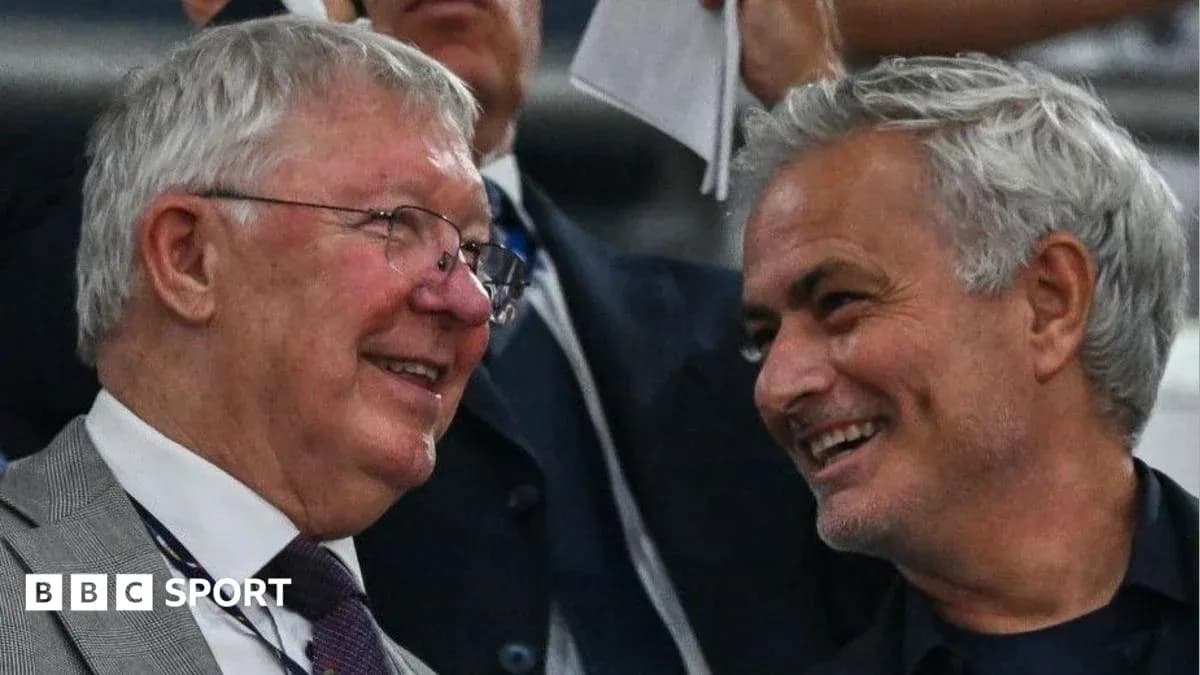
The Mourinho That Could Have Been: Manchester United's 2013 Opportunity
There is a moment in Manchester United’s recent history that still feels like a scene cut from the final version. A sliding door that never quite opened.
In 2013, as Sir Alex Ferguson prepared to step away from the dugout he had ruled for more than a quarter of a century, United thought they had his successor. Not just any successor, but Jose Mourinho – the man Ferguson admired, the serial winner built for turbulence and transition.
For a few days, they believed it was done.
The deal that vanished in days
The courtship had not been rushed. Talks with Mourinho’s camp stretched over weeks, with meetings staged in Madrid and London. Ferguson, who had long enjoyed a warm relationship with the Portuguese coach, stunned him by revealing he would retire at the end of the 2012-13 season.
Negotiations accelerated. Terms were discussed. Agreement was reached.
Then it evaporated.
Ferguson recalls the turning point in the new Netflix documentary on Mourinho’s career, released on 11 August. One night, the phone rang. On the other end, Mourinho was in tears.
“Alex, I can't take it. I've given my word to Chelsea and I'm not going to break my word.”
He cited family reasons. London was home, the city where his family had settled during his first spell at Stamford Bridge. He had promised to return after his 2007 sacking. He still enjoyed a strong relationship with Roman Abramovich. The pull was powerful.
Inside United, some remain unconvinced that family was the only factor. But the outcome was clear. The man they thought they had secured was gone.
The reversal took days. Its impact has stretched over a decade.
A turning point at Old Trafford
Ferguson’s departure alone would have shaken the foundations. He left in the same summer as chief executive David Gill, another pillar of United’s modern era. The club knew they were not just changing managers; they were changing structure.
Ferguson had operated as a one-man empire on the football side. He controlled almost everything that touched the pitch. The next era would need a different model, more modern, more distributed. The transition needed a figure strong enough to absorb the shock while still winning.
Inside Old Trafford, many believed Mourinho fit that brief. Broad shoulders. Big ego. Unshakeable self-belief. Exactly the type to walk into Ferguson’s office, look at the pictures on the wall, and convince himself he could add more.
When he chose Chelsea, United were forced to pivot. Pep Guardiola was already committed to Bayern Munich. The club turned to David Moyes.
Moyes shared some of Ferguson’s managerial traits – intensity, work ethic, a long apprenticeship in the Premier League. What he did not share was experience at the very top level. United unveiled him as “The Chosen One”.
He wasn’t.
The fall from champions to seventh in Moyes’ first and only season was brutal. Ferguson’s final title-winning squad had overperformed, everyone accepts that now. But the drop-off still shocked those inside the dressing room. Even the players have struggled to explain it.
The lingering belief is that Mourinho, with his force of personality and ruthless standards, would have squeezed more from that group.
The Mourinho that finally arrived
United did eventually get Mourinho, three years later, in 2016. By then, the landscape had changed – at the club and in the manager’s own career.
He replaced Louis van Gaal, who was sacked 48 hours after lifting the FA Cup against Crystal Palace. The dressing room he inherited was very different to the one that had just delivered Ferguson’s 13th Premier League title.
Of the 18 players who started 10 or more league games in that 2012-13 season, only six – David de Gea, Phil Jones, Wayne Rooney, Chris Smalling, Michael Carrick and Antonio Valencia – did the same in Mourinho’s first campaign.
Mourinho himself had been through a storm. He had returned to Chelsea and won another Premier League title, only to depart in December 2015 with the champions languishing in 16th place, one point above the relegation zone. He arrived at Old Trafford with his aura intact but with scars visible.
His time at United still divides opinion.
On one hand, the trophy count speaks. He won the Europa League and EFL Cup in his first season. He took United back into the Champions League twice. His 2017-18 side finished second, 19 points behind Manchester City, a campaign he has called one of the “best achievements” of his career. The 81 points they collected that year remain the club’s highest Premier League total since Ferguson left.
On the other hand, the familiar Mourinho flashpoints erupted. He clashed with players, most notably record signing Paul Pogba. He publicly criticised the club’s hierarchy over transfer backing, frustrated that his desire to sell Anthony Martial was blocked. The football grew turgid, the atmosphere toxic. When he left, many felt the club was in disarray.
The question that hangs over it all: what if he had come in 2013 instead?
The alternative 2013 that never happened
Those who were there at the time are convinced of one thing – Mourinho would have attacked that first summer very differently.
United’s hesitancy in the market under Moyes became a defining feature of that window. Deals drifted. Opportunities slipped. The club ended up scrambling on deadline day to sign Marouane Fellaini for £27.5m, having failed to trigger a lower release clause earlier in the summer.
Those close to the 2013 discussions insist Fellaini would not have been signed under Mourinho.
They also stress that Thiago Alcantara’s move from Barcelona – which had been agreed in principle – would have been completed. Mourinho had even offered opinions on a number of potential recruits, including Italy midfielder Daniele de Rossi.
The sense is not just that Mourinho would have signed more of the right players, but that he would have driven more out of the ones already in the building. That he would have relished the challenge of succeeding Ferguson, rather than shrinking from it.
Ferguson’s last squad may have overachieved under him, but many inside the club still believe Mourinho’s presence would have kept them closer to the summit. That his relentless demands, his confrontational edge, would have jolted a group that drifted so sharply under Moyes.
Tears, regret and a club still searching
In the documentary, Ferguson recounts Mourinho’s phone call with clarity and, notably, without bitterness. The image is stark: one of the game’s most self-assured figures, in tears, telling the greatest British manager of all time that he cannot take the job he has been offered.
For United, it felt like a body blow. A rare moment when the club’s aura did not carry the day.
The years since have been shaped by that night. Six permanent managers have tried to step out from Ferguson’s shadow. Different styles, different structures, different promises. None have restored United to what they were under the Scot.
Inside Old Trafford, some still look back to 2013 and wonder. If Mourinho had walked through the door then, fresh from Real Madrid, armed with Ferguson’s blessing and a title-winning squad, would the last decade look different?
The sliding door closed. United are still living with what happened when it did.



