
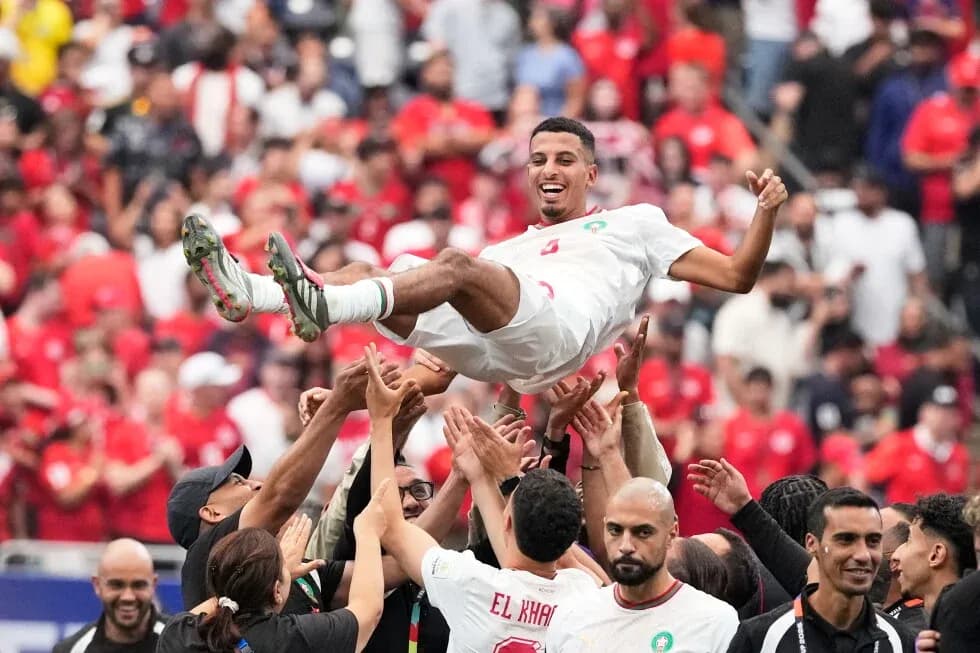
Morocco Dominates Canada 3-0 in World Cup Round of 16
HOUSTON — Morocco no longer knocks on the door of world football’s elite. It walks straight through.
On a humid Texas afternoon, Mohamed Ouahbi’s side dismantled Canada 3-0 in the World Cup round of 16, a scoreline that felt as emphatic as the statement it carried: this is no fairy tale, no one-off run. Morocco is back in the quarterfinals, the first African nation ever to reach that stage more than once, and it does so with the swagger of a team that now expects to be here.
“We are no longer a surprise,” Ouahbi said through a translator afterward. He didn’t sound like a man pinching himself. He sounded like a coach outlining a new normal.
Ounahi breaks it open
For 49 minutes, Canada held its nerve and its shape. The co-hosts, in just their third World Cup, pressed high, moved the ball with ambition and, for long stretches, dictated the rhythm. Morocco absorbed it all.
Then the dam burst.
Five minutes into the second half, Achraf Hakimi stood over a free kick and clipped it short. Azzedine Ounahi, hovering outside the box, pounced. One touch to set, one right-footed drive through a thicket of legs, arrowed low into the bottom-right corner.
1-0. A flash of class, born from a routine that looked harmless until Ounahi turned it into a dagger.
Canada wobbled but did not fold. Jesse Marsch’s team kept pushing, kept believing. Jonathan David whipped a free kick over the bar in the 78th minute. Moments later, Tajon Buchanan unleashed a fierce effort from around 30 yards, forcing Yassine Bounou into a full-stretch, flying save.
Bounou, born in Canada to Moroccan parents, denied the country of his birth with three saves and a calm authority that has become his trademark. On a night loaded with symbolism, he stood between Canada and any hope of a late twist.
The pressure tells
As Canada chased, spaces opened. Morocco smelled the finish.
In the 82nd minute, Brahim Díaz slid into a pocket and picked his pass perfectly. Ounahi, again arriving in the heart of the box, met it with another assured right-footed strike. This one from closer range, this one just as ruthless.
2-0. Game over in all but name.
Soufiane Rahimi added the exclamation mark deep into stoppage time, racing clear to slot home Morocco’s third. By then, Canadian legs were heavy, the dream run clearly spent.
On the touchline, Ouahbi barely celebrated. His players mobbed Rahimi; their coach looked like a man already thinking about Thursday in Boston.
“We want to keep going,” he said. “We don’t want to stop.”
Africa’s standard-bearer
This is not unfamiliar territory anymore. Morocco reached the semifinals in 2022, the first African team ever to do so, and finished fourth. Now they are back in the last eight, the continent’s standard-bearer once again.
“We are so proud to represent Africa because it’s a continent with a lot of talent and Africa deserves to be in the best level in football,” Bounou said.
Ranked sixth in the FIFA standings, Morocco arrived in the United States with a target on its back, then reinforced its reputation by knocking out the Netherlands on penalties to reach the last 16. That result sent the Dutch home earlier than they have departed in decades. This one sends a co-host out, and carries a different kind of weight.
The physical edge underlined the stakes. Eight yellow cards flew — four for each side — in a match that often teetered on the brink. Hakimi and Richie Laryea both saw yellow after a tangle in the 40th minute that spilled into a brief scuffle, Hakimi shoving Laryea to the turf, Laryea responding in kind.
Morocco also suffered a setback when midfielder Ismael Saibari limped off in the 22nd minute. The bench stepped in, the structure held, and the level barely dipped. That, more than any celebration, tells you where this team now stands.
Canada’s brave exit
For Canada, the scoreline cut against the story of their tournament.
This World Cup had already rewritten the country’s relationship with the sport. A first-ever knockout win, 1-0 over South Africa, had lit up a nation more accustomed to ice and boards than grass and touchlines. They arrived in Houston with belief, despite the absence of their brightest star.
Alphonso Davies, limited to just 15 minutes as a substitute against South Africa because of a hamstring problem, never made it onto the pitch. “His hamstring didn’t feel right,” Marsch said. “We were hoping that by the time he woke up this morning that he would feel better, but he didn’t.”
Still, Canada went toe-to-toe with one of the world’s best.
“The way we pushed, the way we were in the match, the quality we showed, the overall impact in the match, we were better,” Marsch said. “We were better than the No. 7 team in the world today.”
He slightly misplaced Morocco’s ranking — they sit sixth, not seventh — and Ouahbi did not let that slide.
“In terms of intensity they were good,” the Morocco coach replied. “They were good for 98 minutes. Were they better? It’s hard to say. It takes some nerve to say that when you lose 3-nil.”
The exchange summed up the night: Canada proud, defiant, convinced it belongs at this level; Morocco unapologetic, fiercely protective of its new status among the game’s heavyweights.
Marsch’s message to his players was blunt and aspirational.
“I told them that I was proud of them and I challenged them to understand that we can play like this all the time against the best teams in the world,” he said. “We can be better on the day. And then the challenge is, can we hold that standard for 90 minutes?”
That is Canada’s next step. They leave with credit, but also with a clear benchmark.
A familiar opponent, a higher ceiling
This meeting carried echoes of Qatar 2022, when Morocco beat Canada 2-1 in the group stage on their way to that historic semifinal run. Two years on, the gap has widened where it matters most: in the boxes, in the coolness of decision-making under pressure, in the belief that big moments belong to you.
Morocco now moves on to face the winner of Paraguay vs. France at Boston Stadium on Thursday. It will be another test, another stage, another chance to push the ceiling a little higher for African football.
Ouahbi insists this is “only the beginning.” With another quarterfinal secured, a continent behind them, and a team that no longer sees itself as an underdog, the more intriguing question is simple:
How far can this Morocco side go now that nobody is surprised to see them here?



