Milos Kerkez: A New Era at Liverpool
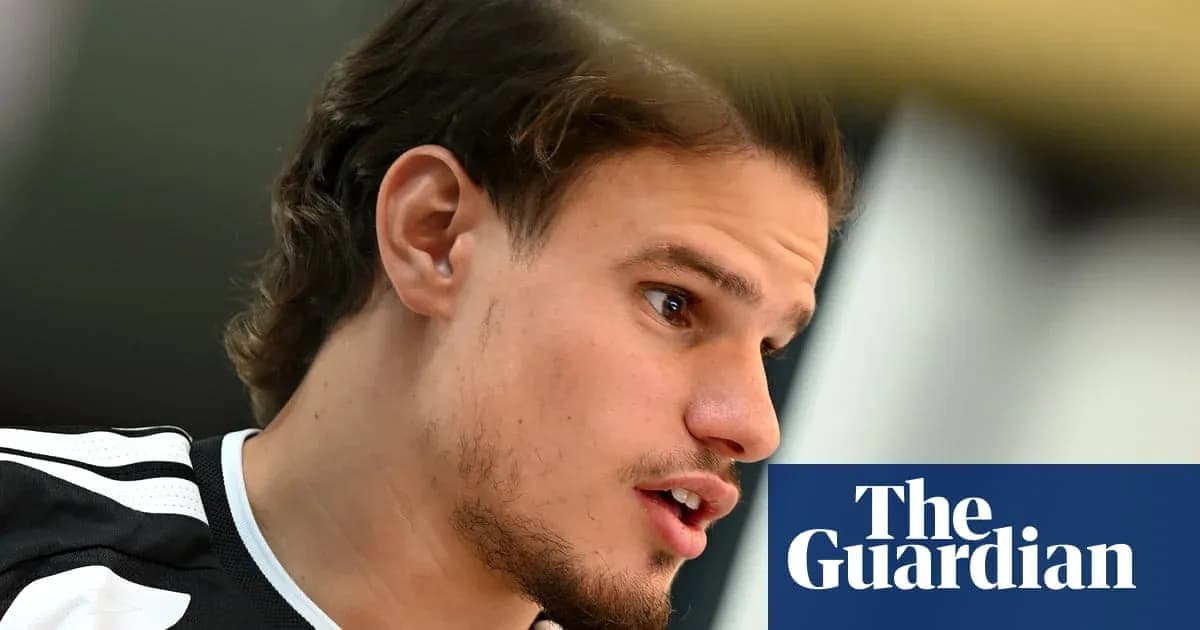
Milos Kerkez leans back in his chair on a rooftop in Chicago and laughs. He has spent half the summer batting away congratulations on a wedding that never happened.
“No! This is wrong, everyone gets this wrong!” he says, still slightly exasperated. The photo that went around Serbia – and then half of Europe – showed him escorting a bride into church in his hometown of Vrbas. The assumption was obvious. The conclusion was wrong.
“It was my oldest brother,” he explains. “In Serbia it is normal for the younger brothers to take the bride to the church. That’s what I did and now everyone thinks I got married. It was Rade, not me.”
Inside Liverpool’s dressing room, the misunderstanding became a running joke. Team-mates, staff, even people around the training ground were offering their best wishes.
“I keep having to explain to people that I never got married,” he says. “I was going around the club when we started back and people were congratulating me. I’m like: ‘No, I’m not ready for this yet!’”
Marriage can wait. Responsibility cannot.
From shadow to spotlight
Kerkez is 22, restless, and on the brink of the most important season of his career. He arrived at Liverpool as the heir to Andy Robertson, a daunting job description for any full-back, and spent his first campaign fighting turbulence on and off the pitch.
Now the landscape has shifted again. Arne Slot is gone, dismissed a year after delivering the Premier League title. Andoni Iraola is in, the man who turned Kerkez into a £40 million left-back at Bournemouth and helped propel him into the PFA team of the year in 2024-25.
The news reached him in the most modern of ways and the most old-fashioned of settings.
“I was back in Serbia, I was sleeping and my brother woke me up,” he recalls. “He knocks on my door and it was a big surprise. Nobody knew. I couldn’t believe it, I was like: ‘Wow.’”
Slot’s sacking stunned him, but the identity of the successor changed everything.
“I was delighted, honestly,” Kerkez says. “He helped me and improved me a lot in the two years I spent with him. I was really happy, obviously for myself but also for the team. Everyone knows what type of football he plays so I think he is the perfect fit for us.”
There is no need for him to impress the new head coach from scratch. Iraola knows exactly what he is getting. More importantly, he knows exactly how to use him.
Built for Iraola football
At Bournemouth, Kerkez thrived in a system that unleashed his energy down the left flank. At Liverpool last season, he sometimes looked boxed in by Slot’s more rigid demands: building from the back, full-backs stepping inside, patterns rehearsed to the millimetre.
There were reasons for that structure, and Kerkez does not point a finger. He remains in touch with Slot and speaks respectfully about him. But his footballing instincts lie elsewhere.
“The gaffer likes to play more with the full-backs down the line, underlapping, overlapping,” he says of Iraola. “It worked well for me at Bournemouth, so I think it will also work well for me here.”
Then comes the line that sums up his education under the Basque coach.
“He always told me that defending is really important, for him that is first of all, and because you are a full-back you need to defend really hard. Everything you can do in front of you is like a bonus. So I was always focused first on defending and then running forward to help the wingers.”
Do your job, then enjoy your freedom. That was the message.
“He showed me that when you do your job then you are free to do what you want, so I felt really free with him. He lets you be more free to do your stuff.”
That freedom comes at a cost. Iraola sessions are not for the faint of heart.
“It’s the intensity,” Kerkez says. “He’s not scared to play one-on-one all over the pitch, to press high and to be on the front foot always. If you see footage of how we all are after training, all lying down, then you can see what he is preparing us for. You definitely need legs and good condition for what he wants us to do, but we will be all right.”
There is a mischievous glint in his eye when he describes one particular drill.
“When we play games with three or four teams he calls it ‘consequences’ and the losing team and the team that finishes second has to run. How much you have to run depends on what he decides in that moment, but there is always running for the team that loses.”
Iraola, he says, is intense and meticulous, but distant enough to make sure every player feels treated the same.
“He’s very professional. He likes to talk sometimes but not a lot. I think maybe he doesn’t want to get too close to some players and wants to show that everyone is the same in the team, so he doesn’t want to get too close to anyone in particular. He keeps it professional, with a lot of hard work.”
For a full-back who lives off his legs, this is the ideal marriage of coach and player – even if Kerkez is still correcting people about the other kind of marriage.
A hard season, a harder edge
Last season bit deep at Liverpool. A title defence that never settled, problems solved only for new ones to appear, an expensive recruitment drive that did not fully ignite. Among the newcomers, Kerkez fared better than most, but the scrutiny still followed him.
He insists it bounced off.
“Honestly, I don’t care about pressure,” he says. “I don’t like ‘pressure’ and that stuff. I grew up a bit different in Serbia. We grew up different. You could say maybe we are built a bit different.”
Then comes the story that explains the steel beneath the smile.
“For example, I started to drive a truck when I was 10 years old,” he says, almost casually.
He sees the raised eyebrow and laughs.
“It was with my dad. I climbed in and then I took the wheel. He was doing the pedals, I was only quite small so I couldn’t reach them.”
His father, Sebastijan, still drives him now – only the journeys are to Liverpool’s training centre rather than through Serbian roads. Both parents, Sebastijan and Tijana, moved to England to help their youngest son settle into life as a Premier League player.
“They are very important,” he says. “My brothers have their own lives now but my parents are with me and I am much happier they are with me.”
Then he taps the side of his head.
“My dad is here to smack me sometimes on the top of the head and to remind me. Sometimes you play a few good games and maybe you start to get a bit carried away. But my dad is here to smack me. I come straight back down and I switch straight back on.”
That grounding matters in a dressing room where reputations can grow quickly. Kerkez and Dominik Szoboszlai, close friends and Hungary team-mates, have emerged as vocal figures during Liverpool’s pre-season camp at Chicago Fire’s performance centre, driving standards in a young group. On Wednesday in New York, Kerkez will face Wrexham in the second game of the club’s US tour, another step in a summer that feels like a reset.
Learning from a Liverpool legend
For all the noise around him, Kerkez has never forgotten the man he was signed to succeed. Andy Robertson, now at Tottenham, did not deliver a grand farewell speech when he left Anfield in May. He did something more useful over the course of the season: he taught.
“I didn’t want to get a lot on to him,” Kerkez says. “He was a bit emotional as everything was coming to an end. I didn’t want to get on to him too much, but throughout the year he helped me.”
The advice came in small, specific details.
“We had a few conversations about crosses and about the big lungs we need to have so we can run until tomorrow. He did a lot of seasons, I should also have the same. We had conversations like that. Also, where to put the last ball, to focus, to put your head up and sometimes put better crosses in.”
Robertson’s legacy at Liverpool looms large over anyone who pulls on the No 26 shirt, but Kerkez does not shrink from it.
“We all know what Andy did for the club. I’m not running away from that. I want to make my own way. I’m going to work hard. I know what it means to play for Liverpool. I showed it a bit last year and I am going to show it more this year.”
He has already woven himself into the fabric of the dressing room. He became close to Mohamed Salah last season, and the Egyptian’s numbers still leave him stunned.
“Before we left the Axa to come to Chicago I saw on TV a show about how many goals and assists Mo had, it was something like 380,” he says. “I just walked out! ‘What is this?’ I was thinking.”
Time, as Kerkez points out, moves quickly in football. One generation racks up numbers, then another arrives to chase them. A title-winning coach is gone within a year. A young full-back, once a promising understudy, suddenly finds the stage cleared in front of him and a familiar voice on the touchline urging him to run, and run, and run.
The bride in Vrbas was his brother’s. The next big ceremony in his life might not involve a church at all. It might be a lap of honour, a medal around his neck, and the feeling that this, finally, is his Liverpool.