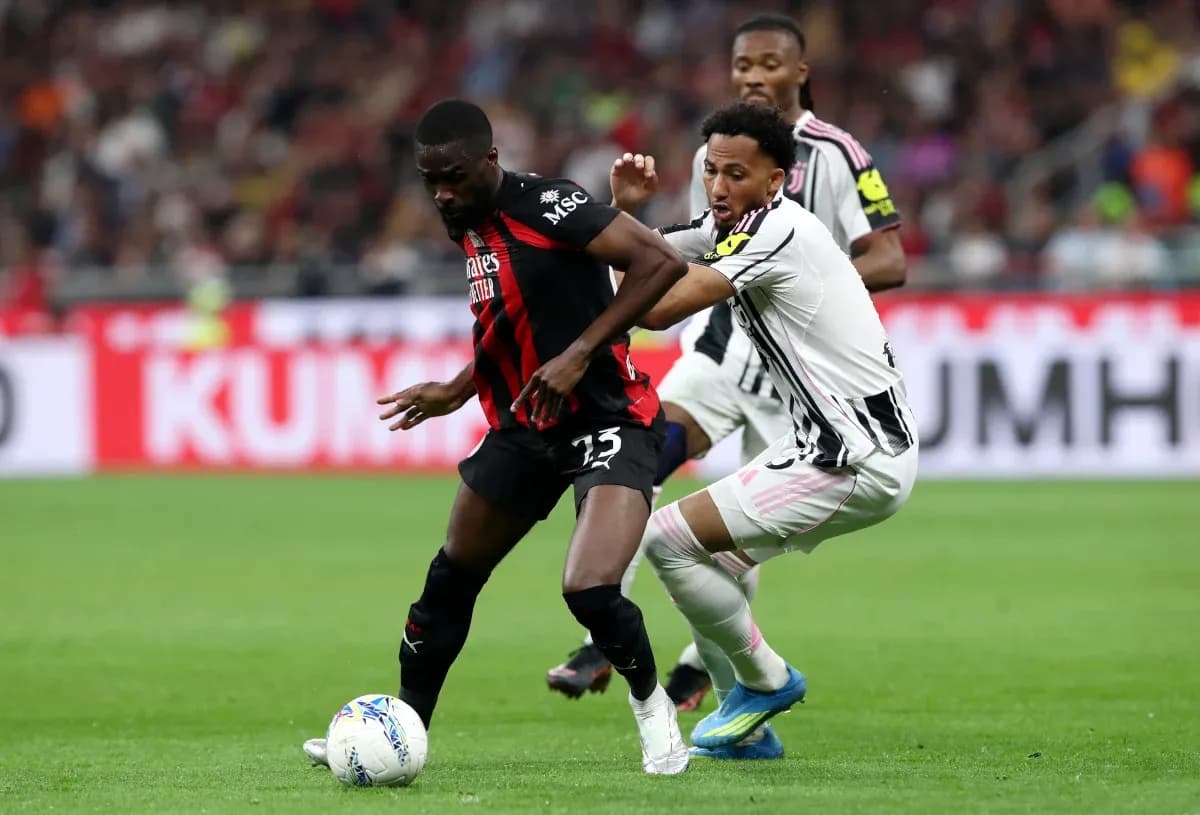
Milan's Tactical Control Shines in 2–0 Victory Over Venezia
Under the lights of San Siro, this was Ruben Amorim’s Milan beginning to look like a fully fledged project rather than a loose collection of marquee names. A 2–0 home win over Venezia, finished in the regular time and sealed after a goalless first half, pushed the Rossoneri to 6 points from 2 league matches, top of Serie A with a goal difference of +3 (4 scored, 1 conceded overall). For Giovanni Stroppa’s Venezia, it was a second straight defeat, leaving them 19th with 0 points and a goal difference of -4 (0 scored, 4 conceded overall).
I. The Big Picture – Structures and Seasonal DNA
Amorim stayed loyal to his early-season template: a 3-4-2-1 that looks like a 3-2-5 in possession. Mike Maignan anchored a back three of M. Gila on the right, K. De Winter central and S. Pavlovic on the left. Ahead of them, a broad four-man band – Samuel Chukwueze and D. Bartesaghi as wing-backs, with Y. Musah and Luka Modric inside – provided the platform for a fluid attacking trio of R. Loftus-Cheek and A. Cisse behind centre-forward Gonçalo Ramos.
Heading into this game, Milan’s numbers already told a story of control and incision. Overall they had played 2 matches, won both, and failed to score in none. At home, they had played 1, won 1, scoring 2 and conceding 0; on their travels, they had played 1, won 1, scored 2 and conceded 1. The offensive profile is clean: 4 goals overall at an average of 2.0 per match, with 2.0 at home and 2.0 away. Defensively, they had conceded just 1 goal overall, an average of 0.5 per match, with 0.0 at home and 1.0 away. One clean sheet had already come at San Siro, and this performance simply extended that pattern.
Venezia arrived with a more fragile identity. Stroppa’s 3-5-2 – F. Stankovic behind a back three of J. Schingtienne, A. Bella-Kotchap and B. Franjic, with R. Haps and A. Hainaut as wide men and a midfield of Kike Pérez, G. Busio and T. Basic behind the forward pair J. Yeboah and A. Adams – has structure, but not yet substance. Heading into this game, Venezia had played 2 matches overall, losing both, with 0 goals scored and 4 conceded. At home, they had played 1, lost 1, scored 0 and conceded 2; on their travels, 1 played, 1 lost, 0 scored and 2 conceded. Their goals against profile is stark: 4 conceded overall at an average of 2.0 per match, with 2.0 at home and 2.0 away. They had failed to score in both fixtures so far.
II. Tactical Voids – Absences and Discipline
Milan’s performance gains extra weight when set against who was missing. R. Leao, a natural left-sided chaos agent, was out with a muscle injury, while F. Tomori and S. Gimenez were sidelined by transfer negotiations, as was Y. Fofana. That forced Amorim to lean into structural control rather than pure individual explosiveness. Pavlovic and Bartesaghi had to provide progression on the left in Leao’s absence, with Modric knitting play from deeper zones.
Venezia were also shorn of depth: A. Adorante (hernia), M. Moreno (health problems) and M. Sverko (hip injury) reduced Stroppa’s options, particularly in rotating his back line and forward line.
Disciplinary trends shaped the risk profile. Milan’s yellow-card distribution this season has been concentrated after the break: 50.00% of their cautions between 46–60 minutes and 50.00% between 61–75. Venezia, meanwhile, are more combustible across the half: 25.00% of their yellows between 16–30 minutes, 50.00% between 46–60, and 25.00% in the 76–90 range. That tendency to pick up cards in the second half, just as Milan’s territorial dominance usually peaks, tilted the attritional battle in the hosts’ favour.
III. Key Matchups – Hunter vs Shield, Engine Room vs Enforcer
The “Hunter vs Shield” duel here was Milan’s emerging strike axis against Venezia’s brittle defensive record. Gonçalo Ramos, already on 1 league goal overall from 2 appearances, is a volume shooter: 10 shots overall with 4 on target, plus 53 passes at 71% accuracy. Flanked by A. Cisse – also on 1 league goal overall, with 4 shots and 16 duels contested, half of them won – and the line-breaking runs of Loftus-Cheek, Milan could attack Venezia’s main weakness: their inability to keep clean sheets. Heading into this game, Venezia had yet to register a single shutout, conceding 2 at home and 2 away.
On the flanks, Chukwueze against Haps and Hainaut was decisive. Chukwueze’s early-season numbers are those of a creative fulcrum: 7 key passes overall, 3 shots (2 on target), 4 dribble attempts with 2 successful, and 4 tackles with 1 shot blocked. He offers both incision and counter-pressing. Haps, by contrast, has been aggressive but exposed: 1 yellow card already, 9 duels overall with only 3 won, and a Venezia side behind him that concedes 2.0 goals per match both home and away. The longer Venezia were pinned back, the more likely Haps was to be dragged into risky defending in the 76–90 window where 25.00% of their yellows arrive.
In the engine room, Modric and Musah faced Kike Pérez and Busio. Pérez has been Venezia’s most industrious midfielder: 92 passes at 78% accuracy, 6 tackles and 19 duels overall with 11 won, plus 1 yellow card. Yet he is often firefighting. Musah’s role was to provide legs around Modric, allowing the Croatian to dictate tempo and feed the advanced trio. With Milan’s overall average of 2.0 goals for and only 0.5 against, the midfield battle was always likely to be about whether Venezia could disrupt patterns rather than impose their own.
IV. Statistical Prognosis – Why 2–0 Felt Inevitable
Even without explicit xG values, the structural and statistical trends pointed towards a Milan win by multiple goals. The league leaders came in with:
- Overall: 2 wins from 2, 4 goals scored, 1 conceded, 1 clean sheet.
- At home: 1 win from 1, 2 scored, 0 conceded.
Venezia, by contrast:
- Overall: 2 losses from 2, 0 scored, 4 conceded, 0 clean sheets.
- On their travels: 1 loss from 1, 0 scored, 2 conceded.
Overlay that with the card timing: Milan tend to avoid early chaos, while Venezia’s yellows cluster around the period where legs tire and defensive shape frays. In a match where Milan’s 3-4-2-1 could patiently suffocate space, the visitors’ defensive line was always likely to crack under sustained pressure.
The 2–0 full-time scoreline at San Siro simply aligned with the underlying data. Milan’s attacking trident of Ramos, Cisse and Loftus-Cheek, fed by Chukwueze and Modric, had too much variety for a Venezia side still searching for their first goal and their first clean sheet of the season. With no penalties taken or missed by either side this campaign, nothing from the spot distorted the balance; this was decided in open play and in the spaces between the lines, where Milan are already operating at Champions League level and Venezia are still fighting to prove they belong.