
Martin O’Neill Confirmed as Celtic’s Permanent Manager Again
Martin O’Neill is set to be confirmed as Celtic’s permanent manager once again, after the 74-year-old agreed a one-year deal to stay in Glasgow – with an option to stretch the reunion into a second season.
The decision ends a fraught few weeks behind the scenes and restores one of the club’s most significant modern figures to the role he first illuminated more than a quarter of a century ago.
O’Neill, again
O’Neill walked back into Celtic Park last season as a firefighter, not a long-term architect. Brendan Rodgers’ resignation in October left the club scrambling; O’Neill answered the call, stabilised the dressing room and, crucially, kept the Premiership trophy in the east end of Glasgow.
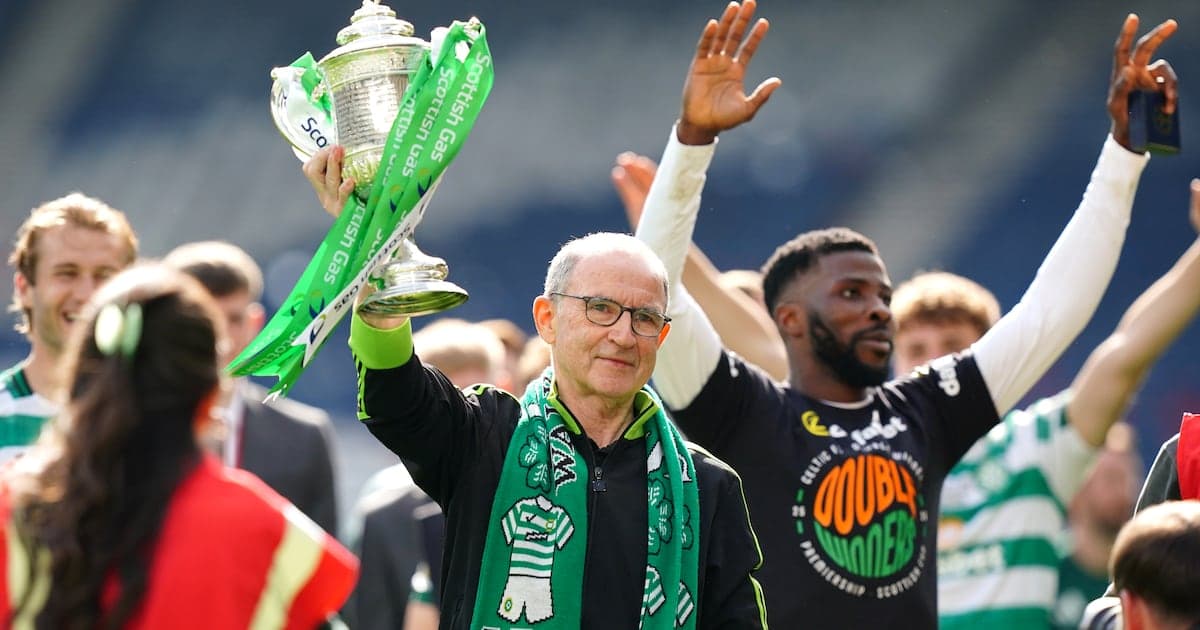
Wilfried Nancy was then brought in as the supposed new era. It collapsed almost immediately. Eight chaotic games later, the Frenchman was gone and O’Neill, once more, was asked to steady the ship. He did more than that. Celtic not only retained their league crown but completed a domestic double, finishing the season with a Scottish Cup final win over Dunfermline.
After that Hampden victory, O’Neill did not rush into anything. He asked for time, stepped back, weighed up whether he wanted the grind again at this stage of his life. Inside Celtic, though, there was a strong feeling that the Northern Irishman still had the appetite. The talks that followed have now produced a one-year agreement, with scope for another, that keeps him in charge.
Keane talk, Keane backlash
For a while, it looked like the story would go another way. Robbie Keane moved sharply into focus as a leading candidate, holding discussions this week with Dermot Desmond, Celtic’s principal shareholder.
Keane, a club icon as a player in the eyes of many, was a very different proposition as a manager. His recent work in Israel with Maccabi Tel Aviv, followed by a stint in Hungary at Ferencvaros before resigning at the end of May, sparked anger among a section of the Celtic support. The reaction was loud, organised and hostile to the idea of his appointment.
That fury mattered. It fed into a sense that, for all Keane’s profile and Desmond’s interest, this was a battle that would be fought not just on football terms but on the club’s moral and political terrain. As the noise around Keane grew more toxic, the logic of turning back to O’Neill hardened.
A circle closes
Desmond first persuaded O’Neill to leave Leicester for Glasgow 26 years ago. The impact of that decision still shapes how Celtic measure themselves. Under O’Neill’s first reign, the club won three Scottish titles, three Scottish Cups and two Scottish League Cups, and marched all the way to the 2003 Uefa Cup final, losing an epic to José Mourinho’s Porto.
Those years built a bond between manager, club and support that never really faded. It is that history Celtic are now tapping into again, not as a nostalgia project, but as a stabilising force at a time when recent gambles have failed.
O’Neill returns not as the young, sharp disruptor of 2000, but as a seasoned figure who has already proven, twice this season, that he can still organise, motivate and deliver trophies. The domestic double he has just completed gives him a platform. The contract gives him authority.
The next step is his. How far can a 74-year-old who once dragged Celtic to the brink of European glory drive this modern version of the club?



