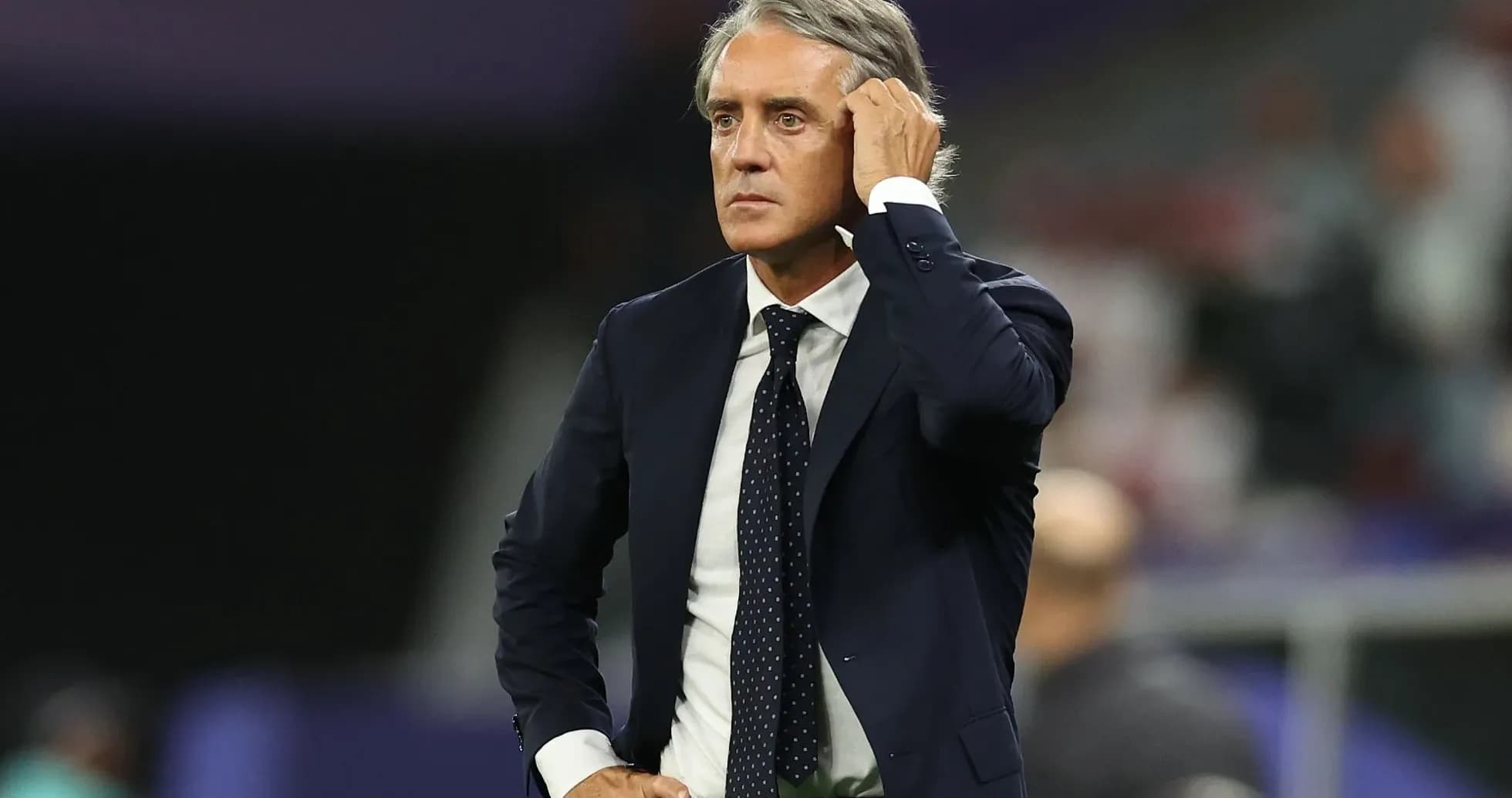
Roberto Mancini Returns to Lead Azzurri Amid FIGC Turmoil
Roberto Mancini is back in charge of the Azzurri. After weeks of confusion, political maneuvering and late-night U-turns inside the FIGC, Italian football has circled back to a familiar face to lead the national team.
The federation confirmed Mancini’s return in an official social media post, with Sky Italia reporting that his formal presentation is set for Wednesday. He steps in after Gennaro Gattuso’s resignation in April, ending a chaotic search that burned through primary targets and exposed deep fractures at the top of the game.
Mancini arrives fresh from a brief spell with Qatari side Al-Sadd, and after his most recent international stint with Saudi Arabia. Now, he is tasked with rebooting Italy once more, a job he knows intimately and a stage he clearly still craves.
Pirlo Blocked, Maldini and Leonardo Walk Out
The road back to Mancini was anything but smooth.
The FIGC had lined up Andrea Pirlo, only for president Giovanni Malagò to slam the brakes at the last moment. The appointment was effectively done when Malagò intervened, blocking Pirlo over his ambassadorial role with a Russian betting company.
That decision detonated inside the federation.
Technical director Paolo Maldini and adviser Leonardo, both only 16 days into their posts, resigned on the spot. Two of the most respected figures in Italian football walked away in protest, leaving the project looking rudderless and exposed.
What should have been a new era quickly turned into a public power struggle. With time ticking and a major vacancy still open, the FIGC had to move.
Malagò Turns to a Proven Operator
Under pressure, Malagò reached for certainty.
“Time was running out and I thought the right person to be coach was Roberto Mancini. He's the best possible choice,” he told the media on Tuesday, laying out his reasoning after the storm that followed the Pirlo decision.
The choice is pragmatic as much as it is symbolic. Mancini knows the Italian environment, understands the expectations, and has already carried the weight of the Azzurri bench. After negotiations with several other leading candidates stalled, the federation circled back to the man they trusted most to steady the ship quickly.
But Malagò’s reset did not stop with the coach.
Ranieri Joins as Technical Director
To reinforce the new structure, the FIGC has turned to another veteran of the European game: Claudio Ranieri.
The former Leicester City manager, a legend in his own right after that historic Premier League title, has agreed to come in as technical director. Malagò was keen to underline that the role remains central to the project, clarifying that the position “has not disappeared” and pointing to a recent statute amendment that allows another figure to also serve as president of Club Italia.
“I needed someone to share the choice of Roberto Mancini as coach, and that person is Claudio Ranieri, who signed his commitment a few minutes ago,” Malagò said.
Ranieri’s arrival gives Mancini a heavyweight ally at the top of the sporting structure, a sounding board with decades of experience in managing dressing rooms, expectations and crises.
A Return Framed by Pressure
This is not a romantic reunion. It is a rescue mission.
Italy turn back to Mancini not from a position of strength, but from a place of urgency and internal conflict. The federation has lost Maldini and Leonardo in a single, dramatic stroke. Its president has taken a hard public stance on ethical and commercial lines. The coaching search has played out in full view.
Now Mancini and Ranieri step into that storm together.
The coach returns to a national side still searching for stability and identity, the technical director arrives to help reshape the framework around him. Between them, they carry decades of experience, titles, sackings, comebacks and reinventions.
The FIGC has made its bet: trusted hands, proven names, no more experiments.
Whether that is enough to calm the waters and push Italy back toward the summit of the international game will be answered not in press rooms or board meetings, but on the pitch in the months ahead.