Manchester United Defeats Nottingham Forest 3-2 at Old Trafford
Manchester United’s 3-2 win over Nottingham Forest at Old Trafford unfolded as a high-volume, territorially balanced contest where United’s structure and attacking repetition eventually overwhelmed Forest’s more direct 4-4-2. Despite Forest edging possession 51%-49%, the hosts generated far more threat, reflected in a 29–11 shot count and a striking xG split of 4.19 to 1.75.
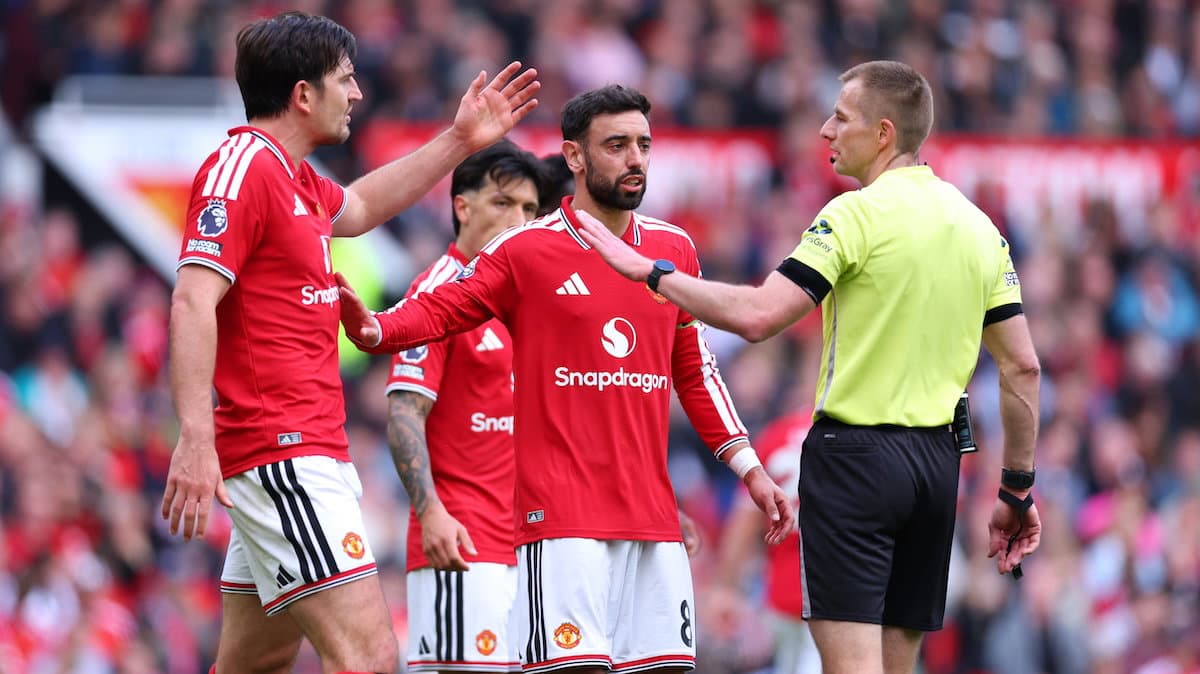
United’s 4-2-3-1 under Michael Carrick was built on a stable back four and an assertive double pivot. S. Lammens in goal had a relatively quiet shot-stopping afternoon (2 saves, 0.01 goals prevented), protected by D. Dalot, Harry Maguire, Lisandro Martinez and Luke Shaw. In front, Casemiro and Kobbie Mainoo formed the platform, with Amad Diallo and B. Mbeumo wide, Bruno Fernandes as the central creator and M. Cunha as a roaming attacking midfielder behind Mbeumo as the nominal forward.
The early goal from Shaw in the 5th minute set the tactical tone. Shaw’s advanced positioning from left-back illustrated United’s intent to pin Forest’s wide midfielders, particularly O. Hutchinson, deep. With 7 corners and 21 of 29 shots coming from inside the box, United repeatedly created overloads down the flanks, then attacked the penalty area with numbers. The passing data underlines control with purpose: 427 passes, 376 accurate (88%), showing United were not sterile in possession but consistently progressing play into dangerous zones.
Forest’s 4-4-2, set by Vitor Pereira, was more vertical. M. Sels in goal (5 saves, 0.01 goals prevented) faced sustained pressure but kept Forest alive long enough for their counters and set plays to matter. The back four of N. Williams, Nikola Milenkovic, Morato and L. Netz had to defend large spaces, with the midfield line of Hutchinson, N. Dominguez, Elliot Anderson and M. Gibbs-White shuttling laterally to plug gaps. Up front, Igor Jesus and C. Wood sought to exploit transitions and crosses, evidenced by Forest’s 11 shots all from inside the box and 6 corners, showing they were dangerous whenever they reached the final third.
The second half reshaped the contest. Morato’s 53rd-minute equaliser, assisted by Anderson, came from Forest’s ability to push their centre-backs into advanced set-piece or second-phase positions. It highlighted United’s vulnerability when their aggressive full-backs left space for Forest to attack deliveries. Yet United’s response was immediate and structurally revealing. M. Cunha’s 55th-minute strike, later confirmed by VAR at 57’, typified the value of the advanced No.10 lane: he found space between Forest’s lines, exploiting the gap between the double pivot and centre-backs. The VAR confirmation underlined how fine the margins were around United’s high central occupation, but the goal stood and reasserted their dominance.
From there, United leaned even more into their attacking rotations. B. Mbeumo’s 76th-minute goal, assisted by Bruno Fernandes, was a direct product of United’s layered right-side patterns: Dalot’s width, Diallo’s inside movements and Bruno’s half-space presence pulled Forest’s block apart, leaving Mbeumo to attack the box from a forward starting position. That made it 3-1 and crystallised United’s superiority in chance quality relative to the raw possession split.
Forest’s substitutions at 70’ — T. Awoniyi (IN) for C. Wood (OUT), I. Sangare (IN) for N. Dominguez (OUT), and D. Bakwa (IN) for O. Hutchinson (OUT) — were an attempt to inject power and ball-winning into midfield while refreshing the front line. The intent was clear: win more second balls and break faster against a United side committing numbers forward. They were partially rewarded when M. Gibbs-White scored in the 78th minute, again assisted by Anderson, trimming the score to 3-2. That goal reflected Forest’s best attacking pattern: Gibbs-White drifting into pockets from the left half-space, combining with Anderson’s forward passing to attack the heart of United’s defence.
Carrick’s response was swift and conservative in structure. At 80’, J. Zirkzee (IN) came on for B. Mbeumo (OUT), and P. Dorgu (IN) for M. Cunha (OUT), followed by M. Mount (IN) for Casemiro (OUT) at 81’. These changes subtly rebalanced the side: Zirkzee offered a more back-to-goal reference to retain possession, Dorgu added fresh legs and defensive security on the flank, and Mount’s energy in midfield helped United contest transitions more aggressively after Casemiro’s booking.
Discipline played a minor but telling role. United collected two yellow cards: Casemiro at 78’ — Foul — and Luke Shaw at 90+3’ — Foul. Forest had one: Elliot Anderson at 90+4’ — Foul. The low foul count (11 for United, 5 for Forest) and modest card total (Manchester United: 2, Nottingham Forest: 1, Total: 3) indicate a game more defined by tactical structure than by disruption. Yet the timing is important: United’s cards came as they tried to protect a narrowing lead, while Anderson’s late booking reflected Forest’s urgency and frustration as they chased an equaliser.
Statistically, the verdict is clear. United’s 4.19 xG versus Forest’s 1.75 aligns tightly with the 3-2 scoreline but suggests the hosts could easily have won by a wider margin. United’s 29 total shots to Forest’s 11, coupled with a near parity in passes (United 427, Forest 447), show that Forest’s 51% possession was largely spent outside the most dangerous zones. United’s 88% pass accuracy against Forest’s 84% further underlines the hosts’ technical edge in tight attacking areas.
Defensively, both goalkeepers’ goals prevented figures (0.01 each) suggest that the scoreline was broadly in line with shot quality rather than being heavily skewed by exceptional shot-stopping. Lammens was protected by volume control — Forest simply did not generate enough high-quality looks — while Sels was exposed by repeated incursions into his box.
Overall, Manchester United’s 4-2-3-1 offered superior vertical layering and box occupation, leveraging Bruno Fernandes, M. Cunha and the full-backs to consistently outnumber Forest in key zones. Forest’s 4-4-2 carried sporadic threat, especially through Anderson’s creativity and Gibbs-White’s movement, but lacked the sustained territorial pressure to turn their 51% possession into a higher xG or more shots. The 3-2 result at Old Trafford, in Premier League Regular Season - 37, therefore reads as a fair reflection of structural superiority, tempered by Forest’s resilience and efficiency when they did manage to reach United’s penalty area.