Everton vs Sunderland: Tactical Analysis of a 1-3 Defeat
Everton’s 1-3 defeat to Sunderland at Hill Dickinson Stadium unfolded as a study in contrasting efficiency within the same base structure. Both sides lined up in a 4-2-3-1, but while Everton’s version front-loaded control and territorial pressure, Sunderland’s was built to absorb, recalibrate, and strike with precision in transition and late-game management. The home side carried a 1-0 lead into half-time and generated the higher xG (1.07 to 0.73), yet Sunderland’s superior structural balance, in-possession composure, and substitution impact turned the match decisively after the interval.
First Half
Everton’s 4-2-3-1 under Leighton Baines was aggressive and front-footed. With Jordan Pickford behind a back four of J. O’Brien, James Tarkowski, Michael Keane, and Vitaliy Mykolenko, the home side pushed their full-backs high, particularly Mykolenko, to pin Sunderland’s wide midfielders. The double pivot of James Garner and Tim Iroegbunam was tasked with both screening and progressing; Garner often dropped alongside the centre-backs to initiate build-up, while Iroegbunam stepped into the right half-space to support the advanced trio of M. Rohl, Kiernan Dewsbury-Hall, and I. Ndiaye behind Beto.
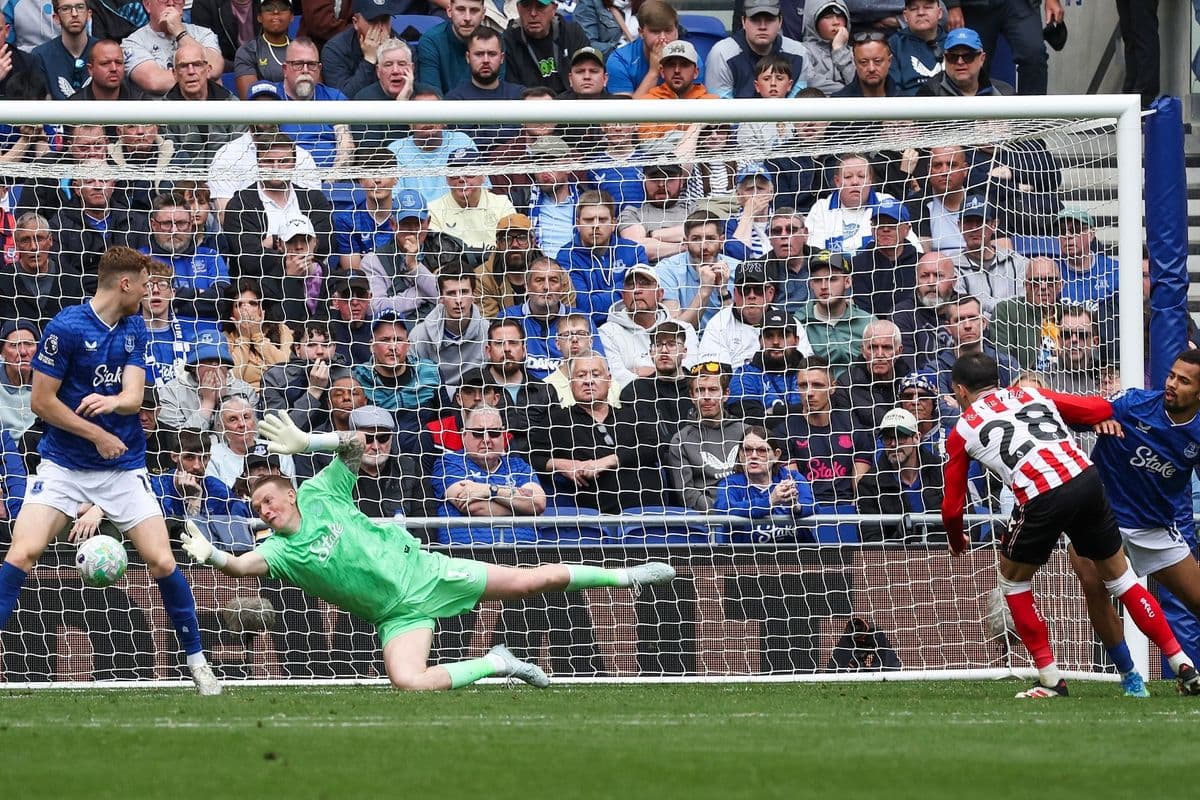
This structure produced volume: 10 total shots, 6 inside the box, and 4 on target, as well as 406 passes, 346 accurate (85%). The first-half pattern reflected that intent. Everton’s pressing from the front, led by Beto and Ndiaye, forced Sunderland into safer circulation through their double pivot, limiting Sunderland to 7 shots overall by full-time. The breakthrough on 43 minutes was a direct product of this territorial dominance and set-piece or second-phase presence: M. Rohl’s goal, assisted by Michael Keane, encapsulated Everton’s use of a centre-back stepping into advanced zones or winning key duels to create shooting chances.
However, this same aggression carried a cost. Everton committed 14 fouls and collected 3 yellow cards, all for “Foul”, signalling a defensive line and midfield that were frequently a step late once Sunderland began to move the ball more cleanly. Iroegbunam’s booking on 25 minutes hinted at the strain on the double pivot when Sunderland’s midfield rotated and tried to draw them out. Jake O’Brien’s yellow card at 47 minutes, again for “Foul”, underlined how Everton’s back line was increasingly exposed in wide and half-space channels as they chased a second goal.
Second Half
Sunderland’s 4-2-3-1 under Regis Le Bris was initially conservative but structurally sound. R. Roefs, who made 3 saves and posted 0.02 goals prevented, sat behind a back four of Lutsharel Geertruida, Nordi Mukiele, Omar Alderete, and Reinildo Mandava. In front, Granit Xhaka and N. Sadiki (later replaced) provided a stable double pivot, with T. Hume, E. Le Fee, and N. Angulo supporting B. Brobbey. Their 430 passes, 365 accurate (85%), and 51% possession show that, despite Everton’s pressure, Sunderland grew into the game and ultimately controlled key phases.
The tactical turning point came after half-time. Sunderland’s equaliser on 59 minutes, B. Brobbey finishing from an E. Le Fee assist, showcased their improved vertical connections: Le Fee found pockets between Everton’s lines as the home double pivot tired and the centre-backs were reluctant to step out. That goal shifted the psychological and tactical momentum. Almost immediately, Sunderland adjusted personnel to sharpen their attacking transitions: at 60 minutes, T. Hume (OUT) made way for C. Talbi (IN), adding fresh energy and directness higher up.
Baines’ response was a double substitution on 73 minutes that inadvertently blunted Everton’s structure. T. George (IN) came on for T. Iroegbunam (OUT), and T. Barry (IN) replaced Beto (OUT). Removing Iroegbunam weakened the screening in front of the defence at precisely the moment Sunderland were attacking more aggressively through the middle. Swapping Beto for Barry altered the reference point up front: Everton lost a central target who could occupy centre-backs and hold long balls, which reduced their ability to relieve pressure and maintain territory.
Le Bris, by contrast, orchestrated a decisive triple change on 77 minutes that re-energised every attacking lane. C. Rigg (IN) replaced N. Angulo (OUT), H. Diarra (IN) came on for N. Sadiki (OUT), and W. Isidor (IN) took over from B. Brobbey (OUT). This injected dynamism between the lines and in the channels. The 81st-minute goal, scored by E. Le Fee and assisted by C. Rigg, was a direct payoff: Rigg’s fresh movement and vision destabilised Everton’s now-weaker midfield shield, allowing Le Fee to arrive into dangerous zones with time to finish.
At 88 minutes, Baines turned to experience, with S. Coleman (IN) for J. O’Brien (OUT) and D. McNeil (IN) for M. Rohl (OUT). These changes aimed to restore control and add crossing quality, but they arrived after Sunderland had already seized the initiative. Everton’s structure by then was stretched: Coleman pushing on, McNeil seeking to create from wide, and Dewsbury-Hall and Ndiaye trying to force play centrally. That imbalance left transition gaps, exploited ruthlessly in the 90th minute when W. Isidor scored, assisted by H. Diarra. Sunderland’s late 3-1 lead was the culmination of their superior game management: fresh legs in all attacking roles, a stable double pivot anchored by Xhaka, and full-backs who timed their advances rather than committing recklessly.
Discipline and defensive behaviour tell the rest of the story. Sunderland committed only 9 fouls and received no yellow cards, reflecting both better positional play and less desperation in defensive actions. Everton’s third yellow, James Garner’s at 90+6 minutes for “Foul”, symbolised a team chasing lost ground and arriving late into challenges. While Pickford registered 0 goalkeeper saves and 0.02 goals prevented, suggesting Sunderland’s shots were either high-quality or beyond his reach, Roefs’ 3 saves were crucial in preserving Sunderland’s platform to come back.
Statistically, Everton’s higher xG and shot volume indicate they were not outplayed in raw chance creation, but Sunderland’s chance quality, timing, and substitution impact were superior. Everton’s 49% possession and 3 corner kicks against Sunderland’s 2 show a relatively balanced territorial battle, yet Sunderland’s clearer identity in the second half—controlled possession, incisive vertical play, and well-timed substitutions—translated into a clinical 1-3 away win despite trailing 1-0 at half-time.