Manchester United vs Manchester City: Tactical Analysis of the Derby
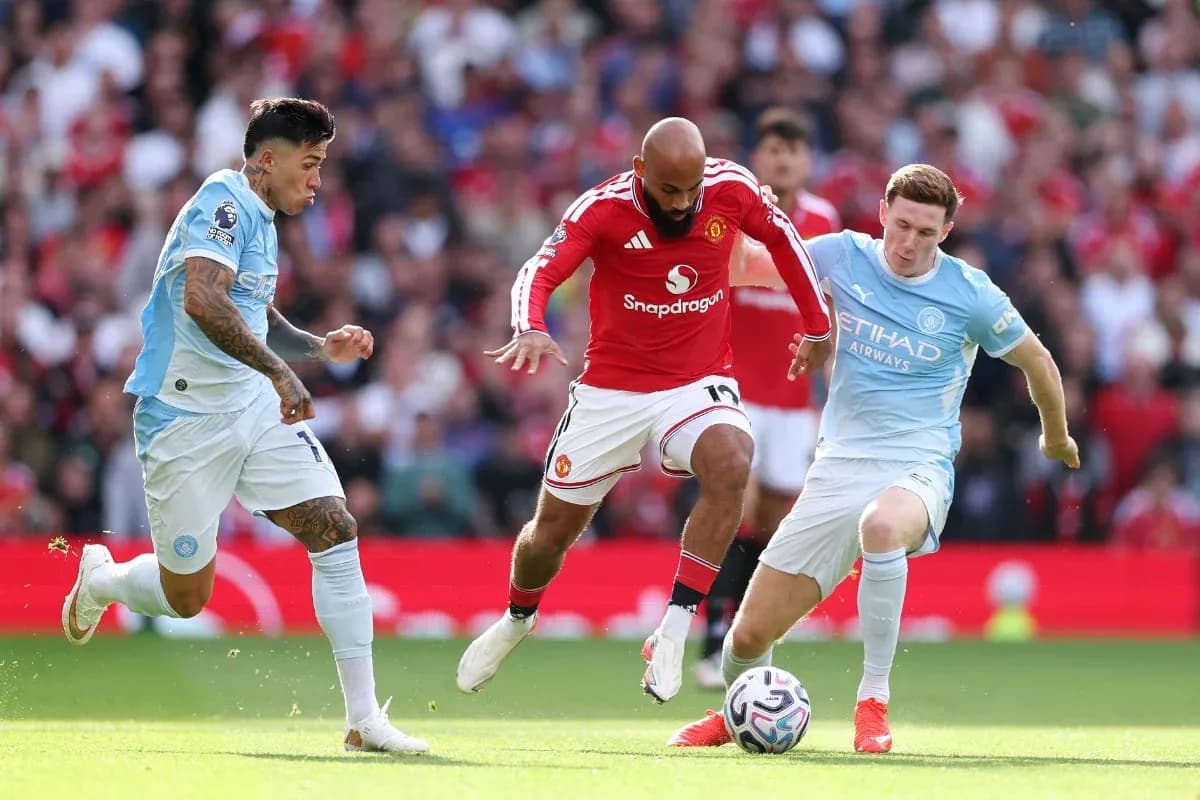
Old Trafford under grey Manchester skies, the Premier League’s “Regular Season - 4” derby closes with a narrow, brutal clarity: Manchester United 0–1 Manchester City. Over 90 minutes, Michael Oliver’s whistle framed a story of contrasting trajectories – United sitting 13th with 4 points and a goal difference of 0, City second with 12 points and a goal difference of 6 – and the squads on the pitch told you exactly why.
I. The Big Picture – Two 4-2-3-1s, Two Different Worlds
Both sides lined up in a mirrored 4-2-3-1, but the shapes carried very different identities.
Manchester United’s version under M. Carrick was a patchwork born of absences. S. Lammens in goal, a back four of Diogo Dalot, H. Maguire, Lisandro Martínez and P. Dorgu, a double pivot of Y. Tielemans and K. Mainoo, with an attacking line of B. Mbeumo, Bruno Fernandes, M. Rashford behind Matheus Cunha.
Heading into this game, United’s season numbers painted an unstable picture: overall they had played 4, winning 1, drawing 1 and losing 2, scoring 7 and conceding 7. At home, though, there was a more expansive, risky profile – 5 goals scored and 3 conceded in 2 matches, an average of 2.5 goals for and 1.5 against. No clean sheets anywhere, and they had already failed to score twice in total. This is a side that lives on the edge, and City were always likely to push them over it.
Manchester City’s 4-2-3-1 under E. Maresca was the structure of a team fully in its rhythm. G. Donnarumma in goal, a back line of Matheus Nunes, M. Guéhi, Rúben Dias and J. Gvardiol, a midfield base of E. Fernández and E. Anderson, with P. Foden, R. Cherki and A. Semenyo supporting E. Haaland.
City arrived with a perfect record: overall 4 wins from 4, 8 scored and just 2 conceded. On their travels they had been ruthless – 2 away games, 2 wins, 5 scored and only 1 conceded, averaging 2.5 goals for and 0.5 against away. Two clean sheets overall, zero games without scoring. This was an away machine rolling into a fragile home.
II. Tactical Voids – Absences and Discipline
United’s squad sheet revealed the scale of the surgery. C. Baleba (ankle), A. Diallo, T. Heaton, L. Shaw, M. Ugarte (knee) and M. de Ligt (back) were all missing. That list strips Carrick of a starting-calibre left-back in Shaw, a cornerstone centre-back in de Ligt and a ball-winning shield in Ugarte. The consequence was a back four where Maguire and Martínez had to defend higher and wider than ideal, with Dorgu thrust into a high-pressure derby.
Those absences also shaped the midfield. Without Ugarte, Tielemans and Mainoo were tasked with both progression and protection. Given United’s card profile heading into this game – yellow cards clustered late, with 50.00% of their cautions arriving between 76–90 minutes – fatigue and stretched distances in the second half were always going to be a risk.
City’s only listed absentee was J. Doku with a calf injury. One winger missing, but the structure intact. Maresca could still field Cherki, Foden and Semenyo as a rotating band of creators and pressers behind Haaland, with a bench that included M. Kovačić, I. Ndiaye and others to adjust the game state.
Disciplinary trends underlined the contrast. City’s season yellow-card distribution also peaked late – 42.86% of their cautions between 76–90 minutes – but crucially they had already shown they can survive with a red: Foden carried 1 red card this season. They know how to manage chaos and still win. United’s defensive leader Maguire, on the other hand, came in with 2 yellows in 4 games and 7 fouls committed; his aggression is both asset and liability in a derby that demands precision.
III. Key Matchups – Hunter vs Shield, Engine Room vs Enforcer
Hunter vs Shield was brutally straightforward: E. Haaland against a United defence that had yet to keep a clean sheet. Haaland entered as the league’s top scorer, with 4 goals in 4 appearances, 15 shots (9 on target) and a rating of 7.91. He is the purest expression of City’s away profile: they average 2.5 goals for and only 0.5 against away, and he is the spearhead of that efficiency.
United’s “shield” is a collective more than an individual. Maguire’s numbers – 34 duels contested, 21 won, 1 blocked shot – show a defender who will step into contact, but he is often exposed by the team’s structure. With Dorgu still bedding in and Dalot asked to advance, the central pairing had to handle Haaland’s runs, Cherki’s between-the-lines drifting and Semenyo’s constant duels (47 contested this season). The 0–1 scoreline ultimately reflects City’s superiority in that duel: they needed only one breakthrough to punish a defence that statistically concedes 1.8 goals per game overall.
In the Engine Room, Bruno Fernandes versus City’s midfield triangle of Fernández, Anderson and Cherki defined United’s attacking ceiling. Bruno arrived as United’s creative heartbeat: 3 goals, 1 assist, 9 key passes and 262 total passes at 85% accuracy in 4 games. He is both their top scorer and joint-top assister, and he had also converted United’s only penalty of the season (1 scored, 0 missed).
But City’s structure was built to suffocate him. Fernández’s positional discipline and Anderson’s legs in the double pivot, combined with Cherki’s intelligent pressing from the 10 space, formed a cage around United’s playmaker. Cherki himself is a dual threat – 2 goals, 2 assists, 10 key passes, 1 blocked shot – and his presence between the lines forced Tielemans and Mainoo to stay deeper, robbing Bruno of close support.
On the flanks, the battle of risk and reward was clear. Rashford and Mbeumo were United’s out-balls, but their ability to isolate Matheus Nunes and Gvardiol depended on United escaping City’s press. With City’s wide creators – Foden (2 assists, 7 key passes, 6 fouls drawn) and Semenyo (2 assists, 7 key passes, 47 duels) – doubling as aggressive pressers, United were often pinned back, their 4-2-3-1 collapsing into a 4-4-1-1 under pressure.
IV. Statistical Prognosis – Why 0–1 Felt Inevitable
Viewed through the season’s statistical lens, the 0–1 scoreline feels less like a twist and more like a confirmation.
Heading into this game, United’s overall goals for and against were perfectly balanced at 7–7, but the underlying patterns were worrying: no clean sheets, 2 games in total without scoring, and a late-card profile that hinted at tired legs and tactical strain. Their favourite home scoreline was a chaotic 5–2 win; their heaviest home defeat a 0–1. This match slotted neatly into that latter template: when their attacking edge is blunted, their defensive frailty is exposed by one decisive moment.
City’s numbers, by contrast, screamed control. Overall they averaged 2.0 goals for and just 0.5 against, with 2 clean sheets in 4 and no matches without scoring. On their travels, 5 goals scored and 1 conceded in 2 games underlined a side that manages away derbies with cold efficiency. Donnarumma arrived with a platform of protection – City’s back line had conceded only 2 goals overall – and the collective pressing in front of him kept United’s main threats at arm’s length.
In the “Hunter vs Shield” narrative, Haaland’s profile – 4 goals from 9 shots on target, 30 duels contested and 17 won – was always likely to tilt the contest. In the “Engine Room”, Cherki’s 10 key passes and 2 assists, supported by Foden and Semenyo’s combined 4 assists and 14 key passes, gave City multiple creative conduits. United, by contrast, leaned heavily on Bruno; shut him down, and their 1.8 goals-per-game overall average becomes theoretical.
Following this result, the story of the squads is one of divergence. City’s 100% start and iron defensive record are perfectly aligned with the profiles of Haaland, Cherki, Foden and a back line anchored by Rúben Dias and Guéhi. United’s uneven form, injury-hit defence and dependence on Bruno Fernandes mirror a side that can thrill but cannot yet control.
At Old Trafford, the numbers and the narrative met in the same place: a single City goal, another clean sheet for an away machine, and a United squad still searching for balance in the shadow of a neighbour at full power.