Manchester United vs Ipswich: Premier League Showdown Analysis
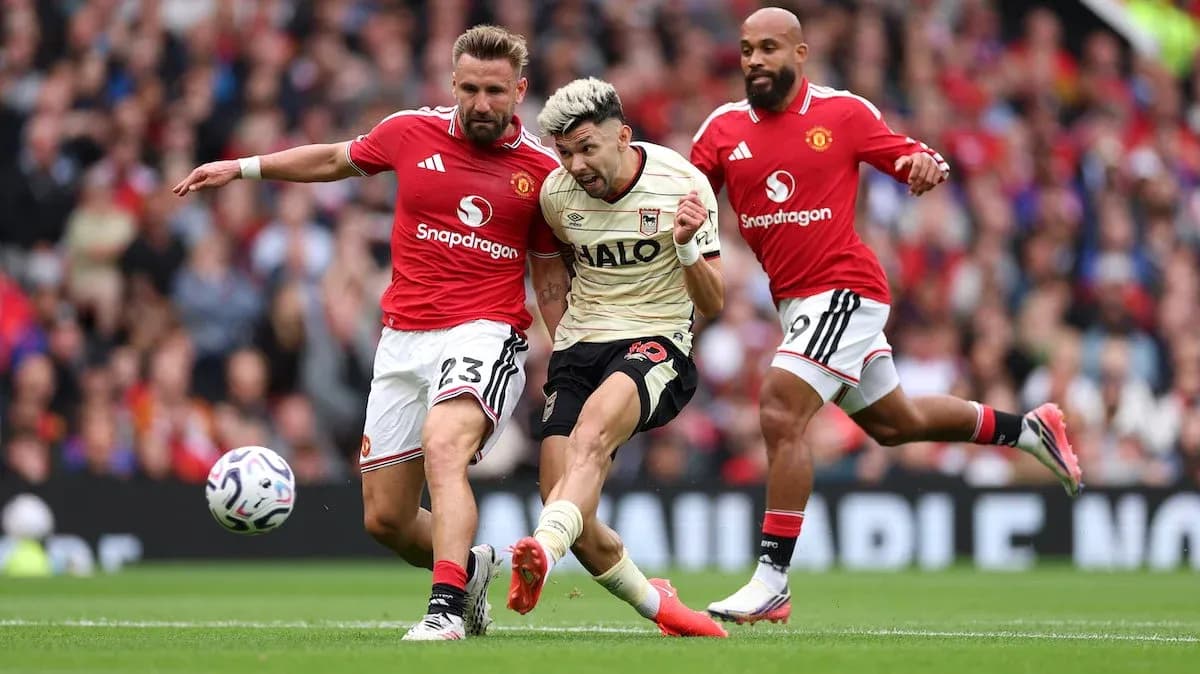
Old Trafford under late‑summer cloud felt oddly like a proving ground rather than a theatre. Round 2 of the Premier League, Manchester United already wobbling after an away defeat, Ipswich arriving with the bounce of an opening‑day win. Ninety minutes later, the scoreboard read 5‑2 to United, and the shape of both squads – their strengths, gaps and identities – was thrown into sharp relief.
I. The Big Picture – Early‑season identities
Following this result, United sit 10th with 3 points from 2 matches, their goal difference a precise +1 (5 scored, 4 conceded). The numbers sketch a side that is front‑loaded and volatile: overall they average 2.5 goals for per game and 2.0 against. At Old Trafford, the profile is even more extreme – 5 goals scored and 2 conceded in their only home outing so far, an attacking avalanche paired with structural looseness.
Ipswich, 12th with 3 points, carry the mirror image. Overall they have 4 goals for and 6 against, a goal difference of -2. On their travels, the story is stark: in their single away game they have scored 2 but shipped 5, an average of 2.0 goals for and 5.0 against. This is a side that can hurt you, but bleeds heavily when the game stretches.
Both managers doubled down on 4‑2‑3‑1, but the systems told different stories. Michael Carrick’s United looked like a high‑ceiling project: S. Lammens trusted in goal behind a back four of D. Dalot, H. Maguire, L. Martinez and L. Shaw, a double pivot of Y. Tielemans and K. Mainoo, and a fluid band of three – B. Mbeumo, B. Fernandes, M. Rashford – behind M. Cunha. It is an XI built for dominance of territory and ball, and the scoreline reflected that ambition.
Gary O’Neil’s Ipswich mirrored the shape but not the control. K. Scherpen started in goal behind D. O’Shea, I. Diop, J. Greaves and L. Davis. S. Lukic and M. Nunez sat as the midfield screen, with I. Fatawu and D. Maeda flanking J. Enciso behind Emersonn. The structure promised vertical transitions and aggressive wide play rather than long spells of possession.
II. Tactical Voids – Absences and discipline
United’s team sheet was shaped as much by those missing as those present. C. Baleba (ankle injury), A. Diallo, T. Heaton, M. Mount (foot), M. Ugarte (knee) and M. de Ligt (back) were all ruled out. That cluster of absences in the spine – a deep midfielder in Ugarte, a ball‑winning option in Baleba, a senior centre‑back in de Ligt and a linking eight/ten in Mount – forced Carrick to lean heavily on Mainoo’s composure and Tielemans’ passing to connect defence and attack.
Ipswich’s voids were more about control and guile. Florentino (inactive), A. Matusiwa, J. Philogene and J. Taylor (knee) all missed out. Without Matusiwa’s ball‑winning and Philogene’s creativity between the lines, O’Neil had to stretch Enciso’s responsibilities as both playmaker and presser, and trust Fatawu and Maeda to provide the chaos out wide.
In disciplinary terms, the broader season pattern matters. United have yet to receive a red card this campaign, and their yellow‑card profile is oddly concentrated: 50.00% of their bookings have arrived between 31‑45 minutes, and 50.00% in added time from 91‑105 minutes. That hints at emotional spikes around half‑time and the closing stretch. Ipswich’s yellows cluster earlier: 66.67% between 31‑45 minutes and 33.33% from 46‑60, suggesting a side that tackles aggressively as the first half opens up and just after the restart.
P. Dorgu, who has already been booked once in just 55–63 minutes of league action for United, lurked on the bench here as a high‑risk, high‑energy option. On Ipswich’s side, I. Fatawu’s early‑season yellow and combative duel numbers underlined the possibility of a flashpoint down United’s left.
III. Key Matchups – Hunter vs Shield, and the engine room
The headline duel was always going to orbit Bruno Fernandes. Heading into this game he was already the league’s top‑rated player, with 3 goals and 1 assist in 180 minutes, 5 shots (4 on target) and 151 passes at 84% accuracy. Operating as the central 10 in the 4‑2‑3‑1, he became the hunter in the “Hunter vs Shield” narrative, testing an Ipswich defence that, away from home, had already conceded 5.
Ipswich’s “shield” was less a single player than the triangle of I. Diop, J. Greaves and S. Lukic. Diop and Greaves were tasked with dealing with Cunha’s movement and Rashford’s diagonal runs from the left, while Lukic had to step out to Bruno without leaving oceans of space behind him. In practice, that triangle was pulled apart: Tielemans’ passing range and Mainoo’s press resistance allowed United to find Bruno between the lines, forcing Lukic to choose between protecting his centre‑backs or closing the Portuguese playmaker. Too often, he could do neither.
Out wide, the duel between M. Rashford and D. O’Shea on United’s left, and B. Mbeumo against L. Davis on the right, defined the game’s rhythm. With Ipswich’s away record showing 2 goals scored but 5 conceded, their full‑backs were always likely to be overloaded. Fatawu and Maeda, both attack‑minded, offered little consistent protection, leaving O’Shea and Davis in repeated two‑v‑one situations as Dalot and Shaw advanced.
In the engine room, K. Mainoo and Y. Tielemans faced S. Lukic and M. Nunez. Mainoo’s calm under pressure allowed United to play through Ipswich’s first line, while Tielemans’ ability to switch play quickly exposed Ipswich’s horizontally stretched block. For Ipswich, Nunez’s remit was to break lines and feed Enciso and Emersonn early; when they did escape, Emersonn’s early‑season numbers – 1 goal, 3 shots with 2 on target, 18 duels with 8 won – showed why he started as the central forward. His willingness to run channels did trouble Maguire, but Ipswich could not sustain enough pressure to tilt the tie.
Further up, J. Enciso and Fatawu formed Ipswich’s creative axis. Enciso, already with 2 assists, 47 passes at 85% accuracy and 11 dribble attempts (6 successful), floated between the lines, trying to exploit any looseness in the Maguire–Martinez partnership. Fatawu, with 5 key passes and 12 dribble attempts (6 successful), aimed to isolate Shaw and drive inside. The plan produced flashes – Ipswich scored twice – but with United’s front four repeatedly forcing Ipswich back, their influence ebbed.
IV. Statistical Prognosis – Where this leaves both squads
United’s season numbers now describe a side that will live and die by its attack. At home they average 5.0 goals for and 2.0 against, with no clean sheets and no home games failed to score. Overall, they have converted their single penalty of the campaign, maintaining a 100.00% record from the spot so far. The defensive metrics – 4 conceded in 2, no clean sheets – warn that better sides than Ipswich will punish them, but the sheer firepower, orchestrated by Bruno Fernandes and supported by Rashford, Mbeumo and Cunha, gives them a top‑six ceiling if they can stabilise the back line once M. de Ligt and M. Ugarte return.
Ipswich’s prognosis is more precarious. Overall they average 2.0 goals scored and 3.0 conceded per match; away from home, the 2.0 for and 5.0 against underline how risky their current balance is. With no penalties taken, no clean sheets and a defensive unit that has already allowed 6 goals in 2 fixtures, they cannot rely on Emersonn and C. Akpom – 2 goals between them so far – to simply outscore opponents.
The tactical story from Old Trafford suggests the path forward for both. United must find a way to graft a more secure rest‑defence onto their expansive 4‑2‑3‑1 without blunting Bruno’s influence. Ipswich need to tighten the shield in front of Diop and Greaves, perhaps by re‑integrating a pure destroyer like Matusiwa when fit, and giving Enciso and Fatawu a platform to counter rather than chase.
For now, this 5‑2 stands as an early‑season manifesto. Manchester United will entertain and overwhelm; Ipswich will thrill in moments but walk a defensive tightrope. The numbers, and the patterns beneath them, say that unless something changes in the shield, the hunter will keep winning these duels.