
Manchester City at a Crossroads: Rodri's Future and Maresca's Vision
Manchester City stand at a crossroads.
A decade of Pep Guardiola has given way to something new, something untested, under Enzo Maresca. The timing is brutal. Not only has the architect gone, but so have pillars of the Treble-winning side. This is not a tweak. It is a reset.
A dynasty dismantled
Four starters from that 2022-23 Treble team have already walked out of the door: Manuel Akanji, Nathan Ake, Bernardo Silva and John Stones. Between them, they offered structure, control, versatility and, in Bernardo’s case, a brain that seemed wired to Guardiola’s.
In their place, City have pushed hard on potential. £116m has gone on Elliot Anderson, a statement fee for a player still to prove himself at the very top, and 17-year-old Jeremy Monga has arrived as a bet on tomorrow rather than today.
The churn may not stop there.
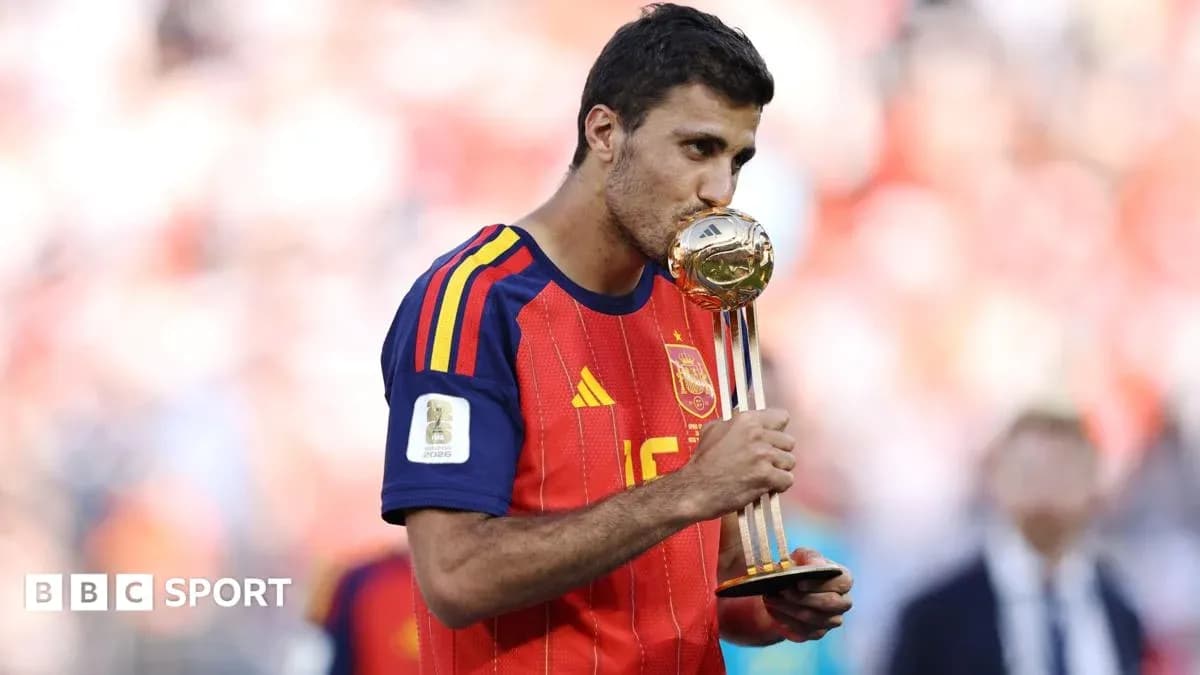
Rodri, fresh from captaining Spain to World Cup glory and winning the Golden Ball as the tournament’s outstanding player, heads for back surgery on Monday. He has a year left on his contract. His future is the question hanging over everything.
Real Madrid are, according to reports, “operating on the basis” that Rodri will eventually join them. That phrase alone changes the mood. It forces City to confront a possibility they would rather ignore: life without the best holding midfielder in the world.
Maresca’s stance is clear. The situation is not.
In his first news conference, Maresca did not flinch.
“I think every manager wants to have Rodri because he is a top player,” he said, before laying out the immediate plan. Surgery. Holiday. Rest. Recovery. Then, in his words, “he will be back with us.”
That is the intention. Keep him. Build around him. Let him anchor the next version of City as he did the last.
But intention and reality are not always team-mates. If Madrid press, if Rodri hesitates over a new deal, if the numbers turn persuasive, City will have a decision to make: cash in when he returns to fitness, or hold their nerve and risk losing control of the timeline.
Maresca wants Rodri. The club may yet have to think like traders.
The chessboard in Maresca’s head
To understand why Rodri matters so much to this new project, you have to understand how Maresca sees the game.
He is a disciple of positional play. He talks about football in the language of chess.
“There are a lot of similarities,” he has said. “The most important is positional play and strategy. For a coach, it's important to have the mentality of a chess player: develop a plan, study counter-moves, choose the arrangement of the pieces.”
His teams typically morph into a 3-2-2-3 with the ball. It is not just a formation; it is a framework for control. The back three, the double pivot, the two advanced midfielders, the front three – all locked into zones, all rotating within strict rules.
Rodri is made for that world.
During the World Cup, he showed exactly why. Nominally a holding midfielder, he dropped into the back line whenever Aymeric Laporte stepped out with the ball. When the space opened in front of him, he stepped in, dictating from higher up. Always in the right place. Always a passing option. Always one move ahead.
In Maresca’s system, that ability to slide between positions inside the same phase of play is priceless. The on-the-ball shape stays intact, but the routes into it change. Rodri is the hinge.
Echoes of Guardiola, with a twist
We have seen this blueprint before.
At City, during that Treble season, the 4-4-2 out of possession would flip into a 3-2-2-3 once they had the ball. Stones, nominally a centre-back, would stride into midfield to sit next to Rodri. From there, they controlled games, smothered transitions and suffocated opponents.
Maresca was Guardiola’s assistant then. He watched that evolution from inside the room.
At Chelsea, he took the same idea and twisted it. Moises Caicedo, signed as a midfielder, was used at right-back in a system that again defended with a back four and attacked in a 3-2-2-3. Once Chelsea had possession, Caicedo would drift inside to form part of the double pivot.
The pattern is clear: Maresca finds players who can move between lines, then redraws the board around them.
Rodri is the ideal piece for that kind of thinking. He reads space. He understands risk. He knows when to slow the game and when to slice through it. Anderson, and any future signings such as 18-year-old Lille midfielder Ayyoub Bouaddi – who caught the eye for Morocco at the World Cup – will need time to learn those nuances.
Rodri needed that time himself. He grew into the role under Fernandinho’s guidance, adjusting to the demands of positional play, the distances, the angles, the relentless precision Guardiola required.
Now he is the reference point others measure themselves against.
Life with Rodri. Life without him.
With Rodri, City can move quickly into Maresca’s model. He gives them a ready-made organiser at the base of midfield, someone who can hold the structure together while new signings and tactical tweaks bed in.
Without him, the task changes.
Anderson will be asked to shoulder responsibility early. Bouaddi, if City push ahead and sign him, would represent another long-term project rather than an instant fix. Maresca’s track record suggests he will not simply replace like-for-like. He will look for players who can shift roles, who can step out of their positional comfort zones.
He has done it before: Stones into holding midfield, Caicedo into full-back, Marc Cucurella pushed into attacking midfield. Each move looked bold on paper, logical on the pitch.
That kind of thinking may be what sustains City if Rodri does eventually go. The system, not the individual, becomes the star – even when the individual is as influential as the Spaniard.
A bigger squad, a different philosophy
One key difference from the Guardiola era is already emerging.
Guardiola liked a tight group, a smaller squad he could drill and refine. Maresca appears more open to having a broader cast, more pieces on the board to shift and experiment with.
Whether Rodri stays or leaves, that matters.
A deeper squad gives Maresca more combinations to test, more ways to build his 3-2-2-3, more chances to stumble upon a formula that works against the Premier League’s growing tactical variety. It also spreads the load at a time when City are trying to evolve while still winning.
For now, the plan is simple: Rodri has surgery, rests, recovers, returns. Maresca builds around him. Madrid wait and watch.
The real question is whether this new City era is shaped with Rodri at the heart of it – or defined by how they cope when the most important piece on Maresca’s chessboard is finally moved off it.



