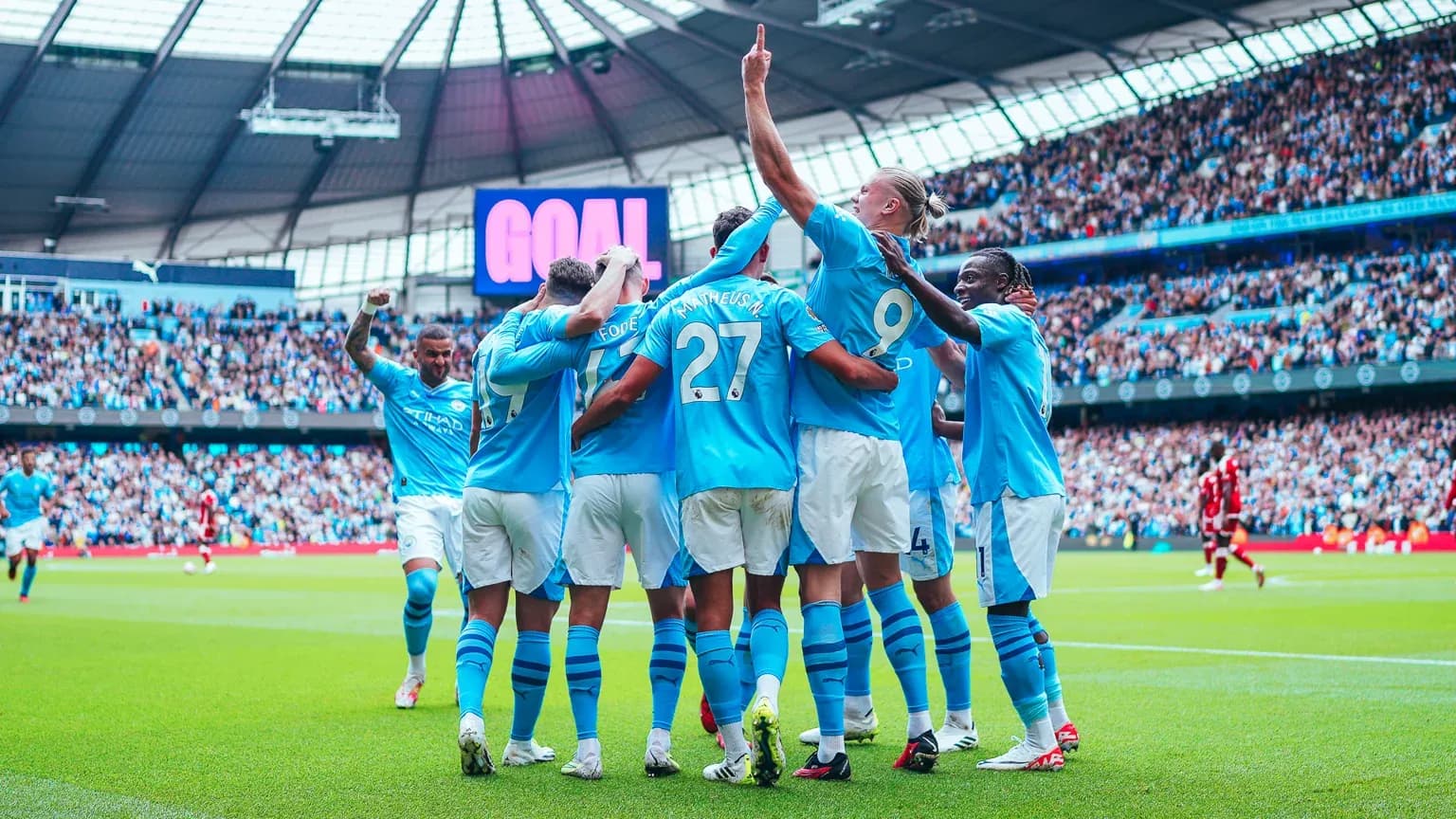
Manchester City Held to Draw by Nottingham Forest
Manchester City were forced to settle for a damaging 2-2 draw against relegation-threatened Nottingham Forest at the Etihad Stadium, a result that jars with their status as second in the Premier League table on 60 points. In a match they dominated territorially and technically, City twice led on xG but not on the scoreboard, undone by Forest’s ruthless counter-attacks and resilient low block. For Forest, 17th on 28 points, this was a statement away performance in their battle to stay clear of the bottom three.
First Half Analysis
City, lining up in a 4-1-3-2, immediately pinned Forest’s 5-3-2 deep, with Rodri orchestrating from the base and the twin threat of Erling Haaland and Antoine Semenyo stretching the visiting back five. Forest largely conceded possession, trying to keep their defensive line compact around the box and spring Morgan Gibbs-White and Igor Jesus in transition.
The breakthrough came on 31 minutes, and it was a goal from open play that showcased City’s central overloads. Rayan Cherki drifted between the lines, received in the inside-left channel and slid a precise pass into Semenyo. The forward took full advantage, finishing to give City a 1-0 lead that reflected their territorial control.
Forest struggled to build any sustained attacks, but they remained combative. Their frustration surfaced in first-half stoppage time when Ibrahim Sangaré was booked at 45+1' for a foul, emblematic of the strain Forest’s midfield was under as City circulated the ball with ease. City went into the interval 1-0 up, but with the sense they should have been further ahead.
Second Half & Tactical Shifts
The second half flipped the narrative almost immediately. On 56 minutes, Forest produced the kind of incisive move they had been threatening sporadically on the break. Igor Jesus linked play cleverly and fed Gibbs-White, who finished a rare Forest chance with composure for a goal from open play to make it 1-1, punishing City’s inability to turn dominance into a cushion.
Forest’s defensive intensity increased, but so did their disciplinary tally. Murillo was booked on 60' for a foul as City tried to reassert control. Just two minutes later, City restored their lead. Rodri, stepping higher from his holding role, latched onto a cut-back from Rayan Aït-Nouri and drove home from inside the box on 62', another goal from open play that underlined City’s layered attacking structure from deep.
The visitors’ dissent and strain were visible when Nikola Milenković received a yellow card on 63' for dissent, but the same minute brought a pivotal tactical shift from Forest. N. Domínguez went off, replaced by Callum Hudson-Odoi on 63', a bold move that tilted Forest towards a more attacking shape from midfield.
That gamble paid off on 76'. Hudson-Odoi, now operating with license to break forward, created the key moment, supplying Elliot Anderson, who struck Forest’s second goal from open play to level at 2-2. It was a textbook counter-punch, exploiting City’s advanced full-backs and central commitment.
Pep Guardiola’s response was immediate and attacking. On 77', Phil Foden was withdrawn for Jérémy Doku, injecting direct one-v-one threat, while Aït-Nouri made way for Abdukodir Khusanov, a like-for-like defensive adjustment to stabilise the left side. Forest countered on 79' with a more traditional centre-forward presence as Igor Jesus went off for Taiwo Awoniyi, a move aimed at holding the ball up and relieving pressure.
City’s final attacking roll of the dice came on 82', when creator Cherki was replaced by Savinho, adding fresh legs and dribbling from wide areas. Yet Forest’s defensive block held, aided by game management that drew the ire of the referee. Goalkeeper Matz Sels was booked for time wasting at 90+4', underlining Forest’s satisfaction with the point.
Late structural tweaks from Forest at 90'—Neco Williams off for Morato, and Gibbs-White off for Ryan Yates—further signalled a shift to defensive consolidation. City pushed until the final whistle, but Forest’s reshaped back line and compact midfield saw out a precious draw.
Statistical Deep Dive
The numbers underline the sense of siege. City attempted 21 shots to Forest’s 9, with 7 on target for the hosts against 4 for the visitors. City’s xG of 2.12 versus Forest’s 0.97 suggests the champions-elect on the night created enough to win but were punished by Forest’s clinical finishing.
Possession was starkly one-sided: City held 70% of the ball, completing 714 of 774 passes for an outstanding 92% accuracy. Forest, with just 30% possession, focused on structural control without the ball and direct counters when they had it, completing 269 of 329 passes (82%). City’s 6 blocked shots indicate Forest’s defenders repeatedly put bodies on the line inside their own box, while Forest’s 3 blocked efforts showed City’s back line was not entirely untested.
In terms of discipline, City committed 10 fouls but avoided any bookings, reflecting controlled aggression. Forest made only 6 fouls but picked up 4 yellow cards—Sangaré, Murillo, Milenković (for dissent) and Sels (for time wasting)—evidence of a side operating on the edge to disrupt City’s rhythm and then protect the draw.
Standings & Implications
For Manchester City, already second on 60 points with a strong goal difference of +32, this draw feels like two points dropped rather than one gained, potentially weakening their margin for error in the title race despite their robust home record. Nottingham Forest, 17th on 28 points and with a -15 goal difference, will treat this as a bonus result that strengthens their survival push, showing they can execute a deep, disciplined game plan and still carry enough threat to trouble elite opposition away from home.