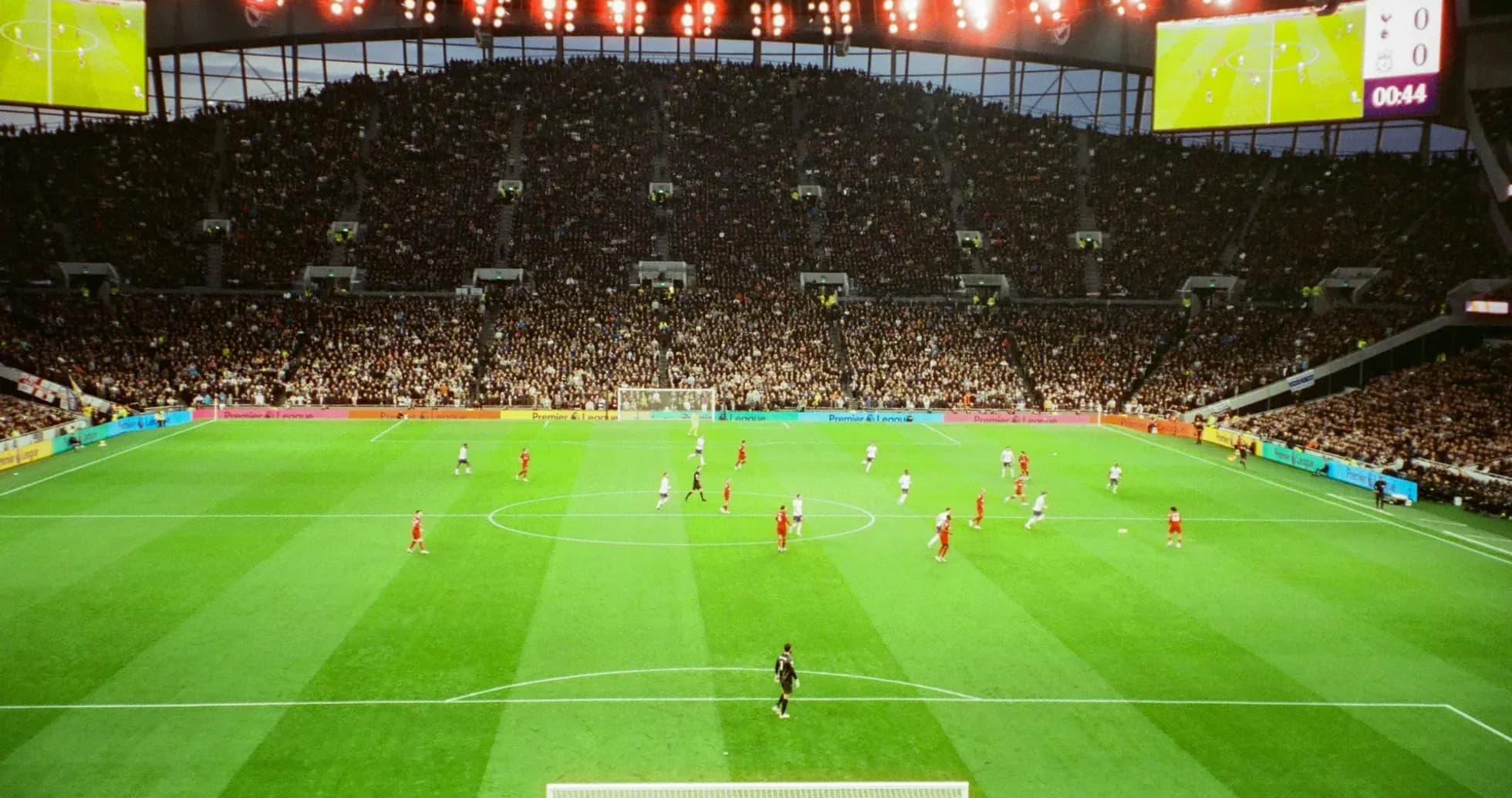
Manchester City Dominates Crystal Palace 3-0 at Etihad Stadium
Manchester City’s 3-0 win over Crystal Palace at Etihad Stadium was a methodical dismantling built on structural superiority, relentless circulation and intelligent occupation of the half-spaces. Pep Guardiola’s side translated 72% possession and a 15–6 shot advantage into a controlled performance that matched the 3-0 scoreline and a 1.56–0.68 xG edge, while Oliver Glasner’s 5-4-1 spent most of the evening in damage limitation.
I. Executive Summary
City, in a 4-2-2-2, used the ball as their main defensive tool and patiently stretched Palace’s back five until the block broke. Goals from Antoine Semenyo, Omar Marmoush and Savinho reflected a clear territorial dominance: 723 passes at 89% accuracy versus Palace’s 278 at 77%. Crystal Palace’s compact 5-4-1 rarely connected to Jean-Philippe Mateta in transition and produced only six shots, two on target, comfortably handled by Gianluigi Donnarumma. The match was effectively decided by half-time at 2-0, with the second half serving to consolidate control and manage energy ahead of the run-in.
II. Scoring Sequence & Disciplinary Log
All three City goals came from well-constructed positional attacks.
- 32' A. Semenyo (Manchester City) — assisted by P. Foden City finally converted pressure when Phil Foden received between Palace’s midfield and defensive lines and slipped a vertical pass into Antoine Semenyo. Semenyo’s movement between the right-sided centre-back and wing-back was perfectly timed, and his finish gave D. Henderson little chance.
- 40' O. Marmoush (Manchester City) — assisted by P. Foden Again Foden operated as the central reference. After sustained circulation, he found a pocket on the left half-space, drew out a centre-back and released Omar Marmoush attacking the blind side. Marmoush’s run behind the last line and composed finish doubled the lead, making City’s 2-0 half-time advantage a fair reflection of their territorial dominance.
- 84' Savinho (Manchester City) — assisted by R. Cherki With Palace stretched and substitutes on, Rayan Cherki combined centrally before releasing Savinho on the right. The winger attacked a retreating back line and finished low to seal the 3-0, capping City’s control in the final third.
Disciplinary log (chronological, all cards):
- 52' Tyrick Mitchell (Crystal Palace) — Foul Mitchell’s yellow came as Palace tried to step higher after the break; he halted a City transition on the flank, reflecting the strain on Palace’s wing-backs in wide isolation.
- 81' Daichi Kamada (Crystal Palace) — Simulation Kamada, introduced to add creativity, received a yellow for Simulation while attempting to draw a foul in an advanced area, underlining Palace’s difficulty in creating genuine threat against City’s compact rest-defense.
Card totals: Manchester City: 0, Crystal Palace: 2, Total: 2.
III. Tactical Breakdown & Personnel
Guardiola’s 4-2-2-2 was fluid rather than rigid. On paper, Josko Gvardiol, Marc Guehi, A. Khusanov and M. Nunes formed the back four in front of Gianluigi Donnarumma, with Rayan Ait-Nouri and Bernardo Silva deeper in midfield, Savinho and Foden as advanced midfielders, and Semenyo with Marmoush as a front two. In practice, City built in a 3-2 or 3-1-6 depending on phase.
In the first phase, Gvardiol often inverted from left-back to form a double pivot with Ait-Nouri, while M. Nunes pushed a little higher on the right, leaving Guehi and Khusanov as the primary rest-defense pair. This allowed City to maintain a two- or three-man cover against Palace’s lone striker while committing numbers between the lines. Donnarumma’s involvement was minimal in shot-stopping terms (two saves), but his positioning and sweeping helped compress the field, supporting a high defensive line that suffocated Palace’s counters.
Between the lines, Bernardo Silva and Foden were the key manipulators. Both operated as narrow “tens,” constantly rotating with Savinho and Ait-Nouri to overload the central corridor. City’s 723 passes, 645 accurate (89%), show how effectively they recycled possession to move Palace’s 5-4-1 laterally. The ball was circulated side to side until a lane opened for Foden or Bernardo to receive on the half-turn. From there, they looked immediately for penetrative passes into Semenyo and Marmoush attacking the channels, as seen on the first two goals.
Out of possession, City’s defensive index was defined by counter-pressing rather than deep defending. With only 10 fouls and no cards, they controlled transitions through structure more than through last-ditch interventions. The double pivot’s staggering ensured that when Palace broke the first line, one midfielder could step while the other held, keeping the back four protected.
Oliver Glasner’s 5-4-1, with Tyrick Mitchell and D. Munoz as wing-backs, was set up to deny central access. The back five stayed narrow, forcing City wide, while the midfield four tried to screen passes into Foden and Bernardo. However, Palace’s 28% possession and 278 passes (215 accurate, 77%) meant they spent long stretches defending, and their block gradually lost compactness. The wing-backs were pinned deep by Savinho and Ait-Nouri’s high positioning, leaving the midfield line exposed to overloads.
In transition, Palace’s plan was to find Mateta early, then connect runners like Y. Pino and B. Johnson. But City’s rest-defense, anchored by Guehi and Khusanov with the nearest full-back tucking in, restricted Palace to six shots, all from inside the box but mostly under pressure. Donnarumma’s goals prevented figure of -0.78 suggests Palace’s finishing underperformed the small volume of chances they did create, but the overall threat level remained modest.
Substitutions subtly reshaped the tactical picture. At 58', J. Doku (IN) came on for J. Gvardiol (OUT), and N. Ake (IN) came on for M. Nunes (OUT), freshening the back line and adding more natural wide threat on the left via Doku. Palace responded on 60' with a triple change: I. Sarr (IN) for Y. Pino (OUT), J. S. Larsen (IN) for J. Mateta (OUT), and A. Wharton (IN) for W. Hughes (OUT), shifting towards more direct transitions and trying to inject pace. At 75', D. Kamada (IN) replaced B. Johnson (OUT), giving Palace a more technical presence between the lines, though his Simulation booking highlighted frustration rather than control.
On 79', M. Kovacic (IN) for Bernardo Silva (OUT) and R. Cherki (IN) for O. Marmoush (OUT) allowed City to maintain technical dominance while resting key starters. Kovacic provided secure circulation in the pivot, and Cherki’s creative freedom between lines led directly to Savinho’s 84' goal. At 82', J. Stones (IN) for P. Foden (OUT) and N. Clyne (IN) for D. Munoz (OUT) signalled both managers’ priorities: Guardiola locked down the back line with an extra natural defender, while Glasner rotated at wing-back but could not alter the game’s trajectory.
IV. The Statistical Verdict
The numbers underline the tactical story. City’s 15 shots (4 on target, 3 blocked) against Palace’s 6 (2 on target) show a sustained ability to reach the final third and generate shooting positions, even if the raw shot-on-target count was modest. Their xG of 1.56 versus Palace’s 0.68 suggests City finished slightly above expectation, while Palace under-shot their limited chances.
Possession at 72% and a 723–278 passing gap reflect City’s overall form as a dominant ball-possession side. Their defensive index in this match was strong: only 7 Palace shots, 2 saves required from Donnarumma, and no cards, indicating control without defensive desperation. Palace’s 7 fouls and 2 yellows — Foul for Mitchell and Simulation for Kamada — show a side often reacting rather than dictating.
Goalkeeper reality is revealing: Donnarumma’s 2 saves with a negative goals prevented figure of -0.78 indicates that, on the rare occasions Palace did break through, the chances were of decent quality, but the volume was too low to trouble the result. At the other end, D. Henderson made just 1 save with his own goals prevented at -0.78, highlighting that City’s three goals came from well-crafted, high-quality situations rather than speculative efforts.
In synthesis, Manchester City’s 3-0 home win was a clinic in positional play and game control, with structural superiority, intelligent rotations and efficient finishing all aligning with the underlying data.