
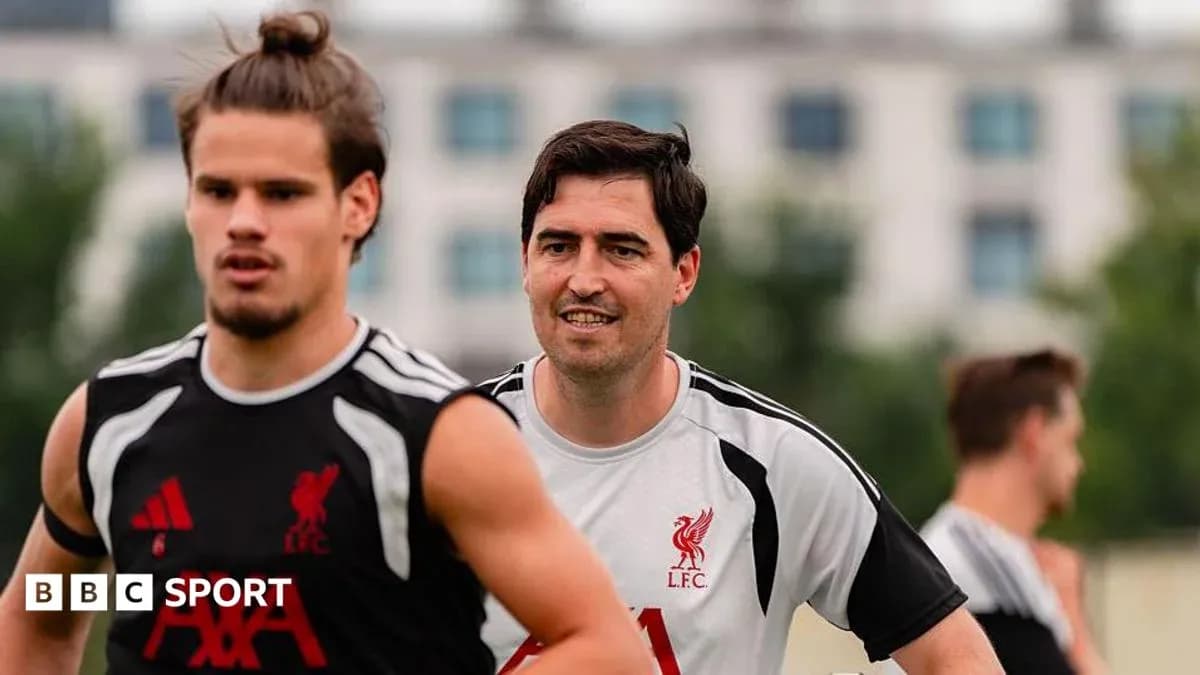
Liverpool's New Era: Insights from Chicago Training
Robert Lewandowski was still on the pitch when Liverpool’s new era quietly began.
As Andoni Iraola walked his players out for their first open training session under his command at Chicago Fire’s performance centre, the 37-year-old Pole was in the background, thumping penalties under slate-grey Midwestern skies. One effort flew high over the bar, his session winding down just as Liverpool’s clicked into gear.
Two clubs, two timelines. One veteran winding towards the finish, one coach just starting to write his chapter.
Szoboszlai, Jones and a storm in a social-media teacup
Earlier in the week, the narrative around Liverpool was not about tactics or fitness, but a 20-second clip.
Dominik Szoboszlai and Curtis Jones, close friends and key figures in this squad, were filmed in a heated exchange at the end of the 1-0 win over Wrexham in New York. Kostas Tsimikas stood between them, the footage racing around social media within minutes. Jones has been linked with a move to Inter Milan; the optics were not ideal.
By Friday in Chicago, the picture could not have looked more different.
Szoboszlai, Jones and Tsimikas strolled out together, laughing, juggling the ball, playing up to the cameras. No tension, no distance. Just three players clearly comfortable in each other’s company.
Szoboszlai had already downplayed the row on Thursday, stressing that everyone was “in the same boat” and pushing for the best for the club and for each other. Those words matched the body language on the training pitch.
The flashpoint is understood to have stemmed from Szoboszlai handing the captain’s armband to Tsimikas instead of Jones. A small detail, but in a dressing room full of ambition and ego, those details can bite. By the time Liverpool reached Chicago, it felt resolved.
It also served as an early reminder for Iraola. With Andy Robertson gone and the vice-captaincy vacant, hierarchy matters. Someone will need that armband soon. Better that decision comes from the head coach than from a spur-of-the-moment call in a pre-season friendly.
A bit of fire between team-mates is normal at elite level. The problem now is that every flare-up can be filmed from the stands and dissected from a thousand angles. Some things, Iraola will have noted, are still best kept behind closed doors.
Isak back, Wirtz on corners, and injury management
On the football side, there was more encouraging news.
Record signing Alexander Isak returned to full training with the group this week. He, Florian Wirtz and Ryan Gravenberch all missed the trip to New York, where Liverpool edged Wrexham 1-0 in their second pre-season outing, but the expectation is that all three will feature against Leeds at Soldier Field on Sunday.
Jeremy Jacquet was absent from the main session, instead working in the gym as Liverpool carefully manage his comeback from the shoulder injury he suffered in February. Iraola had suggested earlier in the week that the centre-back would be involved at the weekend; now, he looks a doubt.
Joe Gomez, already ruled out of the start of the Premier League season, was also inside, continuing his own recovery work.
Out on the grass, Wirtz took responsibility for corners in a set-piece block overseen by Iraola’s assistants, Tommy Elphick and Shaun Cooper. Elphick even pulled on a bib and joined in, a small touch that underlined the staff’s hands-on approach.
Iraola’s imprint: intensity, detail, and noise
Once the warm-ups were out of the way, Iraola’s style came into sharp focus.
The drills were brisk, aggressive, and loud. Iraola barked instructions constantly, demanding “play in possession” and urging “quicker, quicker” as his players moved the ball through tight spaces. He did not hover on the fringes. He stepped into patterns of play, halted moves, shifted players a few yards to adjust their positioning.
Whenever a goal went in during the small-sided exercises, celebrations broke out. High fives, shouts, little clusters of players relishing the competitive edge. It felt less like a gentle pre-season tune-up and more like a manager setting standards from day one.
After the main work, the squad split. One group headed to a smaller pitch for a nine-a-side game, testing Iraola’s principles in a condensed, chaotic format. The other stayed behind to focus on dead-ball routines with Elphick and Cooper, Wirtz whipping in deliveries as the staff fine-tuned runs and blocks.
Watching from the sidelines was Mike Gordon, Fenway Sports Group’s president and the man once again overseeing Liverpool’s football operations. His presence in Chicago, and expected attendance at Soldier Field on Sunday, underlines how closely ownership is tracking this transition.
Old legends, new boss
The work did not end when the cones were packed away.
On Thursday night, the squad and staff gathered for a team dinner. Iraola later shared a beer with club greats Phil Thompson and Robbie Fowler, a relaxed scene that carried its own symbolism.
Thompson, a three-time European Cup winner with Liverpool, told BBC Sport they talked about the season ahead and their families. Simple subjects, but important ones. Iraola was not even born when Thompson lifted his third European Cup. Yet here they were, trading stories, the new coach acknowledging the weight of the club’s history and those who built it.
For a man just weeks into the job, it was a smart, human touch. Liverpool’s past is not a museum piece; it still walks into rooms, still shapes expectations.
Seeds in the Windy City
Back on that Chicago training pitch, Lewandowski’s session had long since finished. The Fire players drifted away. The clouds hung low. Liverpool stayed out, running, pressing, talking, listening.
Iraola has three weeks until his first Premier League game as Liverpool manager. Three weeks to turn ideas into habits, to settle roles, to name a vice-captain, to knit new signings and old stalwarts into something coherent.
The work is only beginning, but in the Windy City, the outlines of his Liverpool are already visible. The question now is how quickly those early seeds grow when the real pressure hits.



