Liverpool's World Cup Journey: Players' Performances and Insights
The World Cup finally exhaled after 104 games, a haze of drama, disputes and VAR debates lifting to reveal Spain as worthy champions. In New York, they outlasted an Argentina side that leaned heavily on cynicism and control, and with that, Liverpool quietly added another chapter to their own World Cup story.
Eight Liverpool players went to the tournament across the United States, Canada and Mexico. Only one of them ended it with a medal around his neck. Another watched the decisive moments from the bench but still joined an exclusive Anfield club.
Now they drift back towards Andoni Iraola’s pre-season plans, some sooner than others, with Sunderland, Leeds United and Wrexham waiting on the US tour. Before that, their World Cup form deserves a closer look.
Victor Munoz – N/A
Spain were still trying to work out how they hadn’t scored against Cape Verde when news broke that Liverpool had triggered Victor Munoz’s £34.5million release clause at Osasuna. The first signing of the Iraola era arrived with a jolt of excitement. Perfect timing, it seemed, to watch him on the biggest stage.
Then nothing.
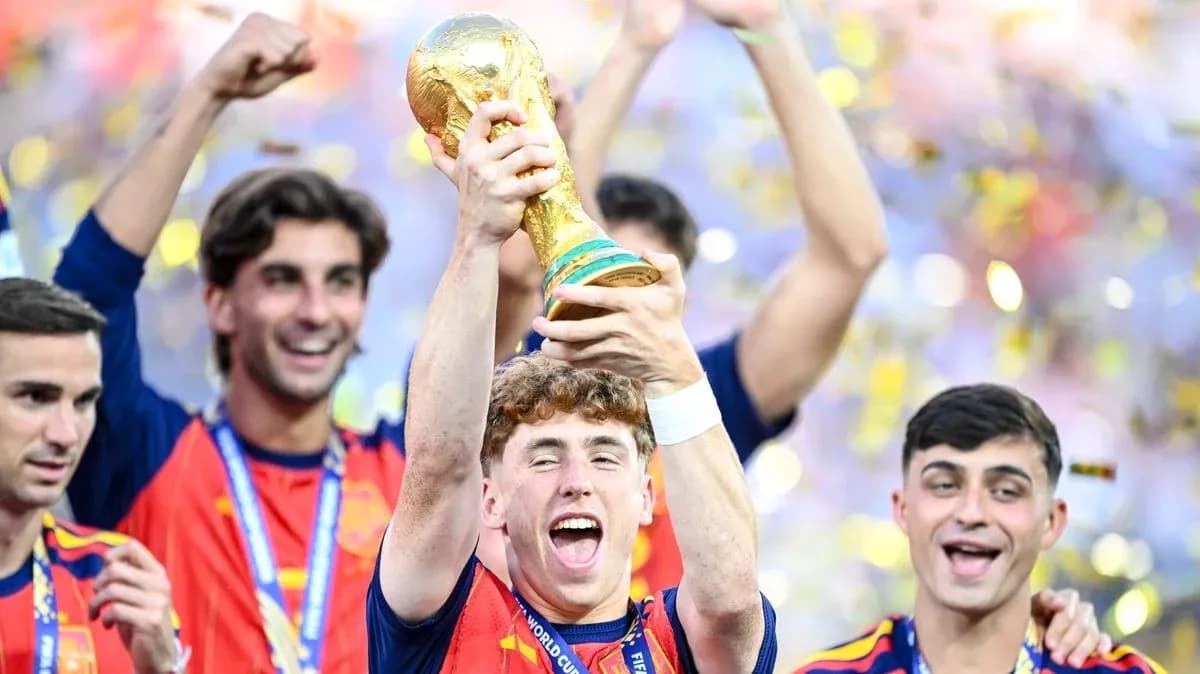
An injury struck, the winger disappeared from the team sheet for a spell and never played a single minute as Spain marched all the way to the trophy. No late cameo, no group-stage run-out. Just a front-row seat to a World Cup win.
It still counts. Munoz becomes only the sixth serving Liverpool player to lift the World Cup, following Roger Hunt, Ian Callaghan, Gerry Byrne, Fernando Torres and Pepe Reina. Not a bad way to walk through the door at Melwood, even if nobody yet knows how he looks in this Spain side when the ball actually rolls.
Alexis Mac Allister – 7
Alexis Mac Allister will not remember the final fondly. Like most of his Argentina team-mates not named Lionel Messi, he laboured through a flat, fractious showpiece.
His tournament as a whole tells a different story.
Mac Allister played every minute bar the dead rubber against Jordan, Argentina already safely through as group winners. From a more advanced midfield role, he knitted moves together and drove them forward, setting up a goal against Cape Verde and striking the opener in the quarter-final victory over Switzerland.
The key moment came against England. Argentina were drifting towards the brink and Mac Allister helped drag them back into the contest, finding pockets, demanding the ball, forcing the issue. Across eight games he picked up just one booking – a minor miracle for a 27-year-old who usually lives on the edge of the referee’s notebook.
Liverpool will want that version of Mac Allister back at Anfield: brave on the ball, front-foot, and with the confidence of a man who has carried a heavyweight nation deep into a World Cup again.
Alisson Becker – 7
Brazil looked like a ghost of their great sides. Alisson Becker did not.
Back from injury, he gave Brazil exactly what they needed behind an uncertain team: calm handling, clean decision-making, authority. When the chaos swirled in front of him, he stayed steady.
Erling Haaland’s two goals in the defeat to Norway that ended Brazil’s run were hardly a goalkeeper’s nightmare; more a defensive one. Alisson could do little about either and left the tournament with his reputation intact, once more underlining why he remains among the best in the world.
For Liverpool, the question is simple. Can he stay fit long enough to anchor Iraola’s high-intensity blueprint?
Alexander Isak – 6
Somewhere on Merseyside, a few eyebrows will have shot up. Alexander Isak, who never once completed 90 minutes for Liverpool last season, went the distance in three of Sweden’s four World Cup matches.
He started in a blur. Against a poor Tunisia side, Isak scored one and set up two more, bullying a fragile defence and gliding through the lines. It looked like the start of a statement tournament.
The impact faded. He added another assist in the heavy win over Holland, but each game chipped away at his influence. Touches grew looser, runs less sharp, the threat dulled as Sweden’s campaign stuttered.
The minutes, though, will not go unnoticed back at Liverpool. Iraola has just seen proof that Isak can handle full matches. Now he has to coax that first-game swagger out of him in a red shirt.
Cody Gakpo – 8
Cody Gakpo arrived at this World Cup with questions hanging over him from Anfield. By the time Holland went out, he had offered some answers.
Freed from what felt like a heavy shirt last season, Gakpo looked lighter, quicker, more decisive. On the left flank he came alive, especially in the meeting with Sweden, where he scored twice and laid on another in a ruthless display of finishing and movement.
Then came a different kind of moment. In the round of 32, he scored in the defeat to Morocco shortly after learning of the loss of his unborn son. It was a goal wrapped in raw emotion, a reminder that footballers carry far more than tactics and form onto the pitch.
Holland may have fallen short, but Gakpo leaves the tournament revitalised. Liverpool will hope that the player who tormented Sweden, not the one who laboured through last season, walks back into their dressing room.
Virgil van Dijk – 7
Virgil van Dijk captained Holland through a wild, open campaign. He even chipped in at the other end, scoring in the entertaining group draw with Japan and providing an assist against Tunisia.
It still wasn’t enough to silence some of his critics at home. In the Netherlands, there remains a vocal group who, for reasons that seem to stretch beyond the pitch, have never fully embraced the Liverpool defender. They stayed loud.
Ronald Koeman’s side were built to attack, to take risks, to throw numbers forward. The back line paid the price. Holland conceded in all four of their games, stretched and exposed as the structure tilted towards the front.
Van Dijk was not flawless, but he also wasn’t the weak link some painted him as. He returns to Liverpool with more minutes in his legs, more leadership tested under stress – and perhaps a point still to prove to his own country.
Ryan Gravenberch – 7
Ryan Gravenberch’s World Cup was a study in contrasts.
Early on, used in a more advanced midfield role than he typically enjoys at Liverpool, he sparkled. Against Japan he produced a brace of clever assists, slipping passes through lines, timing his contributions perfectly. It felt like the version of Gravenberch many believe is waiting to burst out at club level.
Then the dial turned. Against Morocco he dropped back into a more defensive position, asked to shield rather than surge. Holland lost control, and he was substituted before the late equaliser that dragged the tie to penalties.
The numbers still flatter him, and rightly so. This was a tournament that showed his versatility and his ceiling. The challenge now is to find a settled role under Iraola that unlocks the attacking instincts without losing the discipline demanded in the Premier League.
Florian Wirtz – 6
On paper, Florian Wirtz had a strong World Cup. Operating mainly off the left for a stuttering Germany, he produced assists in three of their four matches and regularly found ways to prise open defences.
Yet the feeling lingered that he had another gear. His quality was obvious – the first touch, the awareness, the eye for a pass – but he drifted in and out of games, especially when Germany needed someone to seize control.
By the time Germany’s campaign ended in controversy, beaten by Paraguay on penalties, Wirtz was already off the pitch. His influence had ebbed away before the decisive blows landed.
For Liverpool, that is both frustration and encouragement. The output is there even when he is short of his best. If Iraola can plug him into a more coherent system, those flashes could become something far more consistent.
Spain left with the trophy, Argentina with regrets, and Liverpool with a mixed bag: one new World Cup winner, several reputations enhanced, a few nagging questions. As Iraola gathers his squad in the United States, the real intrigue begins – which versions of these World Cup travellers will show up in red when the season starts?