
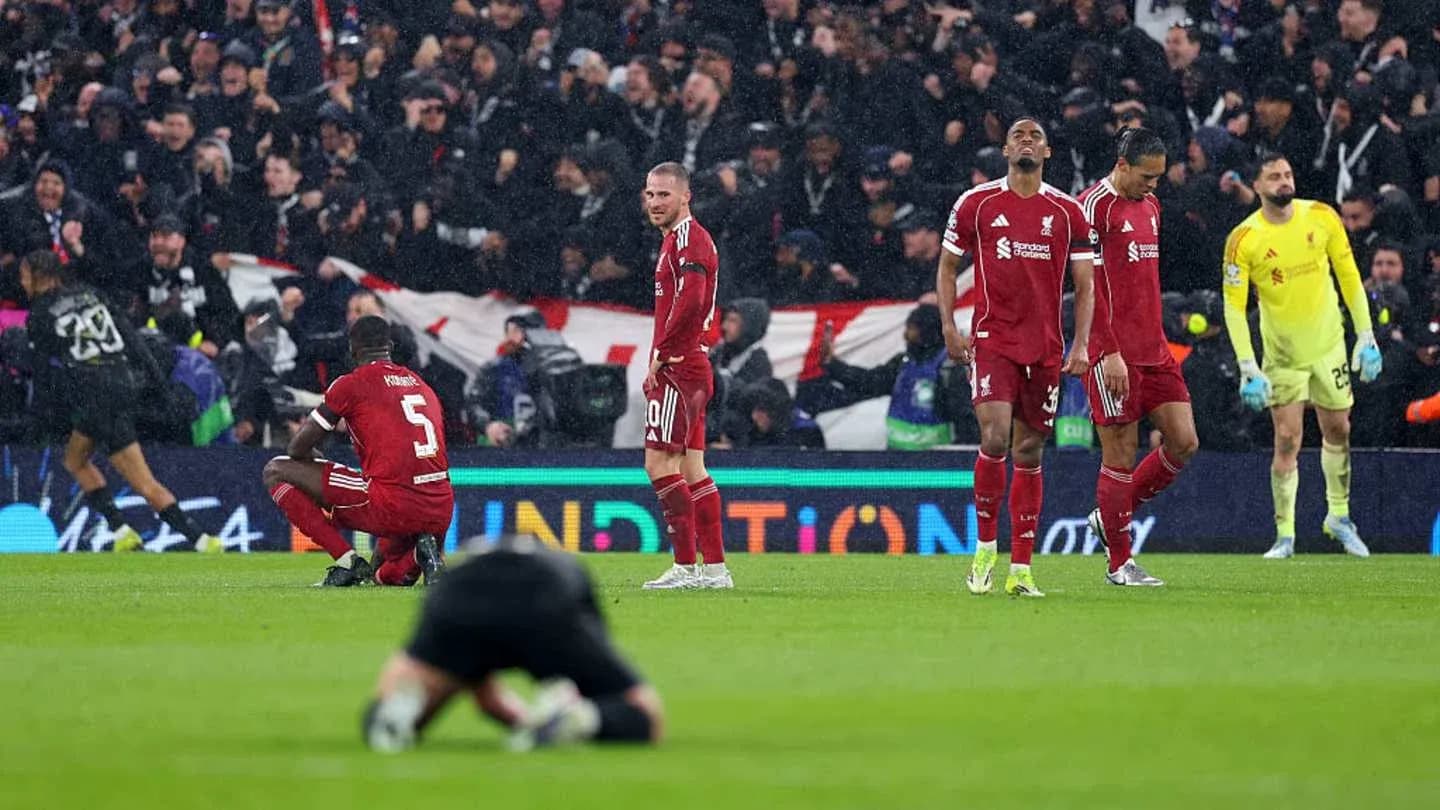
Liverpool vs PSG: Champions League Exit in Brutal Fashion
There was no late twist, no famous swell of noise dragging Liverpool back from the brink. Anfield waited for a miracle on Tuesday night. Paris Saint-Germain snuffed it out.
A 2–0 win on Merseyside, added to last week’s 2–0 at the Parc des Princes, sent the holders through 4–0 on aggregate. The scoreline was brutal, the pattern familiar: Liverpool huffed, pushed, briefly threatened to make the place crackle. Ousmane Dembélé silenced it.
For 20 minutes after half-time, Anfield believed. Then the Ballon d’Or winner walked in, took aim from distance, and ripped the air out of the Kop.
Liverpool’s surge, PSG’s steel
Liverpool had to be better than in Paris. That was the minimum requirement. They were.
The first half, though, never really caught fire. Injury stoppages chopped the game into pieces. The rain and slick surface turned simple passes into small tests of nerve. Both sides found promising positions and then wasted them, as if the tie’s tension had crept into their decision-making.
PSG countered sharply but lacked precision in the final third. Liverpool, desperate for a foothold, were just as guilty when chances to break appeared. The half ended with frustration, not fury.
After the interval, everything changed.
Arne Slot’s team came out as if the clock had skipped straight to the final 15 minutes. They pressed higher, ran harder, took more risks. Nuno Mendes’ withdrawal hurt PSG’s balance and invited Liverpool onto them. The visitors, suddenly pinned back, retreated into a counterattacking shell.
Anfield sensed weakness. The noise rose. Every tackle, every half-chance, every corner felt like the start of something.
Matvey Safonov had other ideas. The PSG goalkeeper, largely untroubled in the first leg, stood firm under the second-half storm. He pawed away efforts, claimed crosses, and watched Liverpool’s finishing unravel at crucial moments. The hosts’ lack of conviction in front of goal, so often disguised by volume of chances this season, was laid bare.
Then came the flashpoint. Alexis Mac Allister tumbled in the box, the referee pointed to the spot, and hope roared. VAR intervened. The decision was overturned. The penalty was gone, the tie still drifting out of reach.
Slot will circle that moment. The reality is harsher: over 180 minutes, Liverpool never truly had PSG on the ropes.
Dembélé ends the argument
PSG knew one clean strike would kill the contest. They waited for it.
Dembélé, wasteful in the first leg and guilty of a big early miss again at Anfield, had already given Liverpool life once in this tie. He did not repeat the mistake. With Liverpool pushing bodies forward and the game stretched, he found space, set himself, and drilled a pinpoint finish beyond Giorgi Mamardashvili from range.
It was ruthless. It was final.
Liverpool’s momentum evaporated in an instant. The Kop, so loud and raw minutes earlier, fell into that particular kind of silence Anfield reserves for nights when it realises the story is already written.
Dembélé added a second to complete his brace and PSG’s second 2–0 of the tie. By then, the contest had turned into a procession.
Performances under the microscope
The numbers tell one story, the eye another.
Liverpool finished with the higher xG on the night, 1.92 to PSG’s 1.25, and took 21 shots to the visitors’ tally. Seventeen of those efforts came after half-time, when they also held 69% of the ball. On paper, that reads like a siege.
Yet the tie never felt close.
Mac Allister, pushed higher up the pitch to hide his legs in transition, looked like a player running on empty. He chased shadows early, picked up a needless booking before the break, and only flickered into life around the box after half-time. Even then, his most notable contribution – the won penalty – was correctly scrubbed off.
Behind him, Liverpool’s centre-backs did their part. Virgil van Dijk and Ibrahima Konaté set an aggressive line, stepped in front of PSG’s forwards, and helped lock the game into the visitors’ half for long spells. Konaté, in particular, played on the edge with his positioning, but his front-foot defending kept attacks alive. They controlled a fluid PSG attack for most of the evening, yet still walked off having conceded twice to Dembélé.
On the flanks, Milos Kerkez embodied Liverpool’s effort. He ran relentlessly, attacked the back post, and twice found himself in prime scoring positions after drifting off Achraf Hakimi. Both times, the finish deserted him.
Ryan Gravenberch brought drive and purpose from deep, especially after the break. He threatened from distance, snapped into duels, and helped sustain the tempo Liverpool needed. Dominik Szoboszlai tried to grab the game, too, constantly demanding the ball and attempting to force the decisive moment that never came.
Up front, the night unravelled early. Hugo Ekitiké started brightly, linking play and offering movement, only for a worrying Achilles injury to cut his evening short. Alexander Isak, making his first start of the year, barely left a mark before a planned withdrawal at half-time.
Mohamed Salah’s introduction on the half hour – potentially his final Champions League appearance at Anfield – should have lit the fuse. Instead, it underlined a difficult season. He immediately created Liverpool’s best first-half chance, then drifted into a performance of loose touches and wasteful decisions. The stage was set for a moment; it never came.
The bench offered energy, not incision. Cody Gakpo buzzed around without delivering the killer touch. Young Rio Ngumoha looked bright after replacing Joe Gomez but faded late on. Curtis Jones arrived with the tie effectively buried.
Behind them all, Mamardashvili endured a strange night. PSG’s finishing spared him in the first leg, and their erratic edge in front of goal meant he was rarely truly stretched here, either. His distribution, though, was chaotic, adding a layer of unease to Liverpool’s attempts to build.
A spirited exit, a clear gap
The conditions didn’t help either side. Both teams finished with pass completion below 88%, and PSG’s dropped to just 63% in the second half as Liverpool squeezed them. The holders looked uncomfortable, rattled even, but never broken.
That is the difference at this level. PSG needed one clear moment. They took it. Liverpool needed several. They fluffed them.
The numbers will offer Slot some comfort: the second-half dominance, the shot volume, the territorial control. The aggregate scoreline will not. Four goals conceded, none scored, and a campaign ended without the defiant Anfield comeback that has framed so much of the club’s recent European history.
On this evidence, Liverpool can still rattle Europe’s best for spells. The question now is whether they can rebuild a side capable of doing it for 180 minutes, when the margins are thin and the miracles no longer arrive on cue.



