Liverpool vs Nottingham Forest: A Tactical Analysis of the 2–2 Draw
Anfield’s first league matinee of the season ended in stalemate, but the 2–2 draw told a deeper tactical story about two sides still discovering their 2026 identities.
I. The Big Picture – contrasting blueprints, shared uncertainty
Heading into this game, Liverpool were an unfinished project under Andoni Iraola: two league matches, two draws, four goals scored and four conceded overall. The goal difference at this early stage was exactly 0, a numerical summary of a team balanced between promise and fragility. At home they had mirrored their overall output, scoring 2 and conceding 2 in their only previous league outing at Anfield.
Nottingham Forest arrived with a different tension. Oliver Glasner’s side had taken 1 point from their first 2 league games, with 2 goals scored and 3 conceded overall for a goal difference of -1. On their travels they had shown more ambition, scoring 2 and conceding 2 in their single away match, compared to a blunt home record of 0 scored and 1 conceded.
The formations set the tone: Liverpool in a 4-2-3-1, Forest in a 3-4-2-1. Iraola’s shape promised width and verticality; Glasner’s, density and counter-punching. Over 90 minutes, those concepts collided in waves.
II. Tactical Voids – absences that bent the game’s rhythm
Liverpool’s squad sheet was notable as much for who was missing as who played. A cluster of injuries – S. Bajcetic (hamstring), C. Bradley (knee), F. Chiesa (back), H. Ekitike (Achilles), J. Gomez (injury) and G. Leoni (knee) – stripped Iraola of rotation options in both full-back and wide attacking zones. H. Elliott’s absence through a coach’s decision further thinned the creative bench.
Those gaps amplified the importance of the starting full-backs J. Frimpong and M. Kerkez, and of Florian Wirtz and Víctor Muñoz between the lines. With no Chiesa to stretch play and no Ekitike as an alternative focal point, Liverpool were locked into Alexander Isak as their primary reference in the box, supported by a narrow band of creators.
Forest’s own voids were more central. I. Sangare (calf) and N. Savona (knee) were both unavailable, depriving Glasner of a natural destroyer and a rotation piece in midfield. That placed heavier defensive and transitional responsibility on X. Schlager and J. McAtee in the double pivot, and on O. Aina and N. Williams as wide outlets.
Disciplinary history also hovered over the contest. For Liverpool, the league data showed a broad spread of yellows: 28.57% of their cautions arriving in each of the 16–30, 46–60 and 76–90 minute windows, with 14.29% between 61–75. That pattern hinted at a side that plays on the edge in every phase of the match. Forest, by contrast, had concentrated 50.00% of their yellows between 46–60 minutes, with 25.00% in each of 16–30 and 31–45, suggesting a team that often emerges from half-time aggressively and risks overstepping.
III. Key Matchups – hunters and shields
The most intriguing duel lived on Liverpool’s left and Forest’s right. Kerkez, already with 4 tackles, 3 successful blocks and 2 interceptions in the league, was tasked with both pinning Aina back and containing him. Aina entered as the league’s most-carded player, with 2 yellows and a reputation for high-intensity duels: 20 contested, 10 won, and 7 dribble attempts with 4 successful. It became a battle of who could force whom onto the back foot.
Ahead of Kerkez, Cody Gakpo drifted into the left half-space. As Liverpool’s joint-top scorer and top assister (1 goal, 1 assist overall), Gakpo’s 5 key passes and 4 drawn fouls made him the creative hinge. His interplay with Wirtz, who had 85 completed passes at 81% accuracy and 2 key passes of his own, repeatedly asked Forest’s back three – Murillo, N. Milenkovic and Cunha – to step out and choose their poison.
Through the middle, Isak was the “hunter” against a Forest defence that had conceded an average of 1.5 goals overall per match, with 2.0 away. Isak’s 5 shots (3 on target) and 7 duels won from 14 overall this season underlined his capacity to occupy all three centre-backs. Every time he pinned Milenkovic or dragged Murillo wide, channels opened for late runs from D. Szoboszlai and A. Mac Allister.
Forest’s own creative axis revolved around Morgan Gibbs-White and Dan Ndoye. Gibbs-White arrived with 1 goal and 1 assist overall, plus 8 dribble attempts with 4 successful and 21 duels contested, 10 won. Operating as one of the two attacking midfielders behind Igor Jesus, he probed the half-spaces around Liverpool’s young centre-back J. Jacquet and Virgil van Dijk. Ndoye, with 1 goal and 3 shots overall, made diagonal runs from the inside-left channel, trying to exploit the space behind Frimpong whenever Liverpool’s right-back surged forward.
Behind them, Schlager’s brief was clear: disrupt Wirtz’s rhythm and deny Mac Allister time to dictate. With Forest yet to keep a clean sheet and having failed to shut out either at home or away, his screening work was as important as any pass.
IV. Statistical Prognosis – chaos as default setting
Liverpool’s early-season numbers painted them as an attacking side with structural leaks: 2.0 goals scored and 2.0 conceded on average both at home and overall, no clean sheets and no matches without scoring. Forest, meanwhile, balanced a home bluntness (0.0 goals scored, 1.0 conceded on average at the City Ground) with more open away days, scoring 2.0 and conceding 2.0 on their travels.
Both teams had perfect penalty records so far, each scoring their single spot-kick overall with no misses, removing the lottery of set-piece waste from the equation.
In tactical terms, that combination pointed towards volatility rather than control. Liverpool’s multi-layered attack – Isak’s presence, Gakpo’s incision, Wirtz’s threading and Muñoz’s directness (1 goal overall, plus 18 duels contested and 4 fouls drawn) – was always likely to create volume. But Forest’s front trio, led by Gibbs-White’s craft and Ndoye’s running, were well-suited to punish the spaces that Iraola’s aggressive 4-2-3-1 leaves in transition.
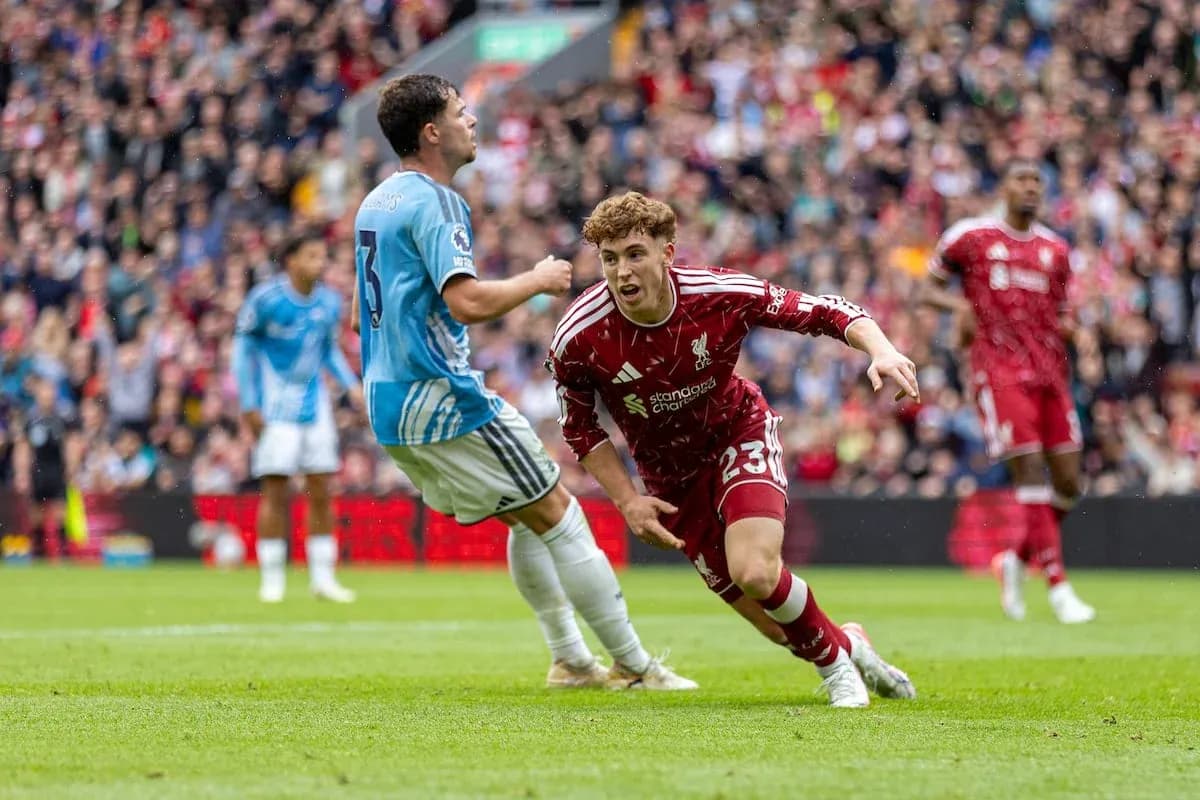
The 2–2 final scoreline, with Liverpool moving to 2 points and Forest to 1, ultimately reflected the statistical and tactical balance. A home side built to attack but still learning to defend, an away team more dangerous on their travels than at home, and two squads whose disciplinary and defensive profiles suggest that calm, low-event football is not on the menu. At Anfield, this fixture confirmed that for both Liverpool and Nottingham Forest, the early-season identity is clear: they live on the edge, and they will take their opponents there with them.