Liverpool and Chelsea Draw 1-1: Tactical Stalemate at Anfield
Liverpool and Chelsea shared a 1–1 draw at Anfield in Premier League Round 36, a match that quickly settled into a tactical stalemate despite early goals for both sides. Arne Slot’s Liverpool struck first through Ryan Gravenberch, but Calum McFarlane’s Chelsea responded via Enzo Fernández before the interval. From there, the game became a battle of control rather than chaos: possession split 48%–52% in Chelsea’s favour, shots narrowly 8–6 to Liverpool, and xG almost dead even at 0.56 vs 0.50. The decisive patterns were structural: Liverpool’s hybrid fullback-midfield roles and Chelsea’s compact double pivot, with both teams ultimately cancelling each other out.
First Half
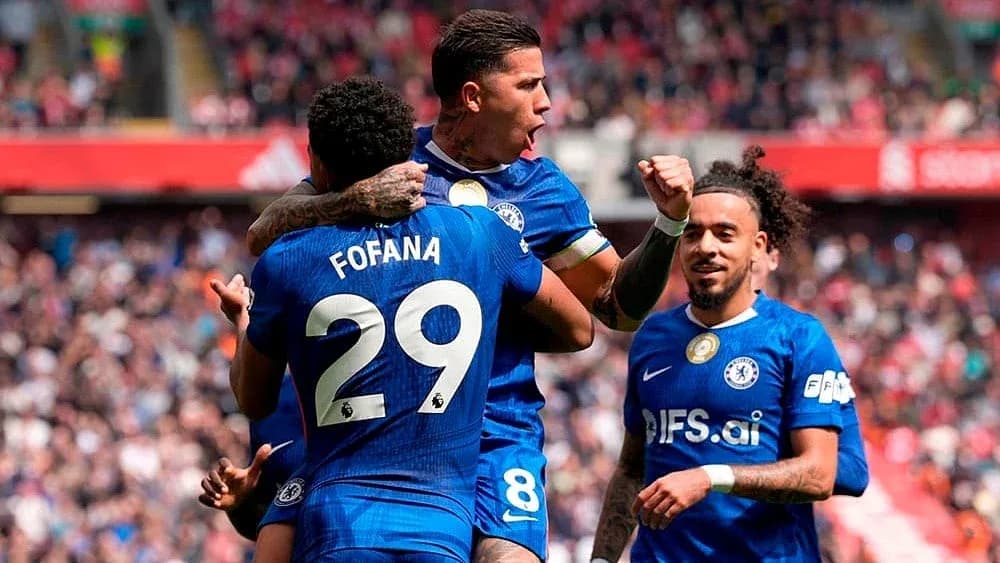
The scoring opened on 6' when Ryan Gravenberch (Liverpool) converted a “Normal Goal” assisted by Rio Ngumoha, rewarding Liverpool’s aggressive start and verticality from midfield. Chelsea equalised on 35' through Enzo Fernández (Chelsea) with another “Normal Goal”, this time unassisted, reflecting Chelsea’s capacity to progress centrally despite Liverpool’s press.
Early in the second half, Chelsea thought they had flipped the game when Cole Palmer found the net, but on 50' a VAR intervention resulted in “Goal cancelled” against Palmer, a key turning point that preserved parity and underlined how fine the margins were for Chelsea’s attacking structure.
Substitutions
Substitutions then reshaped the tactical landscape. On 63', Reece James (IN) came on for Andrey Santos (OUT) for Chelsea, shifting the balance on the right and adding width and crossing threat. Liverpool responded at 67' with Alexander Isak (IN) coming on for Rio Ngumoha (OUT), pushing Cody Gakpo into more flexible zones and giving Liverpool a clearer reference point up front. On 77', Slot doubled down on defensive control: Federico Chiesa (IN) came on for Cody Gakpo (OUT), and Joe Gomez (IN) came on for Ibrahima Konaté (OUT), stabilising the back line and refreshing the press.
Disciplinary Phase
The disciplinary phase was intense and must be recorded precisely:
- 67' Jorrel Hato (Chelsea) — Foul
- 73' Enzo Fernández (Chelsea) — Foul
- 83' Marc Cucurella (Chelsea) — Foul
- 88' Joe Gomez (Liverpool) — Argument
- 89' Moisés Caicedo (Chelsea) — Handball
- 90+4' Alexis Mac Allister (Liverpool) — Persistent fouling
That yields exact totals: Liverpool: 2 yellow cards, Chelsea: 4 yellow cards, Total: 6.
Tactical Analysis
From a tactical standpoint, Slot’s Liverpool used a fluid back line with Curtis Jones and Miloš Kerkez operating as adaptive defenders, allowing Jeremie Frimpong to step high from midfield and threaten Chelsea’s flanks. Gravenberch and Dominik Szoboszlai gave Liverpool vertical running and late arrivals, while Alexis Mac Allister acted as the central organiser. The early goal reflected this design: Ngumoha’s positioning between the lines created the assist lane, and Gravenberch’s timing from midfield exploited Chelsea’s transitional gaps.
Out of possession, Liverpool pressed in waves, but the 17 fouls and the late “Persistent fouling” card for Mac Allister show the cost of repeatedly stepping in to break Chelsea’s rhythm. Joe Gomez’s “Argument” card at 88' indicates rising frustration as Liverpool struggled to turn territorial phases into high-quality chances (only 0.56 xG from 8 shots, 3 on target).
Chelsea’s shape was more conservative but structurally coherent. Levi Colwill and Wesley Fofana anchored a narrow back line, with Jorrel Hato and Malo Gusto managing wide zones. The double pivot of Moisés Caicedo and Andrey Santos (later reshaped with Reece James’ introduction) aimed to screen central spaces and spring Cole Palmer and Enzo Fernández between Liverpool’s lines. Fernández’s goal on 35' highlighted Chelsea’s capacity to exploit pockets in front of Virgil van Dijk and Ibrahima Konaté when Liverpool’s midfield stepped too high.
The booking pattern for Chelsea — Hato, Fernández, Cucurella all for “Foul” and Caicedo for “Handball” — reflects a side willing to break play and disrupt Liverpool’s transitions, especially as the game opened up in the final 25 minutes. The introduction of Reece James gave Chelsea more thrust on the right but also demanded more emergency defending from Liverpool’s reshaped back line, explaining some of the late tactical fouls and handball incidents.
Goalkeeping Performance
In goal, Giorgi Mamardashvili (Liverpool) and Filip Jørgensen (Chelsea) each recorded 2 saves. With both sides producing 3 shots on target, the keepers were not overworked but had to be precise. The “goals prevented” metric sits at -0.49 for both, which, combined with the near-identical xG (0.56 Liverpool, 0.50 Chelsea), suggests that each conceded roughly in line with expectation and did not dramatically outperform or underperform the underlying chances.
Statistical Overview
Statistically, Chelsea’s 52% possession and superior passing numbers (515 total passes, 446 accurate, 87% accuracy) show a marginal edge in ball retention and circulation compared to Liverpool’s 473 passes, 398 accurate, at 84%. However, Liverpool generated more total shots (8–6) and more corners (5–2), indicating that Slot’s side converted slightly less possession into a higher volume of attacking actions, even if those actions did not translate into high xG.
Both teams committed 17 fouls, but the card distribution — Chelsea 4 yellows, Liverpool 2 — underscores that Chelsea’s defensive interventions were more often penalised at the threshold of caution. Overall, the statistical verdict aligns with the scoreline: an evenly contested match where structural ideas were clear on both sides, but neither attack could consistently break the other’s compact organisation after the initial exchange of goals.